Jew Curls (Peyot): Meaning and Why Orthodox Jews Wear Them
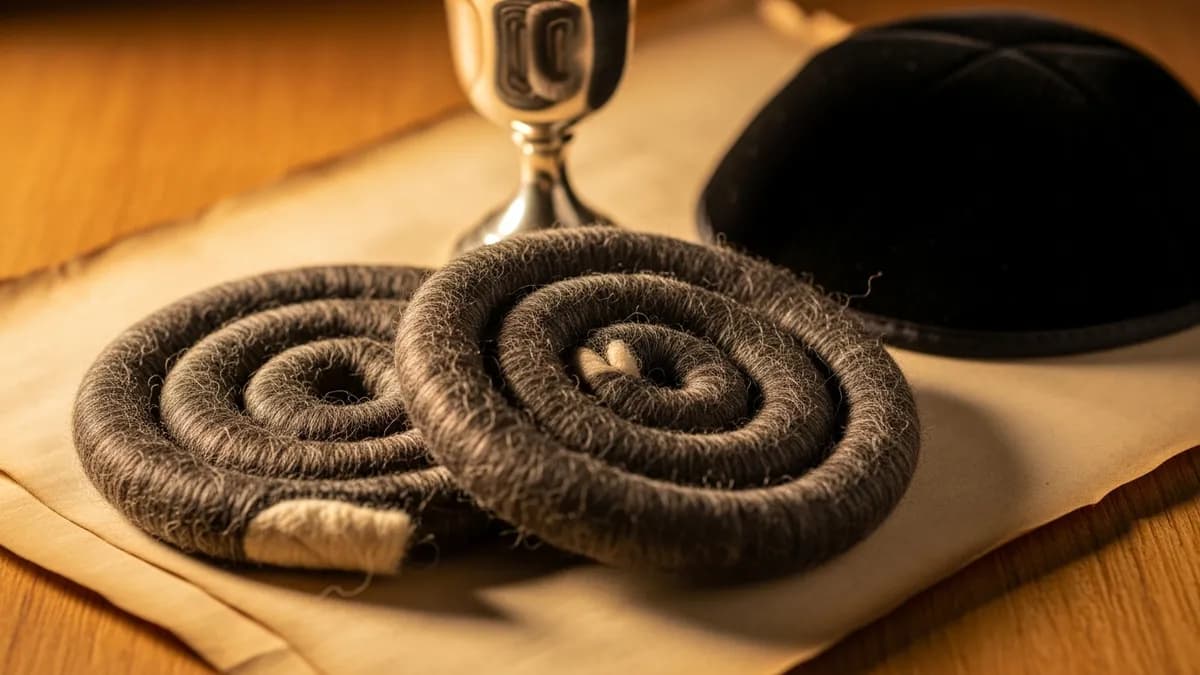
Jew curls are called peyot or payot — the uncut temple hair from Leviticus 19:27. See why Hasidic curls grow into long spirals while others stay short.
Quick Answer
The curls are called peyot (also spelled payot, payos, or payes) — the hair at the temples that Orthodox Jewish men leave uncut because Leviticus 19:27 says, 'Do not round the corners of your head.' The Torah sets no length or style, so the long spiraled Hasidic curls and a Modern Orthodox man's plain sideburns are the very same commandment kept two different ways.
Those long, distinctive curls hanging in front of Orthodox Jewish men's ears are one of the most recognizable features of traditional Jewish appearance. They are called peyot (pronounced PAY-oht), and they are rooted in a specific commandment from the Torah.
I get asked about peyot all the time. When I was growing up, my father had a store, and customers would ask about everything — the kippah, the beard, the curls. The peyot always got the most questions. People are genuinely curious, and I love that. So let me explain them the way I would explain them to someone standing in front of me. (Peyot are one piece of a bigger picture — our complete guide to Orthodox Jewish hair covers the beards, wigs, and head coverings too.)
Jew Curls (or Jewish Curls): The Short Answer
If you searched for "jew curls," you are in exactly the right place, and there is nothing wrong with the question. Most people have seen the curls and have no idea what they are called, so they describe what they see. That is a perfectly reasonable place to start.
Here is the short version:
The curls are called peyot (pronounced PAY-oht). They are the hair at the temples - the strip between the ear and the forehead - that Orthodox Jewish men do not cut, because of a verse in Leviticus (19:27): "Do not round the corners of your head."
Three things that clear up most of the confusion right away:
- The Torah says what not to do, not what to do. It forbids removing the hair at the temples. It says nothing about length, and nothing about curl. Everything beyond "do not shave it" is custom, community, and personal practice.
- They are not always long or curly. The long spiral kind you picture is mostly a Hasidic and Yemenite look. Plenty of Orthodox men fulfill the exact same commandment with hair that looks like ordinary sideburns. My husband is one of them.
- They are not a rank or a title. Longer peyot do not mean a holier man, a rabbi, or someone in charge. They usually just mean he belongs to a community where that is the custom.
So when someone asks me about jew curls, my honest answer is: it is one verse, one prohibition, and about a dozen beautiful ways that different communities have chosen to keep it.
The Torah Commandment
The source is a verse in Leviticus (19:27): "Do not round the corners of your head, and do not destroy the edge of your beard."
The Hebrew word for "corners" is pe'ah (plural: peyot), and Jewish law interprets this as a prohibition against completely removing the hair at the temples — the area between the ear and the forehead, roughly where sideburns would be.
There is a detail hiding in that word that I find beautiful. Earlier in that same chapter (Leviticus 19:9-10), the Torah uses the same word — pe'ah — for the corner of a field that a farmer must leave unharvested for the poor. Not taking everything for yourself, leaving a corner untouched — that idea runs through both laws. Whether you treat it as a deeper reason or simply as a lovely echo, it is worth knowing that the corner of the head and the corner of the field share one word and one chapter.
The commandment tells Jewish men what they may not do: they may not shave or cut this area completely. It does not prescribe a specific length or style. This is why you see such enormous variation in how different communities wear their peyot — the commandment sets a floor, not a ceiling.
What They Are Actually Called (Every Spelling You Will See)
Part of why people end up searching for jew curls is that the real word is spelled about seven different ways, and none of them are obvious if you have never seen them written down. Let me clear that up, because it is genuinely confusing even to people who grew up around it.
They are all the same word:
| What you will see | Where it comes from |
|---|---|
| pe'ah | The Hebrew singular. It means "corner" or "edge" - the word straight out of the verse in Leviticus. |
| peyot / pe'ot / payot | The Hebrew plural, in modern (Israeli) pronunciation. Most common in writing. |
| peyos / payos / payes / peyes | The same plural in Ashkenazi and Yiddish pronunciation, where that final letter sounds like an "s" instead of a "t." This is what you will hear in Brooklyn, Lakewood, and most Hasidic communities. |
| sidelocks / side curls / sidecurls | The English descriptions. Accurate enough, and nobody will be offended by them. |
That is it. Peyot and payes are not two different things - they are one word said by two groups of Jews with different accents. If you hear a Yeshivish man say "payes" and read "peyot" in a book, you are looking at the same hair.
The word itself is worth sitting with for a second, because it explains the whole thing. Pe'ah means corner. The verse says do not round off the corners of your head. So the name of the curls is not a word for "curl" at all - it is the word for the piece of the head the Torah is talking about. The curl is just what that hair does when you let it grow.
If you want the safest thing to say out loud: peyot or payes both work fine, and either one will tell an Orthodox person that you actually looked it up.
Is It Rude to Say "Jew Curls"?
Short answer: no, not at all. When people search for jew curls, they are almost always just describing what they see - they noticed the curls and did not know the real name. That is honest curiosity, and most Orthodox Jews would far rather you ask than assume.
If you want to use the exact word, peyot (or payes) is the term the community itself uses, and reaching for it signals that you took the time to learn. But nobody is going to be offended if "jew curls" or "sidecurls" is the only description you have. The one thing worth keeping in mind is tone - the same words asked with genuine interest land completely differently than words used to mock. In my experience, the interest is what comes through almost every time.
Orthodox Jewish Hairstyle: What You Are Actually Looking At
If you are looking at a photo and searching for the Orthodox Jewish hairstyle, the honest answer is that for men it is not a hairstyle at all — it is a rule about what may not be cut. What you are seeing in that picture is usually three separate things worn at the same time, and only one of them is the curls.
Here is how to take the look apart:
- The curls in front of the ears are the peyot — the subject of this whole page. That is the piece that comes from the commandment about the corners of the head, and it is the part almost everyone is actually asking about.
- The beard is a second rule from the same verse. Leviticus 19:27 continues, "and do not destroy the edge of your beard." Related, but its own law, with its own wide range of practice — I go through it in why Orthodox Jews have beards.
- The hat or the kippah is not hair at all. A kippah, also called a yarmulke, a black fedora, or a fur shtreimel worn on Shabbos is a covering that goes over the head, and it comes from custom rather than from that verse. It belongs to Orthodox Jewish clothing, not to anybody's haircut.
There is a fourth thing people mean when they type that phrase, and it is not about men at all. If you are looking at an Orthodox woman whose hair seems impossibly well done, you may be looking at a sheitel, which is a wig. Many married Orthodox women cover their own hair with a wig, a scarf, or a hat. That is a covering, and it comes from a completely different source than the curls do — so a woman's "Orthodox hairstyle" and a man's are not two versions of one rule. They are two unrelated rules that happen to both involve hair.
The part that surprises people most is the hair on top of the head: the verse says nothing about it. Orthodox men go to a barber like anyone else and get whatever cut suits them — many Hasidic men keep it short simply because there is a hat sitting on it all day. My husband gets a haircut every few weeks like any other man; the barber just knows to leave the corners alone.
So there is no Orthodox Jewish hairstyle in the salon sense of the word. There is no length to ask for and no shape to copy. There is one corner that never gets taken off, and then generations of community custom about what to do with the hair that grows there.
Why They Curl
Here is something that surprises many people: a lot of the curl is simply natural. When hair grows long enough without being cut, it tends to develop waves and curls on its own — especially the finer hair at the temples. The iconic spiral look is partly just what happens when you let that hair grow for years.
But it is not always left to chance. Many men — especially in the Hasidic world — actively twist or wind their peyot by hand to encourage and keep that tight spiral shape, and some set them this way as part of their daily grooming. Tucking peyot behind the ears or wrapping them around can also create a more defined curl over time. So the look is a mix of both: hair that waves naturally, and shaping that many men do deliberately.
Day to day, the care is simpler than people imagine. Some men wet, comb, or re-twist the hair to set the curl in the morning; long peyot are routinely tucked behind the ear or wound up under a hat while working, sleeping, or playing sports, then let down again afterward. Before Shabbos, many men set the spiral with a bit of water so the curls look their neatest and hold through the day on their own, since styling products are generally not used on Shabbos itself. Some use a dab of gel, and some swear by an old trick: a little sugar water, which dries stiff and holds the curl. Growing up, that Friday-afternoon twisting was as much a part of getting ready in our house as the smell of the chicken soup. None of that styling is required by the verse itself — it is custom and personal preference layered on top of the one basic rule. And the curl is not the mitzvah either: a man whose hair happens to be straight ends up with straighter peyot, and he is keeping the commandment exactly as fully as the man beside him with tight ringlets.
Hasidic Curls: Why Do Hasidic Jews Have Them?
Searches for "Hasidic Jew hair" outnumber almost every other phrasing of this question, and the picture behind them — long, dramatic spirals swinging in front of the ears — really is mostly a Hasidic look (shared, in a finer form, with Yemenite Jews). Hasidic men keep the same commandment as every other Orthodox man, but they embrace it visibly: the temple hair is grown long, and many twist it by hand into the defined payot curls you recognize from photos. For Hasidim, the length itself is meaningful — hiddur mitzvah, doing the commandment beautifully rather than minimally, with a Kabbalistic layer of significance on top. In many of these communities the custom is simply not to cut the peyot at all — so the dramatic length is not styling, it is what temple hair does when it is left entirely alone. So very long, curled sidelocks usually point to the Hasidic or Yemenite world, while a Litvish or Modern Orthodox man keeping the identical verse may show nothing more than ordinary sideburns. Here is the community-by-community breakdown.
How Different Communities Wear Peyot
One of the fascinating things about peyot is how much they vary across Orthodox communities. I notice this every time I travel. When I visited Mea Shearim in Jerusalem, the peyot were nothing like what I see here in Brooklyn. The Yerushalmi (Jerusalem) style is often very long and thin, tucked behind the ear in a specific way. Back home, the peyot tend to be thicker and curlier. Same commandment, completely different look.
The style of a man's peyot is often one of the quickest ways to identify which community he belongs to.
Hasidic Peyot
Hasidic men generally wear the longest, most visible peyot. But even within the Hasidic world, there is significant variation:
- Curled and hanging — Many Hungarian and Galician Hasidic groups (such as Satmar and Vizhnitz) grow long peyot that hang down in front of the ears, sometimes reaching the shoulders. These are the most iconic and recognizable style.
- Twisted and tucked behind the ear — Some Hasidic groups wind their peyot into a tight twist and tuck them behind the ear or under the hat. They are long, but less visible. Ger is the familiar example: a Gerrer man's peyot are wound up and tucked away rather than left hanging. Chabad men, by contrast, simply keep the temple hair short — so not every Hasid has the iconic visible curls.
- Wound around the ear — In some communities, men wrap their peyot around the top of the ear itself; Belz is the familiar example.
To an insider, the style is almost like an accent — it hints at which group a man comes from:
| Group | How the peyot are typically worn |
|---|---|
| Satmar (and many Hungarian- and Galician-rooted groups, such as Vizhnitz) | Long, thick, and prominent — left hanging in front of the ears, sometimes tucked behind them |
| Ger (Gerrer) | Wound up and tucked away rather than left to hang |
| Belz | Often wrapped around the ear |
| Chabad-Lubavitch | Short and barely visible — growing long, prominent peyot is simply not the Chabad custom |
| Other groups (Skver, Breslov, and many more) | Each community has its own convention — coiled, hanging, or wound — and those who know the styles can often read the group from the peyot alone |
For Hasidic Jews, long peyot carry spiritual significance beyond the basic commandment. They are seen as an expression of piety and devotion — going beyond the minimum requirement to beautify the mitzvah (commandment). The Kabbalistic tradition also associates the area of the temples with specific spiritual channels, adding a mystical dimension.
Yeshivish/Litvish Peyot
Men in the Yeshivish or Litvish world — the community centered around the great Lithuanian yeshiva tradition — typically keep their peyot much shorter. Their sidelocks may extend just past the ear or even be trimmed to blend with the rest of their hair. They fully observe the commandment (the hair at the temples is present and unshaved), but they do not emphasize length as a spiritual practice.
To an outsider, a Yeshivish man's peyot might not be visible at all — they may look like ordinary sideburns. But they are there, and the man is careful never to shave that area. My husband's peyot are like this — short and tucked. You would not notice them unless you knew to look.
Yemenite Peyot
Yemenite Jews have their own distinctive tradition: thin, long peyot that hang in delicate spirals. In the Yemenite community they are called simanim — Hebrew for "signs" — because they were historically worn as a proud, visible marker of Jewish identity. Yemenite peyot are often thinner than Hasidic ones because the custom is to grow a narrow section of hair rather than a wide one. These thin, elegant curls are one of the most recognizable features of Yemenite Jewish men and boys.
The Yemenite Jewish community, which was isolated from European Jewry for centuries, preserved many ancient customs — and their peyot style is believed to reflect a very old tradition of how this commandment was observed.
Modern Orthodox
Modern Orthodox men observe the commandment by simply not shaving the temple area. Their peyot may be indistinguishable from regular sideburns. The commandment is fulfilled without any distinctive outward appearance.
When Do Jewish Boys Start Growing Peyot?
For a lot of boys, the answer is age three — and this is one of my favorite topics because I have lived through it with my own sons.
People sometimes ask me whether the boys are simply born with the curls. They are not. A boy's peyot begin on the day his family decides that this particular piece of hair is the piece nobody cuts — which, in most of my neighborhood, is his third birthday.
There is a custom called the upsherin (Yiddish, roughly "shear off"; also spelled opsherin or upsherenish; many Sephardic and Mizrahi families call it a chalaka, also written halake, and traditionally hold it at the tomb of Rabbi Shimon bar Yochai in Meron), a ceremony held when a boy turns three years old. For the first three years of his life, a boy's hair is not cut at all. Then, at the upsherin, the family gathers, and everyone takes turns snipping a small piece of hair. But the peyot area is left uncut. It is the beginning — the very first visible sign that this little boy is starting his journey of learning Torah and keeping mitzvos.
My oldest son's upsherin is one of my most treasured memories. He sat on his grandfather's lap with a lollipop while family and friends each took a snip. He had no idea what was happening, but he loved the attention. When it was over, he had these tiny, wispy peyot for the first time, and he kept touching them. He was so proud. All my boys went through the same thing, and each time it was just as special.
After the upsherin, little boys learn to take care of their peyot — at first it is often a father winding them around his finger in the morning, until the boy learns to do it himself. They learn to tuck them behind their ears, to be careful when putting on shirts, to not pull on them. In my community, you see three-year-olds walking around with these brand new little peyot, and it is honestly one of the sweetest sights. The older boys help the younger ones — "No, you tuck it like this" — and there is a real sense of pride in it. By the time they are five or six, those peyot are part of who they are.
A few things worth knowing about the timing:
- It is a custom, not a law. The Torah prohibition (Leviticus 19:27) is an obligation on grown men and says nothing about age three. The third-birthday haircut is a beloved minhag (custom), tied to the start of a child's Torah education, not a strict requirement.
- Not every Orthodox family does it. Many Litvish (Yeshivish) and German-Jewish families cut a boy's hair earlier and still keep the peyot. The age-three ceremony is widespread but far from universal.
- The curls come before the beard. A boy keeps his peyot for years before he is old enough to grow the beard mentioned in the very same verse.
What Jew Curls Are Not (Clearing Up the Common Assumptions)
Over the years, the same handful of assumptions come up, and every one of them is understandable. Let me take them one at a time.
They are not a hairstyle choice. This is the big one. Peyot are not a look someone picked because they liked it, the way you might pick a fade or grow a ponytail. They start from a commandment. What varies is how a community chooses to keep that commandment - and that part is genuinely a matter of custom and taste. If you came here looking for the whole Orthodox Jewish hair picture rather than the curls specifically - beards, married women's sheitels and head coverings, and where each of those rules comes from - I cover all of it in Orthodox Jewish hair.
They are not required to be curly. This surprises people constantly. Nothing in Jewish law says "curl your hair." The commandment is only about not removing it. Long hair at the temples tends to wave on its own, and many men encourage the spiral by hand - but a man with poker-straight peyot down to his chin is keeping the mitzvah exactly as well as a man with tight ringlets.
They are not universal among Jews. Most Jews in the world do not have visible curls at all. This is an Orthodox practice, and even within Orthodoxy, the visible-curl version is concentrated in Hasidic and Yemenite communities. A Modern Orthodox man observing the identical commandment may look, to you, like he simply has sideburns.
They are not a rank, a title, or a uniform. No one earns longer peyot. They do not signal seniority, and there is no ceremony where they get upgraded. If anything, they signal where a man is from - which community, which tradition - more than anything about him personally.
They are not a burden, at least not the way people imagine. I have never once heard a man in my life complain about his peyot. They are not something endured. For most men they are simply part of who they are, the same way you do not think of your own face as an obligation.
At a Glance: Who Wears Them How
| Community | Typical look | How visible? |
|---|---|---|
| Hasidic (Satmar, Belz, Vizhnitz, and others) | Long, often curled; hanging in front of the ear, twisted and tucked behind it, or wound around it | Very - this is the iconic image |
| Yemenite | Thin, long, delicate spirals from a narrow section of hair | Very, but noticeably finer than Hasidic |
| Yeshivish / Litvish | Short; may reach just past the ear or be trimmed to blend in | Barely, or not at all |
| Sephardi (most communities) | Typically at the shorter, sideburn end of the spectrum | Barely, or not at all |
| Modern Orthodox | The temple area simply left unshaved | Usually indistinguishable from sideburns |
Same verse. Same prohibition. Five completely different men on the street.
What Peyot Represent
Beyond the technical observance of a commandment, peyot carry layers of meaning:
Visible Jewish identity. Peyot are an unmistakable marker of Jewish observance. Wearing them is a public statement of commitment to Torah life, even when it draws stares or questions. I remember a reader once wrote to me asking, "Do the boys get teased about their curls?" The honest answer is that within our communities, peyot are a source of pride, not embarrassment. Outside the community, yes, sometimes people stare. But that is true of anything visibly different, and our children learn early that being different for the right reasons is something to be proud of.
Accepting G-d's authority. The Torah does not always spell out the reasons behind its commandments. Growing peyot is an act of obedience — doing something because G-d commanded it. Many treat this kind of mitzvah as a chok, a statute we keep without a stated reason, and see that acceptance as especially meaningful. (Others, like the Rambam, do offer a rationale, connecting the prohibition to distancing ourselves from ancient pagan grooming customs.) Either way, the willingness to observe it remains an expression of commitment.
Community continuity. Jewish men have worn peyot for thousands of years, through persecution, exile, and forced assimilation. In many periods of history, peyot were specifically targeted by oppressive governments trying to erase Jewish identity. Continuing to wear them is an act of defiance and continuity.
Beautifying the mitzvah. The Jewish concept of hiddur mitzvah — beautifying a commandment — encourages going beyond the bare minimum. For many men, growing longer, more visible peyot is a way of embracing the commandment with enthusiasm rather than merely meeting the requirement.
A Personal Note
Peyot are one of those things that look unusual from the outside but become completely normal — even beautiful — once you are part of the community. The little boys playing in the park with their peyot bouncing, the teenagers self-consciously tucking theirs behind their ears (some things are universal, no matter the community), the elderly men with silver peyot curling past their shoulders — it is all part of the texture of daily life in my neighborhood. A living connection to a commandment given thousands of years ago, worn with pride by every generation, including my own sons.
Common Questions
Why do Orthodox Jewish men have curls? Because of a verse in Leviticus (19:27) that says, "Do not round the corners of your head." Jewish law reads this as a prohibition against shaving off the hair at the temples, so observant men leave it to grow - and when that hair grows long, it naturally tends to curl.
Do all Orthodox Jewish men have peyot? All Orthodox men avoid fully shaving the sideburn area, but the length and visibility vary enormously. Modern Orthodox men may have short, trimmed sideburns that are barely noticeable. Hasidic men often grow long, curled peyot that hang past the ears. Different Hasidic sects have different styles — Satmar peyot look different from Chabad peyot.
Are jew curls natural or curled on purpose? Both. The fine hair at the temples often waves and curls on its own once it grows long enough. Many men, especially in the Hasidic world, also twist or wind their peyot by hand to encourage a tighter, more defined spiral.
At what age do boys start growing peyot? Many families begin growing a boy's peyot at the upsherin — a ceremony at age three when the child's hair is cut for the first time, leaving the sideburns to grow. Before that, many boys have their hair uncut entirely.
Can peyot be tucked behind the ears? Yes, and many men do exactly this — especially in professional settings outside the community. The commandment is about not destroying the hair, not about displaying it. Tucking peyot behind the ears or under a hat is perfectly acceptable.
What are jew curls called? They are called peyot (pronounced PAY-oht), from the Hebrew word pe'ah, meaning "corner" - a reference to the verse in Leviticus 19:27 that forbids rounding the corners of the head. You will also see the same word spelled peyos, payos, payot, payes, or pe'ot; those are all the same word in different pronunciations and transliterations, not different things. In plain English they are usually called sidelocks or side curls. And if you came here asking what Hasidic curls are called — same answer: payot, just grown long and worn in the open.
Do all Jewish men have curls? No. Most Jewish men in the world have no visible curls at all. Even among Orthodox men - who all keep the commandment not to shave the hair at the temples - the long, visible curls are mainly a Hasidic and Yemenite custom. A Yeshivish or Modern Orthodox man is keeping the identical commandment, but his peyot may look exactly like ordinary sideburns to you.
Why do Hasidic Jews have long curls when other Orthodox Jews do not? Because the Torah only forbids shaving the hair at the temples — it never sets a length or a style. Many Hasidic communities keep that hair long as a cherished custom and a visible sign of faith, while most other Orthodox men fulfill the exact same commandment with hair no longer than ordinary sideburns — Yemenite Jews, whose thin spiraled simanim are their own ancient custom, are the main non-Hasidic exception.
Do all Hasidic men have long curls? No. The look varies sharply by group: Satmar and many Hungarian-rooted Hasidim wear long, prominent peyot, Gerrer men wind theirs up and tuck them away, Belzer men often wrap them around the ear, and Chabad men keep theirs short and barely visible. Long hanging curls are one Hasidic style, not a rule for all Hasidim.
Can you tell what kind of Jew someone is from his curls? To a degree, yes. Very long, tightly curled sidelocks usually point to the Hasidic or Yemenite world, while short peyot or plain sideburns are typical of Litvish, Yeshivish, and most Sephardi and Modern Orthodox men. But it is only a rough guide — length and style are community customs and personal choices, not a fixed uniform — so the curls hint at a man's background without proving it.
Is there one Orthodox Jewish hairstyle? No — and for men it is not really a hairstyle at all. Jewish law tells a man what he may not remove (the hair at the corners of the head, and the edges of the beard) and says nothing about how the rest of his hair should be cut or worn. What reads to you as a single "Orthodox hairstyle" is usually three separate things at once: the peyot, the beard, and the kippah or hat on top. For married Orthodox women it is not a hairstyle either - it is a covering, often a wig.
Do Orthodox Jewish men get regular haircuts? Yes. The verse about the corners of the head says nothing about the hair on top, so Orthodox men go to a barber and get whatever cut they like - and many Hasidic men keep it short because a hat covers it most of the day anyway. What the barber does not do is take the corner at each temple down to the skin - that hair can be trimmed to whatever length a man's community keeps, but it is never shaved off. The same goes for the edges of the beard, for men who do not shave.
Do Jewish women or girls have curls? No. The commandment in Leviticus 19:27 is understood in Jewish law to apply to men, not women, so the sidelocks are something you will only ever see on Orthodox Jewish men and boys. Married Orthodox women have their own well-known hair practice - covering it - but that is a completely separate custom from a completely different source — married women cover their hair — and it has nothing to do with the curls.
Are peyot ever cut? The hair at the temples is never shaved off - that is the actual prohibition, and it is not negotiable. But peyot are frequently trimmed to a community's customary length, and a boy's peyot are shaped for the first time at his upsherin around age three. Men who wear them short trim them regularly; men who wear them long simply do not. In genuine cases of danger to life, Jewish law permits nearly any commandment to be set aside, and peyot are no exception - but that is an emergency measure, not a normal circumstance.
Is it rude to ask an Orthodox Jewish man about his curls? Asking is almost always fine, and often welcome - genuine curiosity comes across as genuine curiosity. Touching them is not: treat them the way you would treat any stranger's hair or head covering, which is to say, do not. Photographing people without asking is also poor manners anywhere, and in some strictly religious neighborhoods it is actively unwelcome and there may be posted signs requesting that you not. A simple "can I ask you about your peyot?" almost always gets you a real conversation.
Is 'jew curls' an offensive term? Not when it is asked out of curiosity. Most people use it simply because they do not know the real word. If you want the accurate term, use peyot or payes - but a sincere question is welcome either way.
I'm an Orthodox Jewish woman from Brooklyn. I can't speak for every Orthodox Jew — when I write outside my experience, I say so.
Orthodox Jewish Clothing — Why They Dress That Way
What Is a Hasidic Jew? An Insider's Guide to Hasidic Judaism
Why Do Orthodox Jews Wear Black?
Orthodox Jewish Hair: Payot, Beards, Wigs & Coverings
There's more where this came from.
Orthodox Jewish dress touches on modesty, community identity, and religious law. The full tour covers it all.
The Orthodox Insider
A new letter every Thursday, before Shabbos — plus an instant download of “10 Things Everyone Gets Wrong About Orthodox Jews” when you subscribe.
No spam, unsubscribe anytime.