Jewish Prayer: How Jews Pray, Three Times Every Day
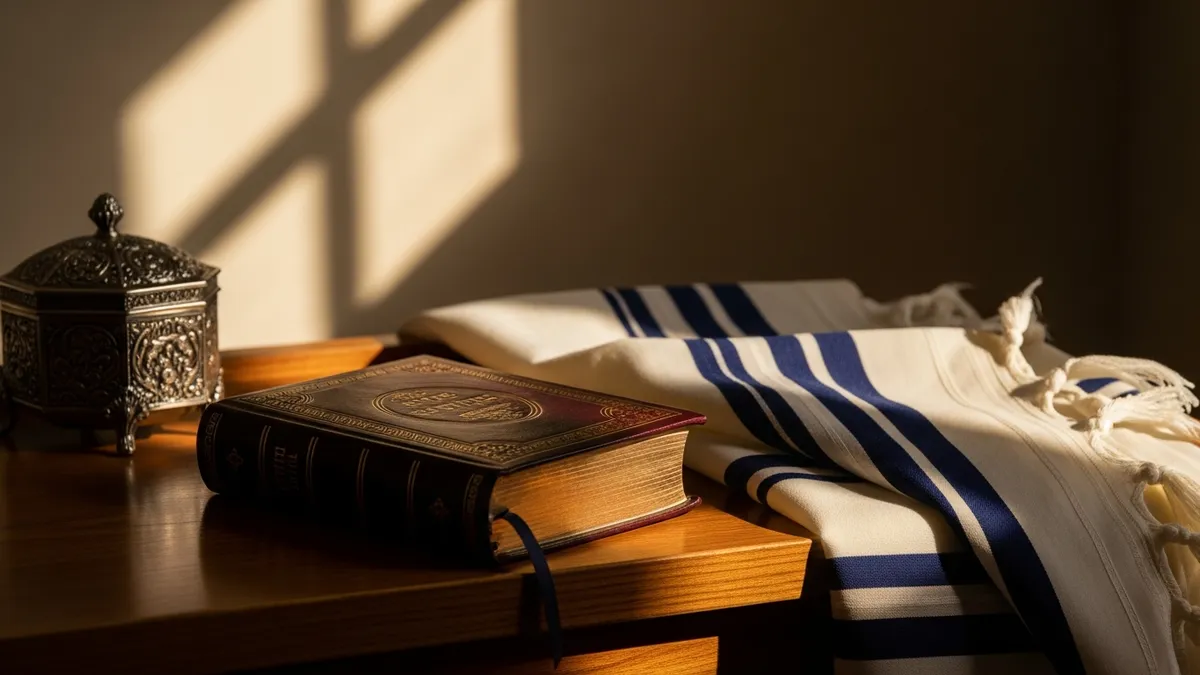
How Jewish prayer works: the three daily services — Shacharit, Mincha, Maariv — what the prayers mean, and how Jews pray at home and in synagogue.
Quick Answer
Jewish prayer is built into every day: three daily services — Shacharit (morning), Mincha (afternoon), and Maariv (evening) — plus blessings woven through the day. Orthodox Jews pray in Hebrew, facing Jerusalem, with a quorum of ten men (a minyan) for communal prayer; the core prayers are the Shema and the Amidah.
If you ever walk past a synagogue early in the morning, you might hear a low hum of voices coming from inside. That is the sound of Jewish prayer — dozens of men wrapped in prayer shawls, swaying gently, speaking directly to their Creator. I grew up with that sound. In my father's shul in Brooklyn, I could hear the davening through the mechitzah (the partition separating the men's and women's sections), and even as a little girl I understood that something powerful was happening on the other side of that wall.
Prayer is the heartbeat of Jewish life — and if you want to understand what Orthodox Judaism actually is, this is a good place to start. It is not something we do when we feel like it or when things go wrong. It is built into the structure of every single day, three times a day, every day of the year. Let me walk you through how it works.
What Is Jewish Prayer?
At its simplest: Jewish prayer is a daily obligation to stand before G-d in words — and most of those words are words that Jews everywhere have been saying, in the same order, for a very long time.
That last part is what surprises newcomers most. Jewish prayer is not primarily improvised. There is a set text, a set order, and set times, and the large majority of what an Orthodox Jew says in a day comes out of a book. Personal, unscripted prayer absolutely exists — I will come back to it further down — but it sits inside a structure rather than replacing one.
The structure has a history behind it. While the Temple stood in Jerusalem, the center of the daily service was the offering brought there each morning and each afternoon. After the Temple was destroyed, words took the place of those offerings — the prophet Hosea's phrase is that we would offer the words of our lips in place of bulls — and the daily prayers were fixed to correspond to them. The Talmud records two explanations for the three daily services side by side: that they were instituted by the forefathers — Abraham the morning prayer, Isaac the afternoon, Jacob the evening — and that they correspond to the offerings of the Temple. Traditional Judaism holds both at once. Prayer is an inheritance from our ancestors and a stand-in for a service we lost.
There is one more line from the Talmud that I have always found to be the cleanest definition of the whole thing. The Torah commands us to serve G-d "with all your heart," and the Sages ask what service of the heart could possibly mean. Their answer is: this is prayer. Not study, not charity, not ritual. Prayer. That is the job description.
The Three Daily Prayers
Prayer holds a central place in Judaism. Orthodox synagogues hold services three times a day — early morning, afternoon, and evening — and Jews have gathered at these set times, in an unbroken rhythm, for thousands of years.
Shacharit — Morning Prayer
Shacharit is the longest of the three daily prayer services and takes place in the morning. Men wear a tallit (prayer shawl) during Shacharit, and on weekdays tefillin as well — tefillin are not worn on Shabbat or holidays. The service includes the Shema (the declaration of G-d's unity), the Amidah (the standing prayer, also called Shemoneh Esrei), and various psalms and blessings. In my house, mornings are a beautiful chaos — getting children dressed, fed, and out the door — but the men in the family make sure Shacharit happens before anything else. It sets the tone for the entire day.
Mincha — Afternoon Prayer
Mincha is the shortest of the daily prayers, but many say it is the hardest to keep because it falls in the middle of a busy day. You have to stop whatever you are doing — work, errands, teaching (in my case, a classroom full of 5th graders) — and turn your attention to G-d. I have always found something beautiful about that interruption. The world does not stop, but you stop for a few minutes to remember what really matters.
Maariv — Evening Prayer
Maariv is the evening prayer, recited after nightfall. It is generally shorter than Shacharit and marks the transition from day to night. In many communities, Maariv is combined with Mincha — men will pray Mincha just before sunset and Maariv right after, making one trip to the synagogue serve for both.
One historical footnote, because people find it strange: the Talmud preserves a debate over whether the evening prayer is strictly obligatory the way the morning and afternoon prayers are. The Jewish people long ago accepted it as binding, and today nobody treats Maariv as optional — but that old discussion is why you will occasionally hear it described as the one prayer that was taken on rather than imposed.
On Shabbat, Rosh Chodesh (the start of a new Jewish month), and the festivals, there is a fourth service called Musaf — "additional" — said right after the morning service, corresponding to the additional offering that was brought in the Temple on those days. And on Yom Kippur alone there is a fifth, Ne'ilah, said as the sun goes down and the day closes.
The Shema and the Amidah — The Heart of Every Service
If you strip a Jewish service down to its two essentials, you get these two. Nearly everything else in the siddur is arranged around them, and if you understand what these are, you understand what Jewish prayer is.
The Shema
The Shema is not really a request. It is a declaration. Six Hebrew words — "Hear, O Israel, the L-rd our G-d, the L-rd is One" — and in saying them a Jew accepts out loud that there is one G-d and that He is ours. It is said twice a day, morning and evening, because the Torah says to speak these words "when you lie down and when you rise up."
In the siddur the Shema runs three paragraphs, all of them taken straight from the Torah. The first is the command to love G-d with everything you have and to teach these words to your children. The second is about consequence — that what we do matters and the world answers back. The third is the passage about tzitzit, the fringes. Between them, those three paragraphs are the source for tefillin, for the mezuzah on the doorpost, and for the fringes on a tallit — which is a large part of why they get said every single day.
It is the first prayer a Jewish child learns. My youngest could say the first line long before she could tie her shoes.
The Amidah
The Amidah — "the standing prayer," also called Shemoneh Esrei — is the main event of every service. You stand with your feet together, facing Jerusalem, and you say the whole thing silently. Not quietly. Silently, lips moving with no sound coming out. The Sages learned that from Hannah, who prays that way in the Book of Samuel — her lips moving, her voice not heard.
On a weekday it is nineteen blessings, and the shape they are arranged in is worth knowing. The first three are pure praise. The last three are pure thanks. The thirteen in the middle are the requests — understanding, forgiveness, healing, a year of livelihood, justice, Jerusalem rebuilt. You do not open with what you want. You open by acknowledging Who you are speaking to, and you close by saying thank you regardless of the answer. (The name Shemoneh Esrei means "eighteen," which is how many blessings there originally were; a nineteenth was added later and the old name stuck.)
On Shabbat and festivals the middle thirteen come out entirely and a single blessing about the holiness of the day takes their place — seven blessings instead of nineteen, and a much shorter Amidah. We do not lay out our requests on Shabbat.
When you finish, you take three steps back, the way you would withdraw from the presence of a king. I still catch myself doing it in an empty room.
What Time Do Jews Pray? Jewish Prayer Times Explained
This is the part that surprises people most: Jewish prayer times are not fixed clock times. They move every single day, because they are calculated from sunrise and sunset rather than from a clock.
The unit that does the work is called a sha'ah zmanit — a "proportional hour." You take the daylight from sunrise to sunset and divide it into twelve equal parts. In June one of those hours might run seventy-five minutes; in December it might run forty-five. Every prayer deadline below is counted in those stretchy hours, which is why the times drift a little each day and differ from one city to the next.
Here is the shape of it:
Shacharit (morning) — The preferred time to begin the Amidah is at sunrise. The Shema should be said by the end of the third proportional hour of the day, and the morning Amidah by the end of the fourth. Those two deadlines are the ones people actually watch; on a winter weekday in Brooklyn the Shema deadline can land before 9:00 a.m., which is why the early minyanim fill up.
Mincha (afternoon) — The window opens half an hour past halachic midday and runs until sunset. Communities usually pick one of two slots: an early Mincha soon after midday, or the more favored late-afternoon Mincha close to sunset.
Maariv (evening) — Recited after nightfall, when three stars are visible. Technically the window runs until dawn, but the widespread practice is not to let it drift past midnight without good reason.
Nobody does this arithmetic by hand. Every Orthodox Jew I know has a zmanim app or a local shul calendar on the fridge, and it tells you today's times for your exact location. Two practical consequences worth knowing: the times shift by a few minutes daily, and a shul in Miami and a shul in Toronto will have genuinely different schedules on the same date. If you are meeting an Orthodox colleague and they say they need fifteen minutes at 1:40, that is Mincha — and next month it will be a different fifteen minutes.
The Siddur — The Jewish Prayer Book
Every Orthodox Jewish home has a few Siddurim (plural of Siddur). The Siddur is the Jewish prayer book, and it contains all the prayers needed for daily services, Shabbat, blessings, and special occasions.
Although the structure of the prayer services was laid out during the time of the Talmud, the first real Siddur was compiled in the ninth century when Babylonian Jewish rabbis worked out the official order of the synagogue service. Even so, differences developed between communities, especially between Ashkenazi and Sephardi traditions. Today you can find the Siddur in many versions, including translations in every language, editions with commentary, and even audio versions for beginners.
Which Siddur Should You Get?
If you are looking to buy a Siddur, the first thing to know is that there are three main versions:
Nusach Ashkenaz — This is the most widely used version among Orthodox Jews today (excluding Hasidim). If you are not sure which to buy, this is usually the safest choice.
Nusach Sefard (Hasidic) — This version is used by most Hasidic communities. It is based on the prayer order of the great Kabbalist Rabbi Yitzchak Luria, the Ari. The founder of the Hasidic movement, the Baal Shem Tov, adopted this version, and all his followers use it. (Chabad-Lubavitch Hasidim use their own version called Nusach Ari.)
Nusach Edot HaMizrach — This version is used by many Sephardic and Mizrahi Jews originating from the Middle East and North Africa — Iraq, Syria, Egypt, Iran, and beyond. (Yemenite Jews are a notable exception; they have their own ancient nusach, with the Baladi version following the Rambam very closely.)
Growing up Hasidic in Brooklyn, we davened Nusach Sefard. When I first visited a Nusach Ashkenaz shul, I was surprised by the small differences — a word here, a phrase there. The core is the same, but each tradition carries its own flavor.
The Machzor — Holiday Prayer Book
For holidays, there are separate prayer books called Machzorim. They usually come in a set of five — one for each major holiday: Pesach (Passover), Shavuot, Rosh Hashanah, Yom Kippur, and Sukkot. The Machzor contains all the special prayers, piyyutim (liturgical poems), and Torah readings unique to each holiday.
Why Do Jews Pray in Hebrew?
People assume it is tradition for its own sake. It is not, quite.
Hebrew is called lashon hakodesh, the holy tongue. It is the language the Torah was given in, the language most of the liturgy was written in, and the language in which the words carry associations that no translation fully carries across. A word in the siddur very often echoes a verse somewhere in Tanach, and that echo is part of what the word is doing. Translate it and the echo goes quiet.
There is also a plainer reason. Hebrew is what makes the prayer the same prayer everywhere. I have davened in Brooklyn, in Jerusalem, and once in an airport lounge in Zurich standing next to a man I could not have held a conversation with — and we were on the same word at the same moment. That is not a small thing.
But here is what people get wrong, and it matters: Hebrew is not a requirement for prayer to count. Jewish law is explicit that someone who does not understand Hebrew may pray in a language they do understand. Prayer said in English with your whole attention is worth more than Hebrew recited at speed that means nothing to you. Almost everyone I know who came to observance later started with an English-facing siddur, stayed there for years, and picked up the Hebrew one prayer at a time. That is the normal path, not a compromise. (Hebrew is the language of the siddur, but it is not necessarily the language of the street — what Orthodox Jews actually speak day to day is a separate question with a more complicated answer.)
Praying Together: What a Minyan Is, and Why Ten
A Jew can pray alone, and a great deal of prayer does happen alone. But certain parts of the service require a minyan — a quorum of ten Jewish men, thirteen and older — and without those ten, those parts are simply left out. The rest is said exactly the same way.
Why ten? The Talmud learns it from the spies Moses sent to scout the Land of Israel. Twelve went; ten came back with a report that broke the nation's nerve, and the Torah refers to that group of ten as an "edah" — a congregation. If ten men are enough to be called a congregation there, ten men are a congregation anywhere. It is not a round number somebody picked. It is the smallest group the Torah treats as a community rather than as a pile of individuals.
What needs the ten: the Kaddish, the public Torah reading, the Kedushah, and the leader's out-loud repetition of the Amidah. What does not: the Shema, the silent Amidah, the blessings over food, and essentially everything else a person says in a day.
If you stood in the doorway of a weekday morning service, here is what you would actually hear, because it is not what most people expect. It is not one continuous chant. It shifts gears constantly. There is a long stretch of psalms said aloud at a brisk clip, half-sung, everyone slightly out of sync with everyone else. Then the leader calls out a line and the whole room answers together. Then — abruptly — silence, for four or five minutes, while everyone stands for the Amidah, and the only sounds are fabric, breathing, and the occasional creak of a shtender. Then the leader picks up out loud again and the room comes back in with "amen." Men are swaying through all of it, some barely, some like a metronome.
The other thing you would notice is that nobody is performing. There is no choir, and in an Orthodox service there are no instruments. It is a room of people each doing the same work at the same time, which is a very different thing from a room watching someone do it on their behalf. If you want the step-by-step of what the men are doing with their hands, their arms, and their clothing while all of this is going on, that is covered in how Orthodox Jews pray.
Tehillim — Psalms
Whenever a Jew wants to add an extra prayer — for healing, for gratitude, for comfort — he or she will pick up a Tehillim (the Book of Psalms) and recite a few chapters. Jews throughout all generations, in times of persecution and in exile, have always found comfort in Tehillim. King David wrote most of the psalms, and his words somehow speak to every situation, every emotion, every generation.
When a family member is sick, we say Tehillim. When we hear good news, we say Tehillim. When a woman is in labor, her friends and family gather to say Tehillim. I remember as a child sitting in shul on Shabbat afternoon, watching the older women recite Tehillim with such feeling that their lips moved but no sound came out — just an intense, private conversation with Hashem. ("Hashem" literally means "The Name" — just one of the many names of G-d, and the same reverence behind why Jews write G-d with a dash.)
There are special chapters designated for special occasions, and many people have the custom of completing the entire Book of Psalms each week or each month.
Prayers for Special Occasions
Beyond the daily prayers, Jewish life is woven through with blessings and prayers for every occasion:
Prayers for healing — The Mi Sheberach prayer is recited in synagogue for those who are ill, asking G-d for a complete recovery.
Prayers for the departed — Kaddish is recited by mourners, and Yizkor (memorial prayers) are said on certain holidays. These prayers honor the deceased and elevate their souls.
Wedding prayers — The Sheva Brachot (Seven Blessings) are recited under the chuppah and at festive meals during the week following a wedding.
Blessings throughout the day — There are blessings before and after eating, upon seeing lightning or hearing thunder, upon seeing a rainbow, even upon waking up in the morning. The very first words a Jew says each day are Modeh Ani — "I give thanks before You, living and eternal King, for You have returned my soul within me with compassion — great is Your faithfulness."
The Fixed Words and Your Own Words
Both exist. They are not in competition with each other — but the balance between them surprises people.
The fixed liturgy is the backbone. The same words, three times a day, for a lifetime. The advantage becomes obvious the first time you are having a genuinely bad year: you do not have to know what to say. The siddur already knows. On a morning when I have nothing in me at all, the words are still there and they still ask for the right things, whether or not I can feel them.
The risk is just as obvious, and the Sages named it a long time ago. The Mishnah warns against letting your prayer become keva — fixed, rote, a recitation rather than a request. Words said identically every day can quietly stop being addressed to anyone. That tension is not a flaw in the system. It is the actual work, and every honest Jew I know is somewhere in the middle of it on any given day.
So personal prayer is built into the structure, in specific places. Inside the Amidah there is a blessing asking G-d to hear our prayers, and that is the designated spot to add your own — by name, in whatever language you think in. My mother slots every sick person she knows into that blessing. Near the end of the Amidah, just before you step back, there is a second opening for whatever else you need to say. And outside the siddur entirely there is a long tradition — strongest in Breslov Hasidic practice, though not confined to it — of simply talking to G-d out loud in your own words, alone, the way you would talk to a person.
That is the honest picture of it: a fixed text that carries you when you cannot carry yourself, with deliberate gaps left in it for the things only you would say.
What Prayer Means to Us
I want to be honest with you. Prayer is not always easy. There are mornings when the words feel routine, when my mind wanders to grocery lists and lesson plans. But there are also moments — sometimes in the middle of the most ordinary Tuesday — when a phrase in the Siddur suddenly hits differently, and I feel the reality of standing before my Creator. Those moments make everything worth it.
Prayer in Judaism is not about asking for things, though we do ask. It is about building a relationship. The Hebrew word for prayer, tefillah, comes from a root meaning "to judge oneself." Prayer is a time to stop, reflect, and realign yourself with what matters. Three times a day, every day, for a lifetime.
My grandmother used to say that prayer is like a phone call to Hashem — except the line is never busy and He always picks up. I think about that every time I open my Siddur.
Attending a Prayer Service
If you are ever invited to attend a Jewish prayer service, here are a few things to know:
- Men and women sit separately in Orthodox synagogues.
- Men cover their heads with a kippah (yarmulke). Women who are married cover their hair.
- The service is conducted primarily in Hebrew, but many synagogues have prayer books with English translations.
- You are welcome to follow along silently if you do not know the prayers.
- The congregation stands and sits at various points — just follow what everyone else is doing.
Do not be intimidated. I have seen visitors at our shul who looked completely lost, and someone always quietly appeared next to them to help them find the page. That is how it works in our community. We are happy to have you there. And if you are not Jewish and wondering whether you may come at all — you may. I walk through what to expect the first time you visit a synagogue as a non-Jew, from the dress code to the kiddush afterward.
And if you want to try Jewish prayer yourself, start small. Pick up a Siddur with an English translation, begin with a few key prayers — the Shema and the Amidah are the heart of every service — and take a moment to sit with what the words actually mean. The rest builds from there.
Common Questions
How many times a day do Orthodox Jews pray? Three times daily — Shacharit (morning), Mincha (afternoon), and Maariv (evening). The morning prayer is the longest, especially with tefillin and tallit. Mincha and Maariv are shorter.
What do Jews actually say when they pray? Two things anchor every service. The Shema is a declaration — "Hear, O Israel, the L-rd our G-d, the L-rd is One" — said morning and evening, followed by three paragraphs taken from the Torah. The Amidah is the request: nineteen blessings on a weekday, opening with three of praise, closing with three of thanks, and asking in between for understanding, health, livelihood, justice, and the rebuilding of Jerusalem. Around those two sit psalms, blessings, and the Torah reading. All of it comes from a fixed text in the siddur.
Why do Jews face Jerusalem when they pray? Because Jerusalem is where the Temple stood, and the Temple was the address prayer was directed to. Jewish law puts it in layers: outside the Land of Israel you face toward the Land, in Israel you face toward Jerusalem, and in Jerusalem you face the Temple Mount itself. In practice, an Orthodox synagogue in New York is built so the whole congregation is already facing roughly east when they stand for the Amidah.
Do Jews kneel when they pray? No. Jewish prayer is done standing or seated, never on the knees. There is bowing — you bend at set points during the Amidah and straighten up again — but full prostration survives in only a couple of moments a year, on Rosh Hashanah and Yom Kippur. If you visit a service, you will see standing, sitting, swaying, and bowing, and that is the whole range.
How long does a Jewish prayer service take? On a weekday, morning prayers run roughly 45 minutes; the afternoon and evening services are about 15 to 20 minutes each, which is why many people pair them back-to-back around sunset. Shabbat morning is the long one — commonly two and a half to three hours, because it includes the Torah reading and the additional Musaf service.
Do women pray the same as men? Women have different prayer obligations — they are exempt from time-bound commandments. Most Orthodox women pray daily but with more flexibility on timing. Women do not wear tefillin or tallit in most Orthodox communities and sit in a separate section in synagogue.
What language are the prayers in? Primarily Hebrew, with some Aramaic sections (like Kaddish). Orthodox Jews learn to read Hebrew from a young age. The prayers follow a set liturgy from the siddur (prayer book).
Why do Jewish prayer times change every day? Because they are measured from sunrise and sunset, not from the clock. Daylight is divided into twelve equal "proportional hours" (sha'ot zmaniyot), so those hours stretch in summer and shrink in winter, and every deadline built on them shifts with them. That is also why prayer times differ between two cities on the very same date.
What is a minyan? A minyan is a quorum of ten Jewish men required for certain communal prayers, including Kaddish, Torah reading, and the repetition of the Amidah. Without a minyan, individuals still pray — just without these communal elements.
I'm an Orthodox Jewish woman from Brooklyn. I can't speak for every Orthodox Jew — when I write outside my experience, I say so.
Want to understand the whole picture?
The guided tour walks you through 8 topics — prayer fits into a larger rhythm of Orthodox life.
The Orthodox Insider
A new letter every Thursday, before Shabbos — plus an instant download of “10 Things Everyone Gets Wrong About Orthodox Jews” when you subscribe.
No spam, unsubscribe anytime.