Tefillin, Tallit & Kippah: Sacred Jewish Objects Explained
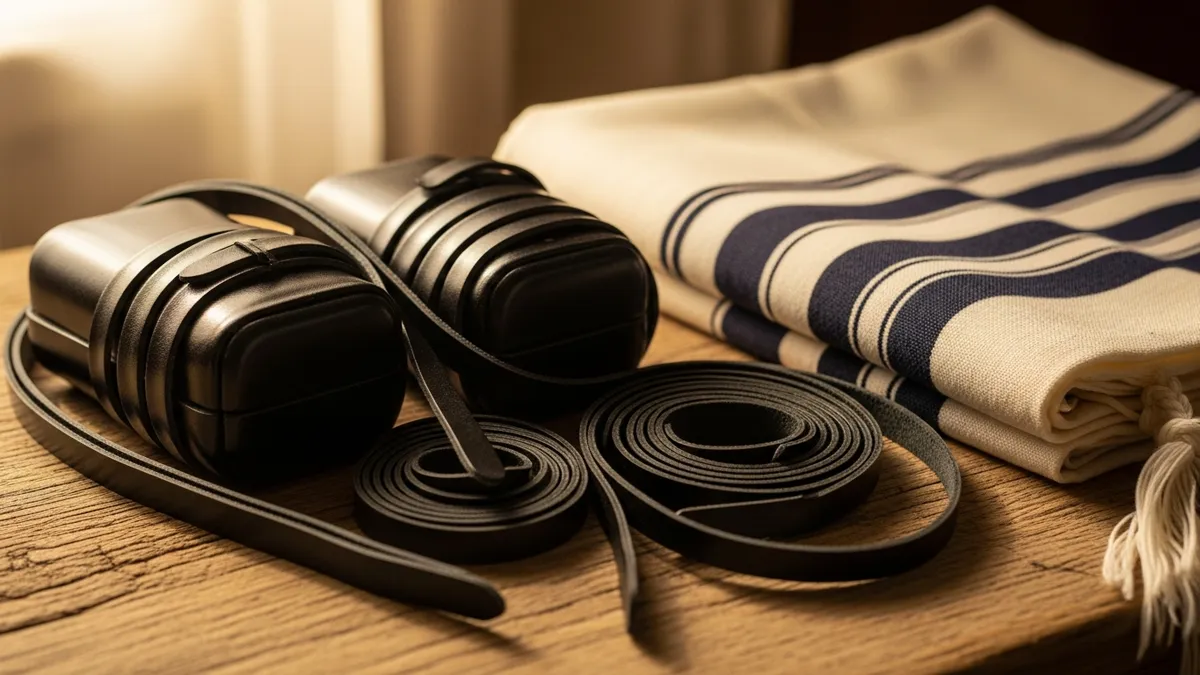
Learn about tefillin (phylacteries), the tallit (prayer shawl), and the kippah (yarmulke) — what they are, how they are worn, and what they mean in Jewish life.
Quick Answer
Tefillin are small black leather boxes containing Torah passages, worn during morning prayers. The tallit is a fringed prayer shawl. The kippah (yarmulke) is a head covering worn by Jewish men to show reverence for G-d. Together, these sacred objects connect a Jew to G-d during prayer and throughout the day.
When I was in the early days of building this website, a reader sent me an email that I will never forget. He wrote: "I have noticed that some men praying at the Wailing Wall have an item on the front of their hats that to my ignorant eyes looks like a small flashlight. Will you please tell me what it is and its use?"
I loved that email. First, because there is nothing ignorant about asking a sincere question. And second, because that "small flashlight" — tefillin — is actually one of the most profound and beautiful objects in all of Judaism. Let me tell you about it, along with the tallit and kippah, the sacred items that accompany Jewish prayer.
Tefillin — The "Flashlight" at the Western Wall
Tefillin (sometimes called phylacteries in English) are small black leather boxes with leather straps attached to them. They come as a set of two — one for the arm, called Tefillin Shel Yad, and one for the head, called Tefillin Shel Rosh. Jewish men wear them during the weekday morning prayer service. They are not worn on Shabbat or on the festival days (Yom Tov), since those days are themselves a sign of the bond between G-d and Israel. (Customs differ on the intermediate festival days, Chol Hamoed — some communities wear tefillin then, and many do not.)
What Is Inside the Tefillin?
Inside each leather box are tiny parchment scrolls inscribed by hand with passages from the Torah. These passages declare that there is only one G-d, that He freed the Jewish people from slavery in Egypt, and that Jews are commanded to bind these words "as a sign upon your hand and as frontlets between your eyes" (Deuteronomy 6:8). Orthodox Jews wear tefillin every morning to fulfill this commandment — to constantly remember their devotion to Hashem and their belief that He is the only G-d and Redeemer.
How Tefillin Are Made
Tefillin are made from the leather of a kosher animal, traditionally a cow. Every part must be handmade by an Orthodox Jew who has the specific intention that the tefillin are being crafted for the holiness of the mitzvah. The scrolls inside are written by a trained scribe (sofer) with special ink on parchment — the same way a Torah scroll is written. The straps are also leather from a kosher animal and must be dyed black.
This is not mass production. A single pair of tefillin can take months to produce, and a good sofer will spend hours on the tiny, precise lettering of the scrolls. When my oldest son needed his first pair before his Bar Mitzvah, we ordered them well in advance and waited — and they cost more than my husband's first car, which tells you something. A proper pair is an investment meant to last a lifetime. It is sacred craftsmanship.
How to Put on Tefillin
Watching a Jewish man put on tefillin for the first time is something you do not forget. Here is how it works:
The arm tefillin (Shel Yad) is placed on the upper left arm (right arm for left-handed men), positioned across from the heart. This is to remind the wearer that his heart should always be devoted to Hashem. The leather strap is then wrapped seven times around the forearm and tied in a specific pattern on the hand and fingers.
The head tefillin (Shel Rosh) is placed on the head, centered above the space between the eyes, resting just above the hairline — never on the forehead itself. Jewish law is precise about this: the box must sit on the skull above where the hair begins, not down on the forehead bone, and placing it too low actually invalidates the mitzvah. The strap is then tied around the head, and two leather straps hang down in front of the body.
The whole process takes just a minute or two for someone experienced, but there is something deeply moving about watching a man wrap himself in these ancient leather straps every morning, binding himself — literally — to G-d's commandments.
The Tefillin Airplane Incident
I have to tell you this story because it perfectly illustrates why understanding other cultures matters. In January 2010, a young Orthodox Jewish boy was putting on his tefillin during a US Airways flight from New York to Louisville. Another passenger saw the unfamiliar leather straps and boxes and feared it might be some kind of explosive device. The plane was diverted to Philadelphia, searched by authorities, and the boy was questioned — only for everyone to quickly realize it was a complete misunderstanding.
No harm done, but what a reminder that something so ordinary in our world can look completely foreign to someone else. That is exactly why I write this website.
A Boy's First Tefillin
When a Jewish boy turns thirteen, he puts on tefillin for the very first time. This happens at his Bar Mitzvah — the day he becomes personally obligated to fulfill Hashem's commandments. In the weeks leading up to the Bar Mitzvah, the boy practices with his father or a mentor, learning the proper way to wrap the straps and recite the blessings. It is one of the most meaningful moments in a young Jewish man's life. I have watched my own sons reach this milestone, and I can tell you — a mother cries every time.
The Deeper Meaning
The Talmud teaches something extraordinary: Hashem Himself, so to speak, wears tefillin. And while our tefillin contain passages about G-d's oneness and His greatness, the Talmud says that Hashem's tefillin contain words about the greatness and uniqueness of the Jewish people. It is a beautiful image — G-d and Israel bound to each other, each wearing tefillin that speak of the other.
The Tallit — Jewish Prayer Shawl
Most adult Jewish men wear a tallit (also spelled tallis) during the morning prayers — though, as you will see below, exactly when a man starts depends on his community. The chazan (cantor) wears the tallit when leading most prayer services. If you have ever seen images of Jewish men draped in white cloth with fringes, that is the tallit.
What Is the Tallit?
The tallit is a rectangular cloth — traditionally wool — with four corners. On each corner hang specially tied fringes called tzitzit. This custom comes directly from a commandment in the Torah: "Speak to the children of Israel and tell them to make fringes on the corners of their garments throughout their generations" (Numbers 15:38). The tzitzit serve as a reminder of all of G-d's commandments.
When Do You Start Wearing a Tallit?
There are two main customs. In many communities, a boy begins wearing his own tallit at his Bar Mitzvah. In other communities — particularly among Ashkenazi Jews — the custom is to start wearing a tallit only at marriage. My husband received his tallit as a wedding gift, which is the tradition in many Hasidic and Yeshivish families.
How Different Jews Wear the Tallit
This is one of those areas where you can spot the differences between communities just by looking:
Ultra-Orthodox and Hasidic Jews wear a large tallit that covers most of the body and is pulled over the head during certain parts of the prayer. When I peek through the mechitzah during Shacharit, I see rows of men completely enveloped in their tallitot, swaying in prayer. It is a powerful sight.
Modern Orthodox Jews often wear a smaller tallit draped over the shoulders like a shawl. Some leading cantors also wear it this way.
If you are buying a tallit, make sure you see a sample first so you know what you are getting. I have heard stories of people expecting a prayer shawl and ending up with a full-body covering — or the reverse.
Why Does the Tallit Have Stripes?
One of the most recognizable features of the tallit is its black or blue stripes. Not all tallitot have them — some are completely white, and some have other colors — but the stripes are traditional in many communities. There are two main explanations:
To remember the techelet — In ancient times, one of the fringes on each corner was dyed with a special blue dye called techelet. This dye was eventually lost (though some communities have revived it in recent years). The stripes on the tallit recall that original blue thread.
A Kabbalistic meaning — According to Kabbalah, white represents Hashem's kindness and black represents His strict judgment. Wearing a white garment with a small amount of black is a prayer that G-d's kindness should prevail over His strict judgment.
The Kippah — Jewish Skull Cap
The kippah (also called a yarmulke) is probably the single most recognizable sign of an Orthodox Jewish man. It is a small head covering worn at all times — not just during prayer.
Why Do Jewish Men Wear a Kippah?
The Talmud (Kiddushin 31a) teaches: "Cover your head, so that the fear of Heaven should be upon you." The Talmud (Shabbat 156b) also describes great sages who would not walk even eight feet without a head covering. The idea is that the Divine Presence rests above a person's head, and covering it shows respect and awareness of Hashem's constant presence.
Although the Talmud does not frame it as a strict obligation in the way other commandments are, the custom has developed over the centuries into a firm requirement in Orthodox communities. Ultra-Orthodox men will not take even a single step without their kippah, while some Modern Orthodox Jews may wear it primarily during prayers and meals.
If you have ever attended an Orthodox Jewish wedding or Bar Mitzvah, you were probably handed a kippah at the door. Even non-Jewish guests are asked to wear one during the event out of respect.
When Do Boys Start Wearing a Kippah?
It is customary for a boy to start wearing a kippah around age three. In Hasidic and Yeshivish circles, the third birthday is a major celebration called an upsherin — the boy gets his first haircut, starts wearing a kippah and tzitzit, and begins to learn the aleph-bet (Hebrew alphabet). I remember each of my children's upsherin days with such joy.
Kippah Styles — You Can Tell a Lot by the Kippah
Here is an insider tip: you can often tell what type of Orthodox community a man belongs to just by looking at his kippah.
- Black velvet covering most of the head — Haredi (ultra-Orthodox) or Yeshivish
- Small black suede or leather — Modern Orthodox
- Colorful crocheted (knitted) — Religious Zionist (Dati Leumi)
- White crocheted — Breslov Hasidim or Jerusalemite (Yerushalmi) communities
- Large black satin under a hat — Hasidic
My father wore a black velvet kippah under his shtreimel. My Modern Orthodox neighbors wear small suede ones clipped to their hair. Different styles, same idea.
These Objects Tell a Story
What I want you to take away from all of this is that tefillin, the tallit, and the kippah are not just religious accessories. They are physical expressions of a relationship with G-d. Every morning, a Jewish man wraps himself in his tallit, binds tefillin to his arm and head, and stands in prayer with his kippah reminding him of the Divine Presence overhead. It is an act of love, devotion, and identity that has been repeated by Jewish men for thousands of years — in ancient Israel, in medieval Europe, in the ghettos, in the camps, and today in synagogues from Brooklyn to Jerusalem.
That reader who saw a "small flashlight" at the Western Wall — he was actually seeing something far more powerful. He was seeing a Jew binding himself to G-d with leather and parchment, the same way his ancestors did three thousand years ago. And that is a light that has never gone out.
If you want to see where these objects fit into the prayer service itself, here is how we pray every morning.
Common Questions
What is the difference between tefillin and a tallit? Tefillin are leather boxes with straps worn on the arm and head during weekday morning prayer. A tallit is a fringed prayer shawl worn over the shoulders. Both are worn during morning prayers; only the tallit is worn on Shabbat.
Do women wear tefillin or tallit? In Orthodox practice, women are exempt from these time-bound commandments and traditionally do not wear them — not because they are excluded, but because Jewish law does not obligate them in mitzvot tied to a specific time of day. A small number of Modern Orthodox women have adopted tallit or tefillin use, which remains controversial and is not the mainstream practice within Orthodoxy.
When does a boy start wearing these? Tefillin begin at bar mitzvah (age 13), with practice starting a month or two before. The tallit tradition varies — Ashkenazi men begin wearing a full tallit at marriage; Sephardic boys start at bar mitzvah.
I'm an Orthodox Jewish woman from Brooklyn. I can't speak for every Orthodox Jew — when I write outside my experience, I say so.
Jewish Prayer: How Jews Pray, Three Times Every Day
Orthodox Jewish Clothing — Why They Dress That Way
How Do Orthodox Jews Pray?
What Is That Box on Their Forehead? (Tefillin Explained)
Want to understand the whole picture?
The guided tour walks you through 8 topics — prayer fits into a larger rhythm of Orthodox life.
The Orthodox Insider
A new letter every Thursday, before Shabbos — plus an instant download of “10 Things Everyone Gets Wrong About Orthodox Jews” when you subscribe.
No spam, unsubscribe anytime.