What is a Mezuzah? The Sign on Every Jewish Doorpost
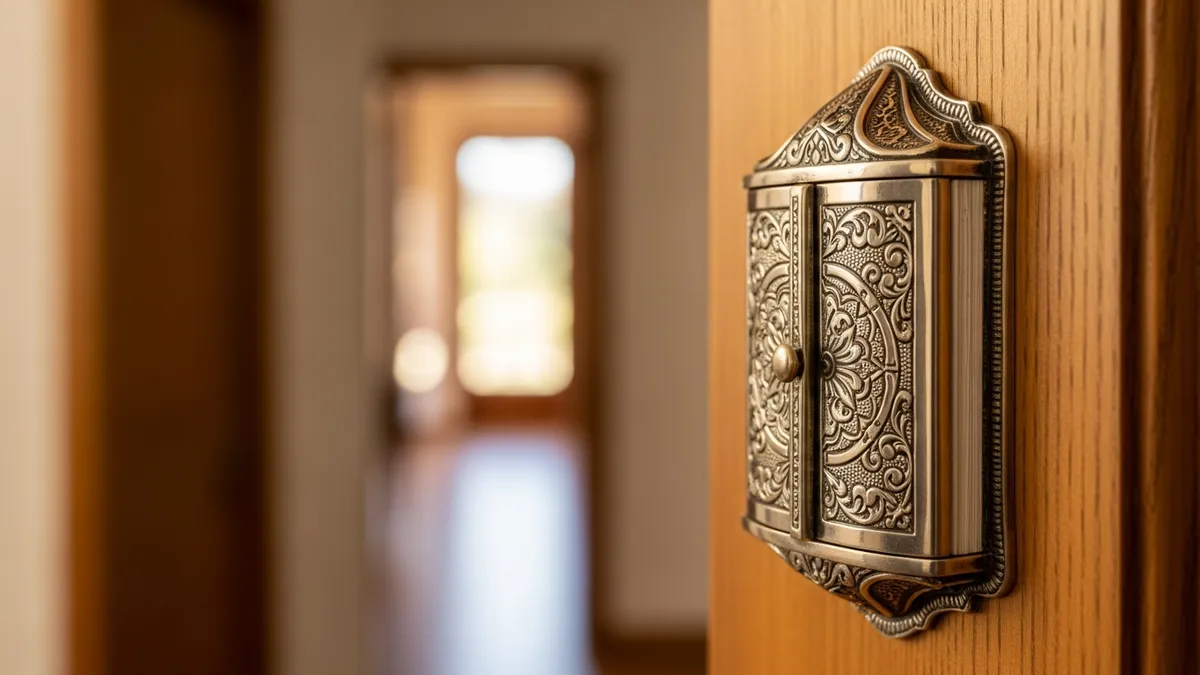
Learn what a mezuzah is, what's written on the parchment inside, where to place it, and why this small scroll marks every Orthodox Jewish home.
Quick Answer
A mezuzah is a small case containing a handwritten parchment scroll with two passages from the Torah (the Shema). It is affixed to the right doorpost of every room in a Jewish home (except bathrooms). The mezuzah fulfills a Torah commandment and serves as a visible sign that a Jewish family lives there.
Want to know a secret for spotting an Orthodox Jewish home? Look at the doorpost. If you see a small case, usually made of wood, metal, or ceramic, attached to the right side of the door frame at a slight angle, you have found it. That is a mezuzah, and it is one of the most recognizable symbols of Orthodox Judaism.
But the mezuzah is far more than a decorative door marker. Let me explain what it really is.
What Is Inside the Mezuzah?
The beautiful case you see on the outside is just the housing. The real mezuzah is what is inside: a small, handwritten parchment scroll called a klaf.
On this scroll, a trained sofer (scribe) has carefully written two passages from the Torah in Hebrew: the first two paragraphs of the Shema (Devarim 6:4-9 and Devarim 11:13-21). These passages contain the fundamental declaration of Jewish faith ("Hear O Israel, the L-rd is our G-d, the L-rd is One") — the single line at the heart of Jewish belief — and include the commandment to "write them on the doorposts of your house and on your gates."
Every letter must be written by hand with special ink on specially prepared parchment. If even a single letter is missing, cracked, or incorrectly formed, the entire mezuzah is pasul (invalid). This is why mezuzah scrolls must be purchased from a reputable sofer and periodically checked to ensure they remain kosher.
Where Does the Mezuzah Go?
The mezuzah is placed on the right doorpost as you enter a room. This applies to virtually every doorway in the home: the front door, bedrooms, kitchen, living room, dining room, and even closets that are large enough to qualify as a room. The only rooms that do not get a mezuzah are bathrooms and rooms that are too small to be considered proper living spaces.
The mezuzah is placed in the upper third of the doorpost, at about shoulder height. In Ashkenazi tradition, it is affixed at a slight angle, with the top tilting inward toward the room. This angled placement actually comes from a compromise between two great medieval authorities: Rashi, who held it should be vertical, and Rabbeinu Tam, who held it should be horizontal. The angle satisfies both opinions.
In Sephardi tradition, the mezuzah is placed vertically.
Before affixing the mezuzah, a bracha (blessing) is recited: "Blessed are You, L-rd our G-d, King of the universe, who has sanctified us with His commandments and commanded us to affix a mezuzah."
Checking the Mezuzah
A mezuzah scroll does not last forever without attention. Over time, the ink can crack, letters can fade, and moisture can damage the parchment. Jewish law requires that mezuzot (plural of mezuzah) be checked twice every seven years to ensure they are still kosher.
Many families have their mezuzot checked more frequently, especially if they are experiencing difficulties. There is a deep-rooted tradition that a kosher mezuzah brings protection and blessing to the home, and a pasul (invalid) one can be a spiritual concern. A sofer will carefully examine each scroll letter by letter and repair or replace any that are no longer valid.
The Deeper Meaning
On one level, the mezuzah is a straightforward fulfillment of a Torah commandment. But on a deeper level, it transforms every doorway into a moment of spiritual awareness.
Every time you walk through a door in a Jewish home, the mezuzah is there. Many people touch the mezuzah case and then kiss their fingers as they pass, a beautiful custom that turns an ordinary act, walking through a door, into a moment of connection with G-d.
The mezuzah also serves as a declaration. It announces to the world and to the family within: this is a Jewish home. The values inside this house are Torah values. The G-d of Israel watches over this threshold. And the doorpost is just the beginning — step past it and you will see what an Orthodox Jewish home looks like inside, from the walls of holy books to the double kitchen.
When I was growing up, one of the first things my father did when we moved into a new home was put up the mezuzot. Before the furniture was arranged, before the pictures were hung, the mezuzot went up. Because that is what makes a house into a Jewish home.
Buying a Mezuzah
If you are looking to purchase a mezuzah, remember that the scroll is what matters most. Beautiful cases are wonderful, and there are stunning options available in Judaica stores, from simple olive wood to ornate silver. But the klaf (parchment scroll) inside must be written by a qualified sofer, and you should purchase it from a reputable source. One reliable option is K Mezuzah, which specializes in certified kosher mezuzah scrolls written by qualified sofrim.
Prices vary widely based on the quality of the writing and the size of the scroll. A basic kosher mezuzah scroll might cost $30 to $50, while a mehudar (beautifully written, higher-quality) scroll can cost significantly more. This is not an area to cut corners. A properly written mezuzah is a Torah commandment, and it is worth investing in quality.
Every Jewish home deserves kosher mezuzot on every door. It is one of the simplest and most powerful ways to bring holiness into your daily life.
Common Questions
What is inside a mezuzah? A handwritten parchment scroll containing the Shema prayer (Deuteronomy 6:4-9 and 11:13-21). It is written by a trained scribe (sofer) and rolled into the decorative case. The case is just a container — the scroll is what matters.
Which doors need a mezuzah? Every doorpost in the home except bathrooms and very small closets. Front door, bedrooms, kitchen, living room, office — all get a mezuzah. The scroll is affixed to the right doorpost as you enter — tilted inward in Ashkenazi practice, vertical in Sephardi homes.
How much does a mezuzah cost? The case can be $10-$500+ (decorative). The scroll (the essential part) costs $30-$100+ depending on quality and the scribe. An Orthodox home with many rooms may need 10-15 mezuzot — it adds up.
I'm an Orthodox Jewish woman from Brooklyn. I can't speak for every Orthodox Jew — when I write outside my experience, I say so.
Want to understand the whole picture?
The guided tour walks you through 8 topics — prayer fits into a larger rhythm of Orthodox life.
The Orthodox Insider
A new letter every Thursday, before Shabbos — plus an instant download of “10 Things Everyone Gets Wrong About Orthodox Jews” when you subscribe.
No spam, unsubscribe anytime.