What Is a Synagogue? Purpose, Layout & Services
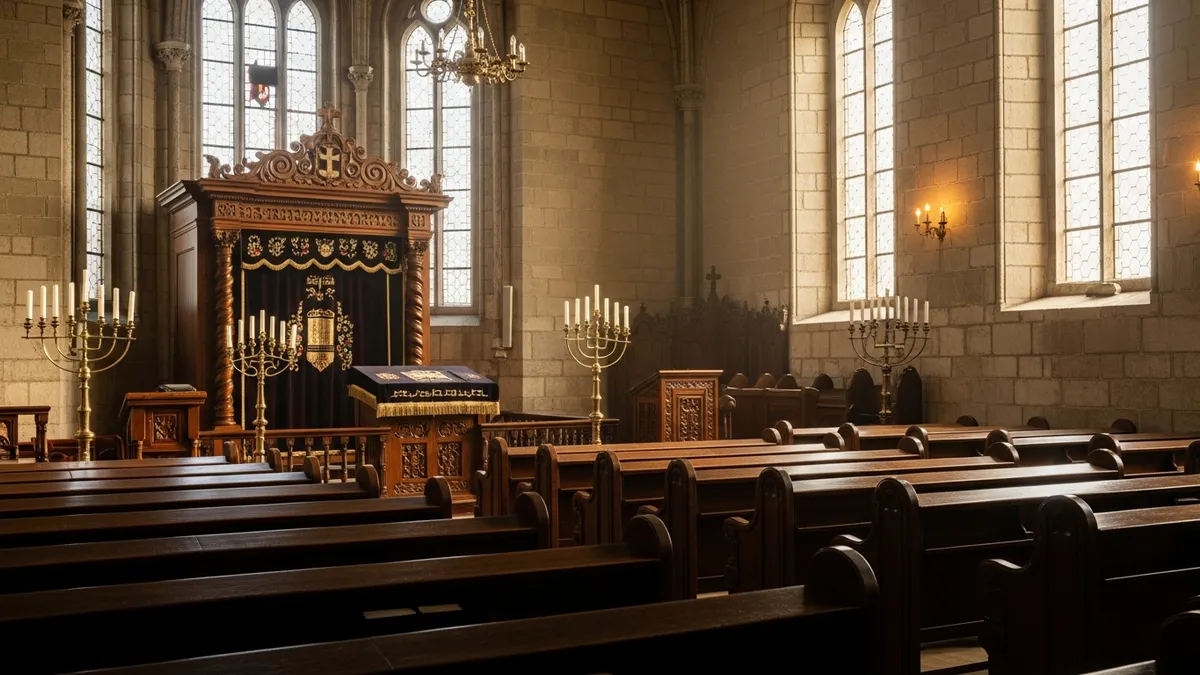
Learn what a synagogue is, what happens inside one, how it's different from a church, and the role it plays in Orthodox Jewish life.
Quick Answer
A synagogue (shul in Yiddish, beit knesset in Hebrew) is a Jewish house of prayer, study, and community gathering. Orthodox synagogues hold daily prayer services, Torah readings, and classes. Unlike churches, synagogues have no altar or sacraments — they're centered on communal prayer and Torah.
What Is a Synagogue?
A synagogue is where Jews gather to pray, study, and build community. In Yiddish, it's called a shul (literally "school"). In Hebrew, it's a beit knesset ("house of assembly") or beit tefillah ("house of prayer"). The different names hint at its multiple roles — it's not just a place of worship. (If it's specifically the Orthodox version you're curious about — the mechitza, the central bimah, the rhythm of services — step inside an Orthodox synagogue.)
The direct answer: a synagogue is a Jewish communal space used for prayer services (three times daily in Orthodox communities), Torah study, lifecycle events, and community gathering. Orthodox synagogues feature separate seating for men and women, a Torah ark, and a reading platform, and they serve as the center of communal religious life.
What's Inside a Synagogue?
The Aron Kodesh (Holy Ark)
The focal point of every synagogue is the ark — a cabinet or alcove on the wall facing Jerusalem that houses the Torah scrolls. The ark is usually ornately decorated with curtains (parochet), carved woodwork, and an eternal light (ner tamid) hanging above it.
When the ark is opened during services, the congregation stands out of respect for the Torah. The Torah scrolls inside are handwritten on parchment by a trained scribe and are among the community's most treasured possessions.
The Bimah (Reading Platform)
The bimah is an elevated platform where the Torah is read publicly. In many Orthodox synagogues, the bimah is in the center of the room, surrounded by seating on all sides. This placement reflects the centrality of Torah in Jewish life.
The Mechitza (Partition)
Orthodox synagogues have a physical separation between men's and women's seating areas. This can be a wall, curtain, balcony arrangement, or other barrier. The style and opacity of the mechitza varies by community.
Seating
Seating is less uniform than in many churches. Some Orthodox synagogues do have forward-facing pews, but arrangements vary widely — theater-style chairs, benches, or tables for placing prayer books.
What Happens in a Synagogue?
Daily Prayer Services
Orthodox synagogues hold three daily prayer services:
- Shacharit (morning): 30-60 minutes, longer on Mondays and Thursdays when Torah is read
- Mincha (afternoon): 15-20 minutes
- Maariv (evening): 15-20 minutes
A quorum of ten men (minyan) is needed for full communal prayer. Many synagogues have multiple minyans at different times to accommodate various schedules.
Shabbat and Holiday Services
Shabbat services are the main weekly gathering — Friday night and Saturday morning services draw the largest attendance. The Saturday morning service includes the Torah reading, a sermon, and the Mussaf additional service. Total time: two to three hours.
Holiday services vary by the holiday but can be quite lengthy — Yom Kippur services span the entire day.
Torah Study
Many synagogues host regular classes (shiurim) on various topics — Talmud, halacha, Chumash with commentaries, Jewish philosophy. These classes might run daily, weekly, or at various intervals.
Life-Cycle Events
Synagogues host baby namings, bar mitzvahs, and memorial services. Weddings may take place in a synagogue but often occur in event halls. During shiva (mourning), prayer services move to the mourner's home, not the synagogue.
Synagogue vs. Church
The differences are significant:
- No clergy-centered worship: Services are led by a chazzan (cantor) or any knowledgeable congregant, not necessarily a rabbi. The rabbi may give a sermon but doesn't "lead" the service in the way a minister leads a church service.
- No altar or sacraments: There's no communion, no baptism, no altar. The focal points are the Torah ark and the reading platform.
- Active participation: Jewish services involve constant participation — standing, sitting, responsive readings, silent personal prayer. It's not a performance you watch.
- No imagery: Orthodox synagogues have no statues, paintings of religious figures, or stained glass depicting people. Artistic decoration is limited to abstract designs, floral patterns, and symbolic images (lions, eagles, tablets of the law).
The Shul Experience
If you've never been to an Orthodox shul, here's what to expect: it's noisier than you'd think. People arrive at different times, chat before and after (and sometimes during) services, and children often run around. The atmosphere is more "community living room" than "hushed cathedral."
This informality isn't disrespect — it reflects the fact that the shul is a second home. People are comfortable there. They know each other, they schmooze, they argue about where to sit. The prayer itself is deeply personal and sincere, but the surrounding atmosphere is warm and communal. That welcome extends beyond the community, too — non-Jewish visitors can attend a synagogue service, and a respectful guest is usually greeted warmly.
My shul has a guy who's been sitting in the same seat for thirty years. Nobody assigned it to him. But everyone knows it's his seat. Try sitting there and you'll get a very polite but firm education in shul politics.
More Than a Building
The synagogue is where community happens. Announcements are made, meals are shared, celebrations are held, and losses are mourned — all within the same walls. For many Orthodox Jews, the shul is as central to daily life as their home.
Want to learn more? Read about Jewish prayer or explore what Orthodox Judaism is.
I'm an Orthodox Jewish woman from Brooklyn. I can't speak for every Orthodox Jew — when I write outside my experience, I say so.
Want to understand the whole picture?
The guided tour walks you through 8 topics — prayer fits into a larger rhythm of Orthodox life.
The Orthodox Insider
A new letter every Thursday, before Shabbos — plus an instant download of “10 Things Everyone Gets Wrong About Orthodox Jews” when you subscribe.
No spam, unsubscribe anytime.