What Is the Star of David? The Jewish Star Explained
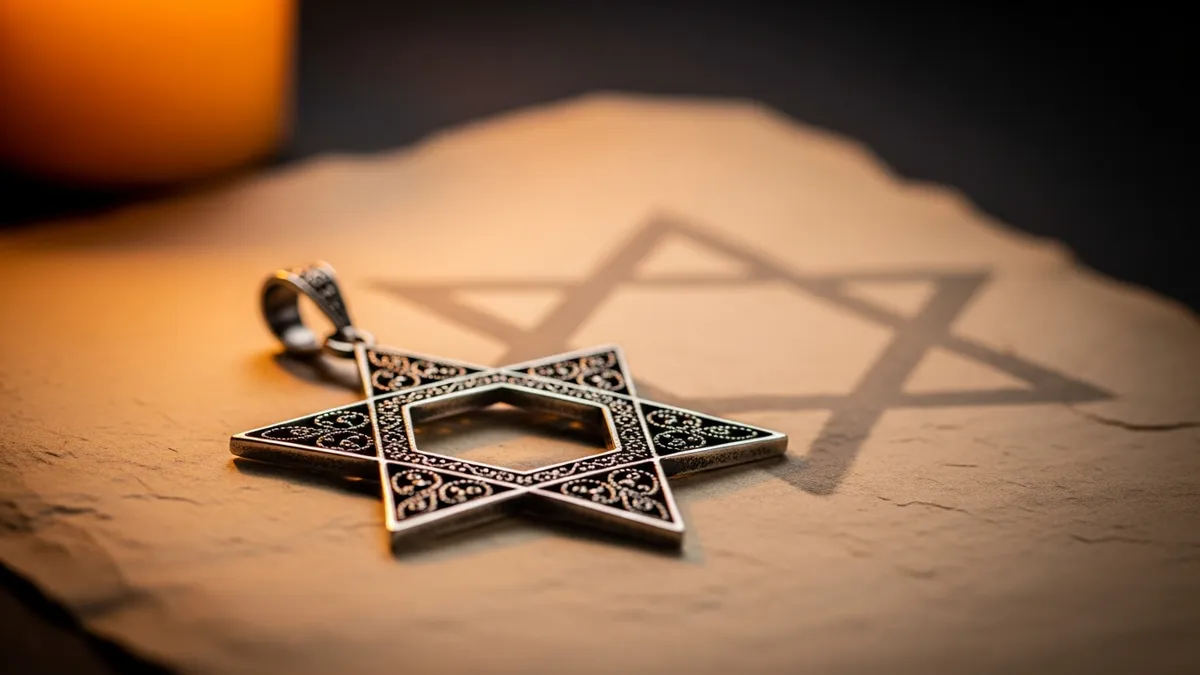
The Star of David (Magen David) is the six-pointed star symbol of Judaism. Learn its history, meaning, and how it became the universal Jewish symbol.
Quick Answer
The Star of David (Magen David, meaning 'Shield of David') is a six-pointed star formed by two overlapping triangles. While not a religious symbol commanded by the Torah, it has been the most recognized symbol of Jewish identity for centuries and appears on the flag of Israel.
The six-pointed star is one of the most instantly recognizable symbols in the world. You see it on the flag of Israel, on synagogues, on jewelry, on tombstones, on Judaica shops from Brooklyn to Jerusalem. But here is something that surprises many people: the Star of David is not actually a religious symbol in the way that the cross is for Christianity or the crescent for Islam. It does not appear in the Torah. It is not required by Jewish law. Its connection to Judaism is cultural and historical rather than halachic.
The Magen David (Hebrew: מגן דוד, "Shield of David") is a hexagram — two overlapping equilateral triangles forming a six-pointed star. Its association with the Jewish people has grown over centuries, and today it is the universal symbol of Jewish identity.
The History
The six-pointed star as a geometric shape appears in many ancient cultures — it was not originally exclusive to Judaism. However, its association with the Jewish community began to solidify in the Middle Ages:
Medieval Prague — One of the earliest confirmed Jewish uses was in 14th-century Prague, where the Jewish community was granted a flag featuring the Magen David. It became associated with the city's Jewish quarter.
Kabbalistic writings — Some Jewish mystical texts from the medieval period assigned spiritual significance to the six-pointed star, seeing it as representing the six days of creation surrounding the central Shabbat, or the six directions of space (north, south, east, west, up, down) with the center representing the spiritual.
17th-18th centuries — The symbol became increasingly common on synagogues across Europe as a way to identify Jewish houses of worship, similar to how churches used the cross.
The Zionist movement — In the late 19th century, the early Zionists adopted the Magen David as a national symbol. When the State of Israel was established in 1948, the blue Star of David on a white background (between two blue stripes representing a tallit) became the national flag.
The Darkest Chapter
During the Holocaust, the Nazis forced Jews to wear a yellow Star of David as a badge of identification and shame. The symbol that represented Jewish identity became a tool of persecution — Jews across occupied Europe were required to sew the yellow star onto their clothing, marking them for discrimination, deportation, and murder.
After the war, the Jewish people reclaimed the Magen David as a symbol of pride, resilience, and survival. What was meant to degrade became a badge of honor. The Star of David on the flag of Israel flies over a sovereign Jewish state that rose from the ashes of the Holocaust. That transformation carries immense emotional weight for Jewish people worldwide.
What Does It Symbolize?
Because the Magen David is not a Torah-mandated symbol, its meaning is open to interpretation. Some common explanations include:
- The shield of King David — Though there is no clear historical evidence that King David used this symbol, tradition connects it to him. Some say his shield was shaped this way, or that the Hebrew letter dalet (ד), the first letter of David's name, was originally written as a triangle, and two dalets together form the star.
- The connection between G-d and humanity — One triangle points upward (toward heaven) and one points downward (toward earth), representing the relationship between the divine and the human.
- The Jewish people and the Torah — The six points plus the center equal seven, corresponding to the seven days of creation and the centrality of Shabbat.
- Unity in diversity — The interlocking triangles cannot be separated, representing the unbreakable bond of the Jewish people.
The Star of David Today
Today, the Magen David appears everywhere in Jewish life:
- On synagogues and Jewish institutions
- On the Israeli flag and on Magen David Adom (Israel's emergency medical service, equivalent to the Red Cross)
- On jewelry — Star of David necklaces are one of the most common expressions of Jewish identity
- On gravestones in Jewish cemeteries
- On Judaica items — challah covers, kiddush cups, mezuzah cases
In my home, we have a Star of David on a necklace my mother gave me, on a decoration in our sukkah, and on the cover of my siddur. It is woven into the visual language of Jewish life in a way that feels both ancient and completely current.
More Than a Shape
When my daughter drew a Star of David in school and brought it home, she was beaming. "This is us, right, Mommy?" she said. And she is right. It is us. Not because the Torah commands it, but because history made it so — through joy and through tragedy, through exile and return. The Magen David is not just a shape. It is a statement: we are here, we are Jewish, and we are not going anywhere.
I'm an Orthodox Jewish woman from Brooklyn. I can't speak for every Orthodox Jew — when I write outside my experience, I say so.
What Is Judaica? Jewish Ritual Objects and Art Explained
The History of Israel: A Jewish Perspective
What Is a Hasidic Jew? An Insider's Guide to Hasidic Judaism
What Is the Red String Bracelet? Is It Really Jewish?
Partway in, or just curious?
If you're in an interfaith relationship, have Jewish ancestry, or are quietly exploring deeper engagement, there's a separate page for you.
The Orthodox Insider
A new letter every Thursday, before Shabbos — plus an instant download of “10 Things Everyone Gets Wrong About Orthodox Jews” when you subscribe.
No spam, unsubscribe anytime.