What Is a Kosher Meal? How One Actually Comes Together
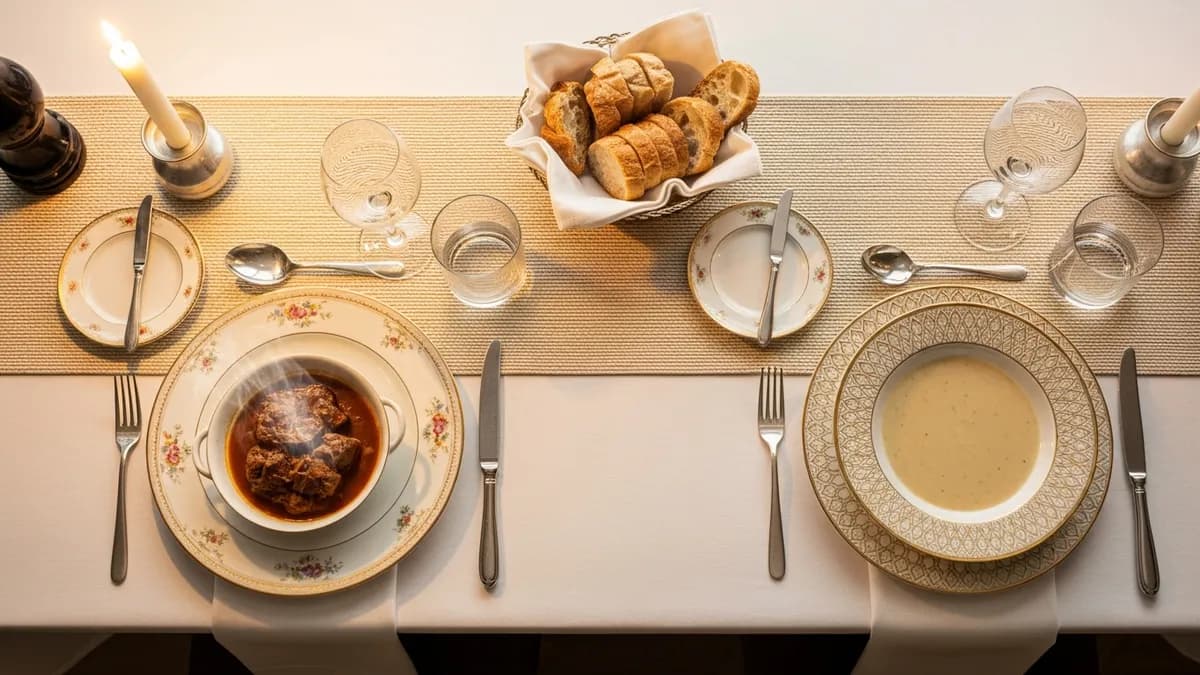
A kosher meal isn't just about ingredients — it's about categories, timing, and how meat, dairy, and pareve foods interact on your plate.
Quick Answer
A kosher meal is built around three food categories — meat (fleishig), dairy (milchig), and neutral (pareve) — with the cardinal rule that meat and dairy cannot be eaten at the same meal. A meat meal might be Friday night chicken soup and roast; a dairy meal might be Sunday bagels and lox. Pareve foods like fish, eggs, and produce can go with either.
People ask me this question in the strangest places. At my son's school play. In the checkout line when someone spots the three separate packages in my cart. On an airplane, when my seatmate watches the flight attendant hand me a foil-wrapped tray and wants to know what exactly is going on.
What is a kosher meal, actually? Not the laws — you can read those at /kosher-laws — but the practical reality. What does it mean to construct a meal from scratch, and why does it look the way it does?
Let me walk you through it as someone who does this three times a day, for a large family, while also packing school lunches and explaining it to a Bais Yaakov class of ten-year-olds every few months.
Orthodox Jews eat according to a detailed body of dietary law that has been observed for thousands of years. Understanding the meal — how it comes together, what you can and can't put on the same plate — starts with understanding three categories.
The Three Categories on Every Kosher Plate
Every food you will ever eat falls into one of three buckets. Once you understand the buckets, the rest makes sense.
Fleishig (meat). This is anything that comes from a land animal or poultry — beef, chicken, lamb, turkey, veal. To be kosher, the animal has to be the right species, slaughtered in a specific way (shechita) by a trained person, and have certain veins and fats removed. When a meal is "meat," that designation covers everything — the main dish, the soup, the sides cooked in chicken stock, the plate it was served on.
Milchig (dairy). Milk, butter, cheese, yogurt, sour cream, ice cream. Anything derived from a kosher animal's milk. A dairy meal is also a designation that covers everything on the table.
Pareve (neutral). This is the category that makes Orthodox cooking possible. Pareve means neither meat nor dairy — and it can go with either. Fish, eggs, fruits, vegetables, grains, legumes, and most plant-based foods are pareve. Plain pasta is pareve. A salad with oil and vinegar is pareve. A loaf of challah made with no dairy is pareve. Pareve foods are the diplomatic heroes of a kosher kitchen.
Here is the one rule that shapes every single meal: you cannot eat meat and dairy together at the same meal. Not the same bite, not even the same table setting if you are being careful. This comes from the Torah verse — repeated three times — "do not cook a kid in its mother's milk." The practical application developed over centuries into a full separation system. For the details of why and how, see what is kosher.
The Waiting Question (and Why It Varies by Family)
After you eat meat, you wait before you eat dairy. This is where you will hear different numbers from different families and communities.
Six hours is the standard Ashkenazic practice, though the specific customs vary — some families wait five and a half hours, some six full hours, some have their own tradition. The short version: meat takes longer to digest and the fat lingers in your mouth and throat. The Talmudic discussion of this waiting period led to varying customs across different communities. My family waits six hours. My neighbor, who comes from a Dutch Jewish family, waits one hour. We have had many lively conversations about this. Neither of us is wrong.
After dairy, the wait before meat is much shorter — most Ashkenazic authorities require only that you eat something, rinse your mouth, and check your teeth. Sephardic practice often includes a short waiting period as well, though shorter than six hours. Hard aged cheeses are different — many authorities require a longer wait after those, because of how they linger in the mouth.
The practical result: when I am planning menus for a full day, I think in blocks. If we eat a meat Shabbat lunch at 1 PM, nobody is having milchig dessert until at least 7 PM. Plan accordingly.
What a Meat Meal Looks Like at My House
Friday night is the flagship meat meal of the week — and if you have never been to an Orthodox Friday night dinner, let me paint the picture.
We start with gefilte fish (pareve — it's fish, not meat) and challah. Then comes the chicken soup, with lokshen (thin egg noodles) and soft-cooked pieces of chicken. The soup itself was made with chicken bones and vegetables all day Friday. Nothing in that pot touches dairy, and the pot it cooked in has never seen milk or butter.
Main course: roast chicken or a brisket, depending on what kind of week I'm having. Roasted potatoes. A green vegetable on the side, cooked in oil, not butter. Maybe a pareve salad.
Dessert: this is where pareve becomes your best friend. I cannot serve ice cream after a meat meal. I cannot serve cheesecake. What I can serve is a fruit salad, a sorbet, a pareve cake (made with oil and no dairy), or the fancy pareve chocolate mousse my daughter has been perfecting since ninth grade. Pareve desserts have to work harder to be good, and honestly? Orthodox bakers have been figuring this out for centuries. When you cannot use butter, you learn to use good quality oil, coconut cream, and a lot of chocolate.
Everything that cooked the meat meal — the pots, the pans, the serving dishes, the forks and knives — goes to the meat side of my kitchen to be washed. Not with the dairy dishes. Separate. If this sounds complicated, it becomes completely natural once you have done it for a while. My kids set the table automatically with the right color. It's just how we live.
What a Dairy Meal Looks Like at My House
Sunday morning is the great dairy meal of the week in my house. This is not a religious designation — there is no halacha requiring bagels on Sunday — it is just the way our family has always done it, and possibly every Ashkenazic Jewish family in the history of the universe.
Bagels. Cream cheese. Lox (smoked salmon — pareve, because fish is pareve, so it can go with either dairy or meat). Sliced tomatoes. Red onion. Capers, if anyone other than me is feeling adventurous. Scrambled eggs — pareve — or omelets with cheese, which is dairy. Possibly a quiche. Definitely a plate of sliced vegetables that nobody touches until I push it toward them.
This is also a legitimate kosher meal. No meat. No meat-tainted dishes. Everyone is happy. The lox can sit next to the cream cheese because fish, being pareve, coexists peacefully with dairy. (There is actually a minority opinion that fish and meat should also be separated, which is a separate discussion — but fish and dairy together is universally fine and extremely delicious.)
Dairy meals are often lighter and faster. A weekday lunch in my house might be: toasted bread with cheese, a bowl of soup made with milk or vegetable broth, and some fruit. Nobody is waiting six hours for anything. We're back to meat for dinner, which means we manage the timing from the last bite of cheese.
Pareve: The Diplomat of the Kosher Kitchen
I want to give pareve foods the credit they deserve, because they are doing a lot of work.
Fish is pareve, which means it can appear in both meat meals and dairy meals. Friday night? Gefilte fish before the chicken soup. Sunday bagel brunch? Lox next to the cream cheese. Same ingredient, two completely different meal contexts.
Eggs are pareve. An egg fried in oil can sit next to the roast chicken at a meat meal, or it can sit next to the cheese omelet at a dairy meal. This makes eggs one of the most useful ingredients in an Orthodox kitchen. (The question of a blood spot in an egg is a separate kashrus topic — the short answer is that you check, and if there is a spot, you ask your rabbi.)
Produce is pareve, which sounds obvious until you realize that certain vegetables require checking for insects before use. This is not a minor point — lettuce, broccoli, asparagus, and a few other vegetables are leafy enough that tiny insects can hide in them, and insects are not kosher. Why Orthodox Jews check their lettuce is actually a whole topic on its own. Properly washed and checked produce is pareve and can go anywhere.
Grains and legumes are pareve. Plain pasta, rice, bread made without milk or butter, canned beans — all pareve, all highly flexible. When I make a pareve cake for Shabbat dessert, I am usually making it because I need something that can follow a meat meal. The recipe adjusts accordingly — oil replaces butter, pareve margarine if needed, pareve chocolate.
How Restaurants, Airlines, and Hospitals Do It
If you have eaten next to an Orthodox person on a plane and watched them receive a special foil-wrapped tray while you got the regular meal — here is what that is.
Kosher airline meals are produced in certified kosher kitchens, double-wrapped and sealed. The outer wrapping, the inner container, the cutlery (often plastic to avoid any kashrus questions) — all of it comes sealed directly from the kosher facility. The flight attendant does not unwrap it, does not put it on a tray that has had non-kosher food, and ideally does not handle it more than necessary. When my seatmate hands me my tray and asks "what is that?" I have gotten very good at the one-sentence explanation: "It's a certified kosher meal, prepared separately in a kosher kitchen and sealed — kind of like a tamper-evident package for religion."
The reason it comes wrapped in foil and plastic is specifically because once it leaves the kosher kitchen, there is no guarantee of what it will encounter. The sealed packaging preserves its kashrus status even in a non-kosher environment.
Hospitals that serve kosher meals typically use the same approach — individually sealed, certified trays brought in from a kosher caterer, served in their original sealed packaging. If you have an Orthodox family member who is hospitalized, this is what you arrange with the dietary department in advance.
Kosher restaurants operate with a certified kitchen, a mashgiach (supervisory inspector) on premises, and full separation of meat and dairy — to the point that most kosher restaurants are either entirely meat or entirely dairy, because maintaining two separate full kitchens in one space is genuinely complicated. When you see a kosher restaurant with both meat and dairy options on the menu, that typically means there are two distinct sections with separate kitchens, dishes, and sometimes even separate entrances. If you are hosting Orthodox Jewish guests who are eating out, understand that they cannot eat at just any restaurant that has some kosher items — the whole kitchen needs to be certified.
Reading a Kosher Label in Ten Seconds
You are standing in the grocery store. You pick up a package. You want to know if it is kosher, and if so, what category.
First, find the symbol. Look for a small mark — a U inside a circle (OU), a K inside a star, a circle with a small letter inside, or one of dozens of other agency symbols. If you see one of these certified kosher symbols, it means an agency verified the product's production. See kosher symbols for a full guide to what each one means.
Second, look for a modifier next to the symbol. If it says D (or "Dairy"), the product is dairy or was produced on dairy equipment. If it says Meat or Fleishig, it's meat. If it says Pareve or nothing at all, it's neutral.
Third, look for DE — "Dairy Equipment." This means the product itself contains no dairy ingredients but was made on the same equipment as dairy products. Different families and communities have different practices about DE products after meat meals — some are fine with it, some wait a bit, some avoid it entirely after meat. When in doubt, ask the person you are buying for.
That is genuinely it. If you have a symbol and understand D/Meat/Pareve, you can navigate a kosher label in under ten seconds.
Common Questions
Can a vegetarian meal automatically be kosher?
Mostly — but not automatically, and there are a few traps. A vegetarian meal has no meat, so the meat-dairy separation issue is simpler. But kosher requires more than just "no meat." Wine needs kosher certification (non-kosher wine, even in cooking, is a real issue). Hard cheeses need a kosher rennet. Certain vegetables need to be insect-checked. And the kitchen equipment matters — if the pot that cooked the "vegetarian" soup was previously used for non-kosher meat and not kashered, that is a problem. Vegetarian and vegan foods are often easier to find with kosher certification, but "vegetarian" alone is not the same as "kosher."
Is kosher food healthier than regular food?
Kosher = healthy
Kosher is about religious law, not nutrition. You can eat a completely kosher meal of fried chicken, kugel, and pareve cake that would make a cardiologist cry. The dietary laws are about what is permitted and how food is prepared — not calories, not sodium, not fat content. Kosher junk food is very much a real thing, and it is delicious.
What about food allergies at a kosher event?
The kosher structure actually helps here, in an unexpected way. Because everything is labeled and categorized, and because the kitchen separation is documented and supervised, you often have more information about ingredients than at a regular catered event. Pareve means no dairy, which matters for people with dairy allergies. That said, always ask — kosher certification tells you about religious compliance, not about allergen cross-contact for medical purposes.
The Meal Is a Complete System
What strikes me about explaining a kosher meal to people who are encountering it for the first time is that they usually expect a list of forbidden foods. And there is that — pork is not on my table, shellfish is not on my table. But the more interesting thing, the thing that actually shapes daily life, is the system of categories.
Every meal in my house gets made with an awareness of what came before it and what will come after it. A meat meal means pareve dessert. A dairy meal means checking the clock before we talk about dinner. Pareve ingredients get deployed strategically, as the bridge between worlds.
It's not complicated once it is your life. It just becomes the grammar of how you cook and eat. And honestly? It makes you a more creative cook, because you cannot default to butter for everything, you cannot throw cheese on top of the chicken just because it would taste good, you have to actually think about what you are building and why.
My kids don't know any other way to eat. My youngest once looked at a non-kosher restaurant menu — we were waiting for someone outside — and asked me, genuinely confused, "Mama, why is there chicken and cheese in the same section?" Because for her, those two things simply do not belong together. They are from different worlds.
That is a kosher meal. Not just the ingredients — the understanding.
I'm an Orthodox Jewish woman from Brooklyn. I can't speak for every Orthodox Jew — when I write outside my experience, I say so.
What is Kosher? The Complete Guide to Jewish Dietary Laws
Kosher Laws — A Complete Guide to the Rules of Kashrut
Kosher Sign Guide: How to Read Kosher Symbols on Food
How to Host Orthodox Jewish Guests: A Practical Guide
Want to keep reading about kosher?
The full site covers kosher laws, symbols, and specific foods. Or if you're a professional working with Orthodox Jewish clients on food — there's a specific guide for that.
The Orthodox Insider
A new letter every Thursday, before Shabbos — plus an instant download of “10 Things Everyone Gets Wrong About Orthodox Jews” when you subscribe.
No spam, unsubscribe anytime.