What Is a Mikveh? The Jewish Ritual Bath Explained
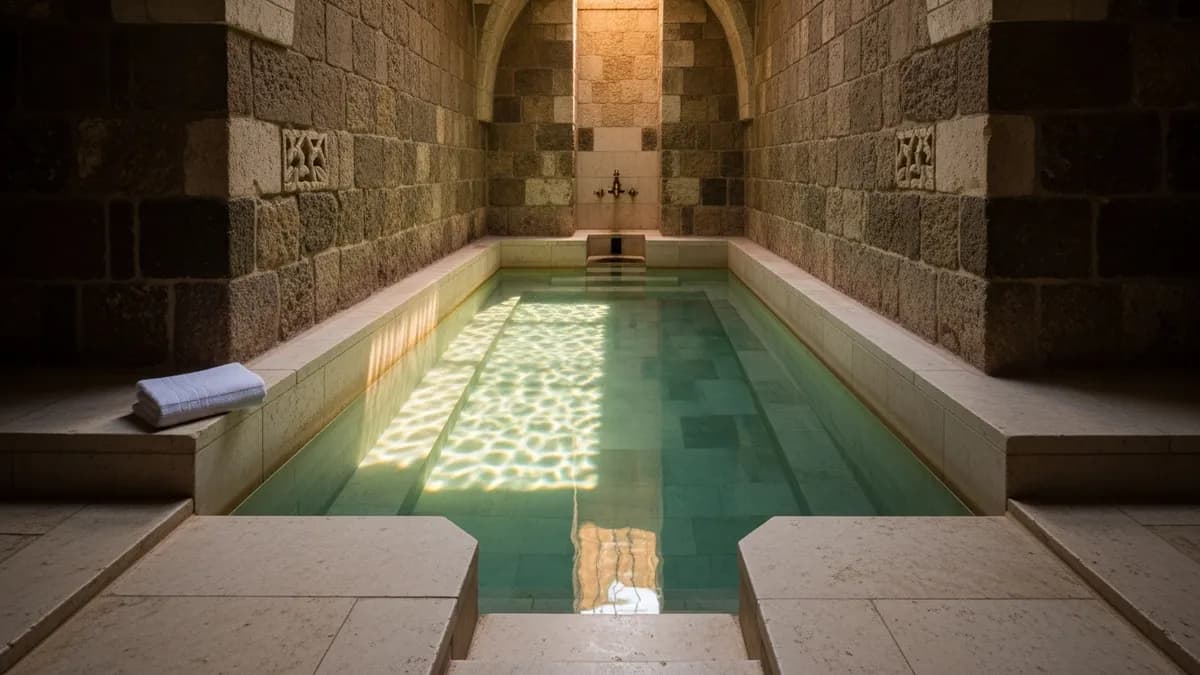
A mikveh is a ritual immersion pool used for spiritual purification. Learn who uses it, how it works, what it looks like inside, and why it matters.
Quick Answer
A mikveh is a pool of natural water (rainwater or spring-fed) used for ritual immersion. Married women immerse monthly after their menstrual cycle as part of family purity laws. Converts immerse as part of their conversion. Some men immerse before Shabbat or holidays. The mikveh is not about physical cleanliness — it is about spiritual transition.
The mikveh is probably the least understood institution in Orthodox Jewish life. Most non-Jews have never heard of it. Many secular Jews know the word but not what happens inside. And yet Jewish law holds that if a community must choose between building a synagogue and building a mikveh, the mikveh comes first.
What It Is
A mikveh (plural: mikvaot) is a pool of water used for ritual immersion. The water must meet specific requirements:
- It must contain natural water — rainwater, spring water, or melted ice/snow
- The pool must hold at least 40 se'ah (approximately 200 gallons / 750 liters)
- The water cannot be drawn through pipes in the conventional sense — it must flow naturally into the pool (there are halachic mechanisms for connecting municipal water to natural sources)
Modern mikvaot look nothing like what you might imagine. They are clean, private, well-maintained facilities that resemble a small spa. The immersion pool is typically tiled, heated to a comfortable temperature, and accessed through a private preparation room with a shower, bathtub, and grooming supplies.
Who Uses It
Married Women (Primary Use)
The most common use of the mikveh is by married women as part of the family purity laws (taharat hamishpacha). After the menstrual period and a count of seven clean days, a woman immerses in the mikveh. This immersion marks the transition from a state of niddah (separation) back to physical closeness with her husband.
The visit is private. Women go at night, by appointment. The mikveh attendant (balanit) watches to confirm the immersion is valid — that the woman is fully submerged (every part of the body must be under at once) and that no hair floats to the surface. It is done with great modesty and discretion, but observing the immersion is precisely her role.
Converts
Immersion in a mikveh is the final step of conversion to Judaism, for both men and women. It is witnessed by a beit din (rabbinical court of three) and marks the moment a person becomes Jewish.
Before Shabbat and Holidays
Many Orthodox men immerse in the mikveh on Friday afternoon before Shabbat, or before major holidays. This is a custom (minhag) rather than an obligation, but it is widespread in Hasidic communities.
New Dishes and Utensils
Metal and glass food vessels that were owned or made by a non-Jew are immersed in the mikveh before a Jew uses them for food. This is a separate requirement from kashering — it addresses the vessel's ritual status, not its cleanliness, so even brand-new dishes need immersion. (Practice on glassware and on exactly which vessels require immersion varies by community and posek.)
What Happens During a Visit
A woman's typical mikveh visit:
-
Preparation — thorough cleaning at home or in the mikveh's preparation room. This includes bathing, removing nail polish, brushing and combing hair to remove tangles, removing jewelry, contact lenses, and anything that creates a barrier between skin and water.
-
Immersion — she descends into the pool and submerges completely, including all hair. She recites a blessing and immerses again (customs vary on how many times — usually two or three).
-
The balanit confirms — the attendant says "kosher" when the immersion is complete.
-
She goes home. The entire visit takes 30-60 minutes.
Why It Matters
The mikveh is not about physical cleanliness — you shower before entering. It is about spiritual transition. Water in Jewish thought represents the primordial state — before creation, before separation, before identity. Immersion is a return to that state and an emergence as renewed.
For married couples, the monthly cycle of separation and reunion creates a rhythm that many describe as keeping the relationship fresh. The mikveh night — the night a woman returns from immersion — is treated as a mini-honeymoon in many families.
For converts, the moment of immersion is the most emotional moment of the entire process. You go under as one person and come up as another. Every convert I have spoken to describes it the same way: overwhelming.
Finding a Mikveh
Every Orthodox community has at least one mikveh. Many have several. They are typically not advertised with prominent signage — privacy is paramount. To find one, ask at a local Orthodox synagogue or search online for "[city name] mikveh."
Most mikvaot welcome visitors who want to understand what they are — but call ahead. The facility is used by appointment, and showing up unannounced is not appropriate.
I'm an Orthodox Jewish woman from Brooklyn. I can't speak for every Orthodox Jew — when I write outside my experience, I say so.
Family Purity Laws (Taharat Hamishpacha)
Can You Convert to Orthodox Judaism?
Orthodox Jewish Rules for Women: Modesty, Prayer, Daily Life
Why Do Orthodox Jewish Women Cover Their Hair?
Want to understand the whole picture?
The guided tour walks you through 8 topics — prayer fits into a larger rhythm of Orthodox life.
The Orthodox Insider
A new letter every Thursday, before Shabbos — plus an instant download of “10 Things Everyone Gets Wrong About Orthodox Jews” when you subscribe.
No spam, unsubscribe anytime.