What Is a Shtender? The Prayer Stand in Orthodox Life
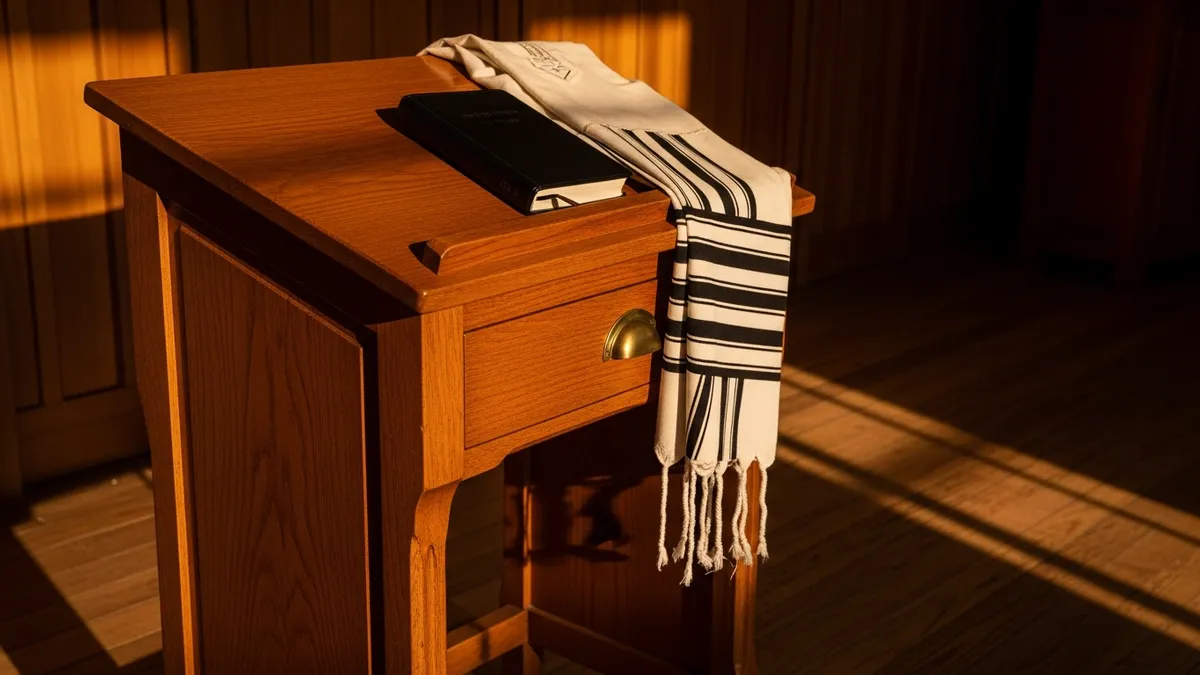
Learn what a shtender is, why it's used in Jewish prayer and Torah study, and its place in Orthodox Jewish life and yeshiva culture.
Quick Answer
A shtender is a wooden stand or lectern used for holding prayer books and Torah texts during davening (prayer) or learning. Common in synagogues and yeshivas, it lets you stand and pray or study at a comfortable height without holding heavy books.
If you have ever walked into a yeshiva or a traditional shul, you have seen rows and rows of shtenders. They are as much a part of the furniture as the benches themselves — simple wooden stands, usually tilted at an angle, where men place their siddurim, Gemaras, and sefarim while they daven or learn.
A shtender (Yiddish: שטענדער) literally means "stander" — something you stand at. Think of it as a Jewish lectern, though calling it that makes it sound fancier than it is. Most shtenders are pretty basic — a flat angled surface on a post, sometimes with a small shelf underneath for storing books. Some are adjustable. Some have seen better days. The ones in my husband's shul have been there since before we were born, and they look it.
Why Use a Shtender?
The practical reason is simple: when you are davening Shemoneh Esrei, the Amidah prayer, you stand for an extended period. Holding a heavy siddur in your hands the entire time is tiring and distracting. A shtender holds the siddur at eye level so you can focus on your tefillos.
For learning, a shtender is even more essential. A Gemara is a large, heavy book. If you are learning for hours — which is what yeshiva bochurim do — you need somewhere to put it. The angled surface of the shtender keeps the text at a readable angle without straining your neck. Many men also sway back and forth (shuckling) while learning, and the shtender gives them something to lean on or hold onto.
Shtenders in Different Settings
In a yeshiva, every student has his own shtender in the beis midrash (study hall). These are usually arranged in long rows facing each other so learning partners (chavrusas) can sit across from each other. The shtender becomes almost like a personal desk — guys leave their sefarim there, sometimes a coffee cup, maybe notes tucked into the shelf.
In a shul, shtenders are often built into the benches or placed in front of seats. Some shuls have freestanding shtenders near the walls for people who prefer to daven standing.
At home, some men have a personal shtender in their study or living room. My husband has one in our dining room where he learns at night after the kids are in bed. It is a simple wooden one, nothing special, but it is where he does his best thinking.
More Than Just Furniture
There is something about the shtender that represents a whole approach to Jewish life. It is built for standing — for being upright, engaged, actively present in your learning or davening. It is not a couch. It is not a recliner. It is a tool that says: this work matters, and I am going to stand here and do it properly.
My father-in-law has a shtender that belonged to his father. It is worn smooth from decades of hands resting on it, the wood darkened from use. He will not replace it. Some things carry more than books.
When people ask me what a shtender is, I tell them it is where Torah happens. It is where a boy becomes a man, where a man meets his Creator in prayer, where generations of learning have taken place. It is just a wooden stand — but it holds up a lot more than books.
I'm an Orthodox Jewish woman from Brooklyn. I can't speak for every Orthodox Jew — when I write outside my experience, I say so.
Want to understand the whole picture?
The guided tour walks you through 8 topics — prayer fits into a larger rhythm of Orthodox life.
The Orthodox Insider
A new letter every Thursday, before Shabbos — plus an instant download of “10 Things Everyone Gets Wrong About Orthodox Jews” when you subscribe.
No spam, unsubscribe anytime.