What Is an Orthodox Jewish Wedding Like? A Guest's Guide
Everything a non-Jewish guest needs to know before attending an Orthodox wedding: the ceremony, the dancing, the food, and the moments that surprise you.
Quick Answer
An Orthodox Jewish wedding has two main parts: the ceremony (chuppah — about 20 minutes under a canopy) and the reception (dancing, food, celebration — 3-5 hours). Men and women celebrate separately with a mechitza dividing the dance floor. The energy is electric — think a packed concert, not a quiet church ceremony. Expect to be on your feet.
You have been invited to an Orthodox Jewish wedding. You said yes. Now you are Googling "what to expect" at midnight because the invitation said 5:00 PM and you have no idea if that means dinner at 5 or something else entirely. Let me save you the panic.
An Orthodox wedding is unlike any wedding you have attended. It is louder, longer, more emotional, and more joyful than you expect. It is also more structured than it appears. Here is the whole thing, start to finish.
Before the Ceremony
What Time to Arrive
The invitation time is usually the start of the kabbalat panim — a pre-ceremony reception. The chuppah (actual ceremony) happens 30-60 minutes later. Arriving at the listed time is fine. Arriving 20 minutes late is also fine. This is not a 2:00 PM church wedding where the doors close.
What to Wear
Women: Dress or skirt below the knee, sleeves to the elbow, modest neckline. Think cocktail attire, not casual. Colors are welcome — this is a celebration, not a funeral. Avoid white or ivory (that is for the bride).
Men: Suit and tie. A kippah will be available at the entrance — take one and wear it all evening.
The Kabbalat Panim (Reception Before the Ceremony)
Men and women are in separate rooms:
The bride's room (women's side): The bride sits on a decorated chair like a queen receiving visitors. Guests approach, wish her mazel tov, take photos, and chat. Music plays. The energy is intimate and warm.
The groom's room (men's side): The groom sits at a table, often surrounded by singing men. A Torah discourse (dvar Torah) may be given. The ketubah (marriage contract) is signed by witnesses. This is more raucous than the bride's room — think communal singing, back-slapping, and shots of whiskey.
The Badeken (Veiling)
The groom walks from his room to the bride's room, surrounded by singing men. He places a veil over the bride's face. This is one of the most emotional moments of the evening — mothers cry, the bride cries, the groom's hands shake. The custom recalls the biblical story of Jacob, who was tricked into marrying the wrong sister because she was veiled. The groom verifies: this is the right woman.
The Ceremony (Chuppah)
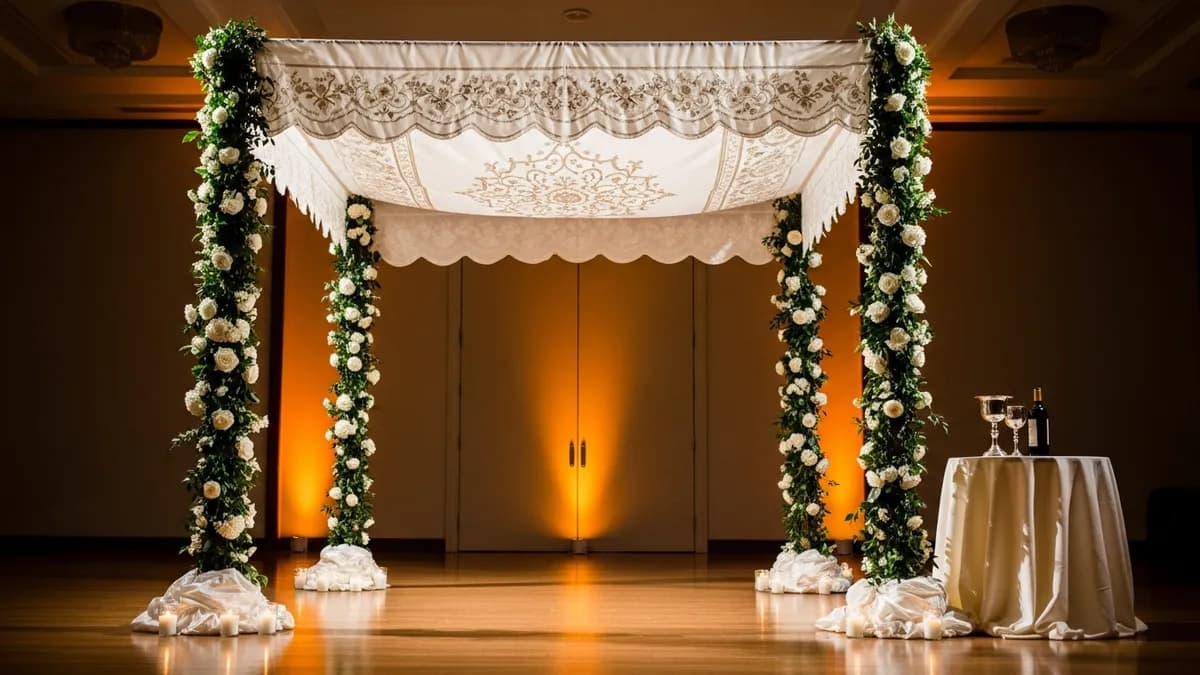
The ceremony takes place under a chuppah — a canopy held up by four poles, symbolizing the home the couple will build together. It is typically outdoors or in the main ballroom.
Duration: About 15-20 minutes.
What happens:
- The groom walks to the chuppah, escorted by both parents (not just the father)
- The bride walks to the chuppah, escorted by both parents, often to music
- The bride circles the groom seven times (in most traditions)
- Two blessings are said over a cup of wine — the groom and bride each drink
- The groom places a ring on the bride's right index finger and says: "You are consecrated to me with this ring according to the law of Moses and Israel"
- The ketubah is read aloud (in Aramaic — nobody understands it, including most of the guests)
- Seven blessings (sheva brachot) are chanted — by the rabbi and honored guests
- The groom smashes a glass under his foot — the crowd shouts "MAZEL TOV!" — and the celebration explodes
What You Do During the Chuppah
Stand when you arrive (if possible — some venues have chairs). Watch. Smile. You do not need to understand the Hebrew. The emotions are universal: two people starting a life together, surrounded by everyone who loves them. When the glass breaks, shout mazel tov with everyone else.
The Reception
The Yichud Room
Immediately after the chuppah, the couple goes to a private room (yichud) for about 10 minutes. This is their first moment alone as a married couple. They usually eat — they have been fasting all day (a tradition before the wedding).
Dinner and Dancing
Now the party begins. And it is a PARTY.
The dance floor is divided. A mechitza (partition) separates the men's side from the women's side. This is not optional and it is not negotiable. You dance on your side. If the setup seems strange, there is a real answer to why Orthodox Jews keep men and women on separate sides — it is about modesty and letting everyone dance freely, not about keeping anyone out.
The dancing is wild. Circles, lift-the-groom-on-a-chair, acrobatics, jump-rope-in-the-circle, human pyramids. The band plays at concert volume. The energy in the room is unlike anything at a typical American wedding. Think: mosh pit meets family reunion meets the best night of your life.
Women's side dancing: Equally energetic. Circles within circles, the bride in the center, coordinated group dances, scarves and props, singing. If you do not know the dances, jump in anyway — someone will grab your hand and pull you into the circle.
The food is enormous. Multiple courses served at your table between dance sets:
- Appetizer course (salads, dips, bread)
- Soup
- Main course (chicken, meat, fish — all kosher)
- Dessert
- Plus a smorgasbord or sushi station during the cocktail hour
The Mitzvah Tantz (Some Weddings)
In Hasidic weddings, there is a special dance near the end of the evening called the mitzvah tantz. Family members and honored rabbis dance before the bride while holding one end of a gartel (belt) — the bride holds the other end. The groom dances last. This is intimate, emotional, and not for casual guests to join.
Practical Tips
You will be there for 4-6 hours. Plan accordingly.
Nobody will explain things in real time. If you want to understand what is happening, read this guide beforehand. During the event, just experience it.
Do not bring a gift to the venue. Mail a check or gift to the couple's home before or after the wedding. Handling money at the event is awkward — and for the record, the wedding itself will not fall on Shabbat or a major holiday, since weddings are not held on those days.
If you are a woman, do not approach the men's dance circle. If you are a man, do not approach the women's side. This is not the time to test boundaries.
Photos: Check with the hosts. Some Orthodox weddings have a photographer but discourage guest photography. If it is on a night that borders Shabbat or a holiday, photography may be restricted after a certain time.
Leaving early is fine. The core event is the chuppah and the first round of dancing. If you need to leave after two hours, you have been to the wedding. Nobody will be offended.
One Last Thing
An Orthodox wedding is the most joyful event in Jewish life. The Talmud says that making the bride and groom happy is one of the greatest mitzvot. Everything about the evening — the music, the dancing, the food, the crazy energy — exists to create joy.
You are part of that joy just by being there. You do not need to understand every blessing. You do not need to know the dances. You just need to show up, celebrate, and tell the couple they look beautiful.
Mazel tov.
I'm an Orthodox Jewish woman from Brooklyn. I can't speak for every Orthodox Jew — when I write outside my experience, I say so.
Jewish Wedding Traditions: A Guide to the Orthodox Ceremony
What Is a Chuppah? The Jewish Wedding Canopy Explained
What Is a Ketubah? The Jewish Marriage Contract Explained
What to Wear to an Orthodox Jewish Wedding or Event
Attending one of these in real life?
Weddings, bar mitzvahs, and other Jewish life events often include non-Jewish guests. If you want practical guest etiquette, ask.
The Orthodox Insider
A new letter every Thursday, before Shabbos — plus an instant download of “10 Things Everyone Gets Wrong About Orthodox Jews” when you subscribe.
No spam, unsubscribe anytime.