What Is an Upsherin? The First Haircut Ceremony at Age Three
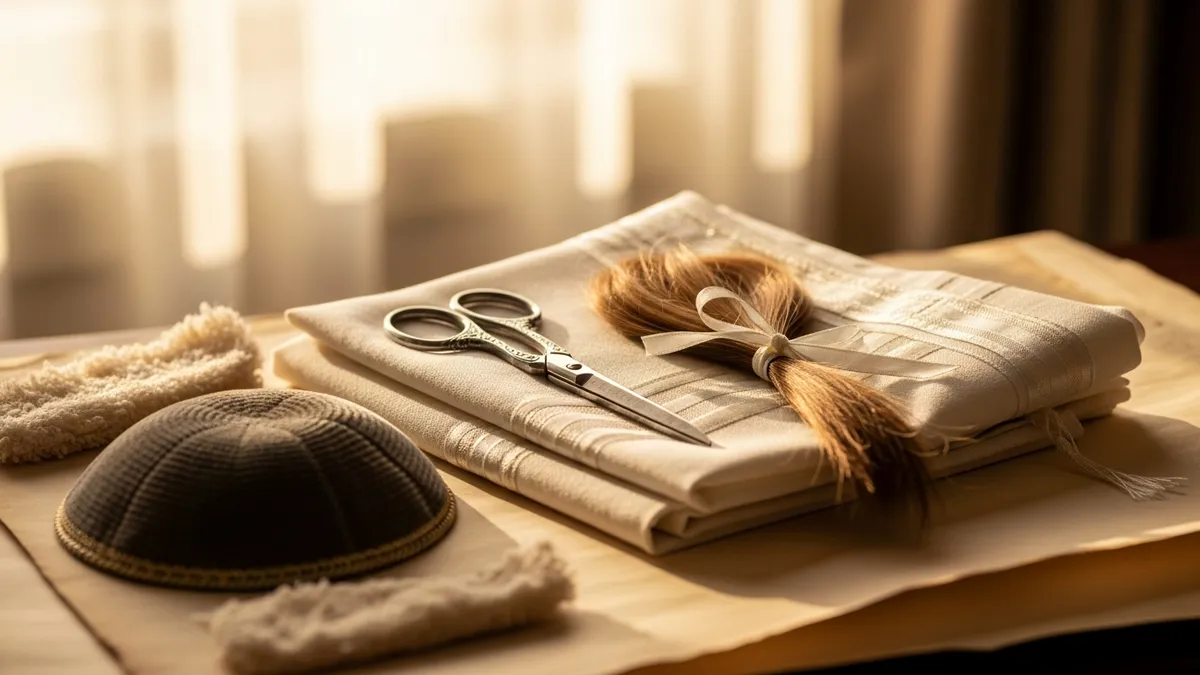
An upsherin is a Jewish boy's first haircut, given at age three. Learn its origins, customs, and spiritual meaning in Orthodox Jewish life.
Quick Answer
An upsherin (Yiddish for 'shearing off') is a Jewish boy's first haircut, traditionally given at age three. Family and friends each snip a lock of hair in a joyful celebration marking the child's entry into formal Torah education. The peyos (sidelocks) are left uncut.
An upsherin is a Jewish boy's first haircut, traditionally celebrated at age three. Family and friends each snip a small lock of hair at a joyful gathering, marking the child's entry into formal Torah education. The peyos (sidelocks) are left uncut, and it is one of the most meaningful early milestones in Orthodox family life.
When my oldest son turned three, he had the most beautiful curls you have ever seen. Long, golden, cascading ringlets that strangers would stop me on the street to compliment. And then we cut them off. Well, most of them. Welcome to the upsherin.
An upsherin (Yiddish: אפשערן, also spelled upshernish) literally means "to shear off." It is the celebration of a Jewish boy's first haircut, traditionally held on or around his third birthday. Until that point, many families in the Orthodox and especially Chassidic world do not cut a boy's hair at all. Then, at three, there is a celebration — and the haircut becomes a milestone as significant in its own way as many other life events.
Why Age Three?
The custom is rooted in a beautiful concept. The Torah compares a person to a tree, and there is a mitzvah called orlah that prohibits eating the fruit of a tree for its first three years. Just as we wait three years before "harvesting" from a tree, we wait three years before "cutting" from a child. At three, the child is considered ready to begin his chinuch — his formal Jewish education.
On the day of the upsherin, the boy typically begins wearing a kippah (yarmulke) and tzitzis (fringed garment) for the first time. He starts learning the aleph-beis — the Hebrew alphabet. It is the beginning of his life as a conscious participant in Torah and mitzvos.
What Happens at an Upsherin?
The celebration varies from family to family, but the basic structure is similar. Family and friends gather — sometimes at home, sometimes at a hall, sometimes at a holy site. In Israel, many families hold the upsherin at the kever (grave) of Rabbi Shimon bar Yochai in Meron, especially on Lag B'Omer.
The honor of the first snip usually goes to the grandfather, the family's rabbi, or another respected person. Then other guests each take a turn snipping a small lock of hair. The atmosphere is festive — there is music, food, and a lot of joy. Some families have the child point to Hebrew letters dipped in honey and lick the honey off, symbolizing the sweetness of Torah learning.
The peyos — the sidelocks — are carefully left uncut, in accordance with the Torah's commandment not to round the corners of one's head. For many boys, this is the first time their peyos become distinct, since up until now all their hair was the same length.
The Emotional Side
I will be honest with you — the upsherin is emotional. For three years you have watched your baby grow, and his hair has been part of his identity as a little one. Cutting it feels like a passage. He walks in looking like a toddler with flowing curls. He walks out looking like a little boy with a kippah, tzitzis, and peyos. Something shifts.
My son cried during his upsherin. Not because of the haircut, but because there were too many people and he wanted his blanket. That is pretty standard. Three-year-olds are not always cooperative participants in their own milestone celebrations. We had candy ready. It helped.
Not Just Chassidic
While the upsherin is most strongly associated with Chassidic communities, it has been embraced across many segments of the Orthodox world — Sephardic families (who often call it a chalake), Litvish families, and Modern Orthodox families. The specific customs vary, but the core idea is the same: at three years old, a Jewish boy takes his first steps into a life of Torah and mitzvos, and we celebrate that beginning with joy.
Some families collect the cut hair and save it. Some weigh it and donate the equivalent weight in gold or silver to tzedakah. My mother kept a lock from each of her sons' upsherins in a little envelope. She still has them, decades later. Some things you do not throw away.
I'm an Orthodox Jewish woman from Brooklyn. I can't speak for every Orthodox Jew — when I write outside my experience, I say so.
Jew Curls (Peyot): Meaning and Why Orthodox Jews Wear Them
Bar & Bat Mitzvah: Meaning, Customs & What to Expect
Jewish Wedding Traditions: A Guide to the Orthodox Ceremony
My Arranged Marriage: A Hasidic Jew's Experience
Attending one of these in real life?
Weddings, bar mitzvahs, and other Jewish life events often include non-Jewish guests. If you want practical guest etiquette, ask.
The Orthodox Insider
A new letter every Thursday, before Shabbos — plus an instant download of “10 Things Everyone Gets Wrong About Orthodox Jews” when you subscribe.
No spam, unsubscribe anytime.