What Is Challah? The Braided Bread of Shabbat
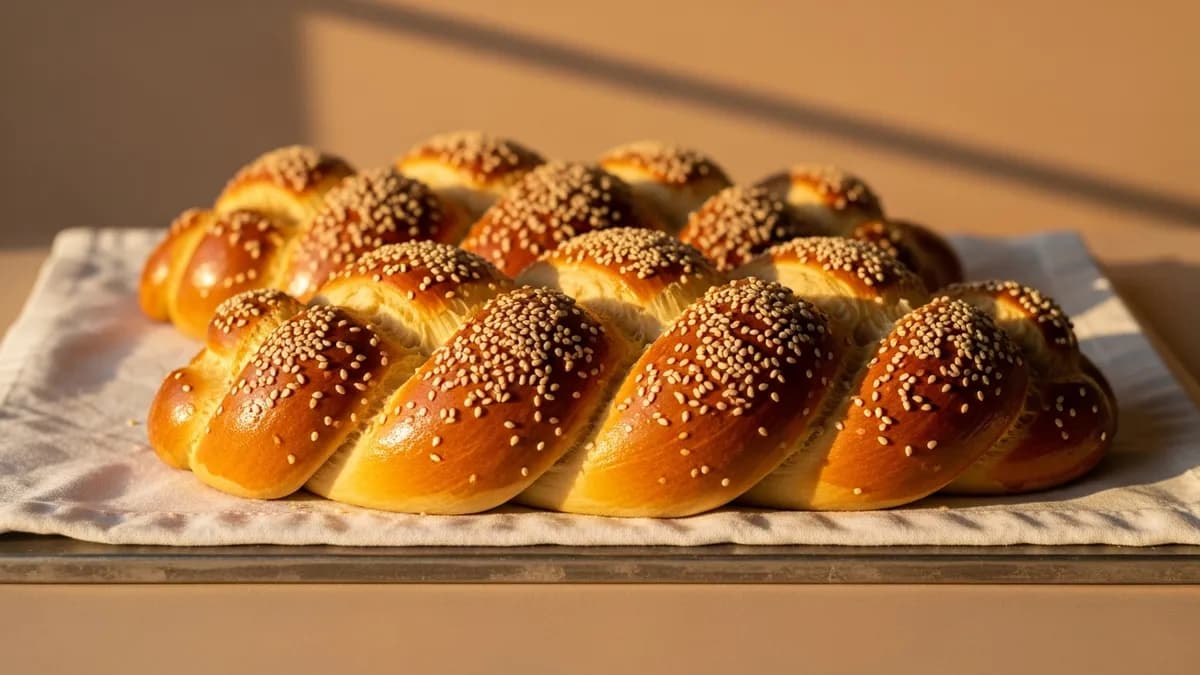
Learn what challah is, why it's braided, when it's eaten, and the special mitzvah of separating challah dough in Jewish tradition.
Quick Answer
Challah is a braided egg bread eaten on Shabbat and Jewish holidays. The braided loaves symbolize unity and are central to Shabbat meals — two loaves represent the double portion of manna that fell on Fridays in the desert. 'Challah' also refers to the mitzvah of separating a portion of dough.
What Is Challah?
If you've never had freshly baked challah, you're missing one of the great food experiences. Golden, slightly sweet, soft and pillowy, with that gorgeous braided shape — challah is the bread that marks the Jewish week, turning every Shabbat table into something special.
The direct answer: challah is an enriched egg bread, typically braided, that is eaten on Shabbat and Jewish holidays. Two loaves (lechem mishneh) are placed on the Shabbat table, representing the double portion of manna that G-d provided on Fridays during the Israelites' forty years in the desert. The word "challah" also refers to the biblical commandment to separate a portion of dough as an offering.
The Shabbat Connection
Every Shabbat meal begins with a blessing over bread — specifically, over two whole loaves. This lechem mishneh (double bread) commemorates the manna. In the desert, a double portion fell on Friday so the Israelites wouldn't need to gather on Shabbat.
The ritual is beautiful in its simplicity:
- Two challahs are placed on the table, usually covered with a special cloth
- After Kiddush (the blessing over wine), everyone washes hands and says a blessing
- The person leading the meal uncovers the challahs, recites hamotzi (the blessing over bread), and cuts or tears pieces for everyone
That first bite of challah after Kiddush is one of the most satisfying moments of the week. Warm from the oven, slightly sweet, maybe sprinkled with sesame or poppy seeds — it sets the tone for the entire meal.
The Mitzvah of Separating Challah
The word "challah" actually refers to a biblical commandment (Numbers 15:20): when baking bread, a portion of dough must be separated and set aside. In Temple times, this portion was given to the Kohanim (priests). Today, since we can't give it to the priests (the Temple hasn't been rebuilt), the separated piece is burned.
How it works:
- When making a batch of dough with at least approximately five pounds of flour, a small piece is separated
- A blessing is recited: "Blessed are You... who commanded us to separate challah"
- The separated piece is wrapped in foil and burned (usually in the oven)
This mitzvah is especially meaningful to Jewish women and is considered one of the three mitzvos specifically associated with women (along with Shabbat candle lighting and family purity). Many women use the moment of separating challah as a time for personal prayer — the spiritual intensity of that moment is powerful.
How Challah Is Made
Traditional challah is a rich, egg-based bread:
Basic ingredients:
- Flour
- Eggs (often several)
- Sugar or honey
- Yeast
- Oil
- Water
- Salt
The dough is kneaded, allowed to rise, then divided into strands that are braided. The most common braid is a three-strand, but six-strand and even more elaborate braids are popular. Before baking, the challah is brushed with egg wash for that characteristic golden shine.
Variations include:
- Raisin challah: Popular for Rosh Hashanah and other special occasions
- Round challah: Baked for Rosh Hashanah, symbolizing the cycle of the year
- Whole wheat challah: A healthier take
- Water challah: Made without eggs — lighter and less rich, which some prefer for the meat meals of Shabbat (egg challah is pareve too, so it may also be eaten with meat)
- Stuffed challah: Filled with chocolate, cinnamon, or other sweet fillings (a modern favorite)
The Challah-Baking Tradition
In many Orthodox homes, challah baking is a Friday ritual. Women (and sometimes men and children) spend part of Thursday night or Friday morning mixing, kneading, braiding, and baking.
The scent of fresh challah baking is, for many Orthodox Jews, the smell of home. It's the smell of Shabbat approaching, of preparation and anticipation. My kids can tell it's Friday based solely on what the kitchen smells like.
Some women bake enough challah for the week — leftover challah makes excellent French toast (the Sunday morning after Shabbat is prime French toast time in our house). Others bake just enough for the two meals.
Community challah bakes have also become popular — women gather, bake together, and use the time for prayer and social connection. These events combine the mitzvah of separating challah with community building, and they've become meaningful communal experiences.
Beyond Shabbat
Challah appears at other occasions too:
- Holiday meals: All major Jewish holidays use lechem mishneh (on Pesach the two loaves are matzah rather than challah, since leavened bread is forbidden — but the principle is the same)
- Weddings: Challah is served at wedding meals
- Shalom zachar: A Friday night celebration for a newborn boy includes challah
- Any festive meal: When a meal is elevated to a religious occasion, challah is appropriate
A Simple Joy
There's something profoundly grounding about bread. In a world of complicated food trends and exotic cuisines, challah is simple — flour, eggs, yeast, and hands. The same recipe that Jewish women have been baking for generations still fills homes with warmth every Friday.
When I pull my challahs out of the oven and set them on the table, I'm doing what my mother did, and her mother before her. The braids might not be as neat as my grandmother's, but the meaning is the same. Shabbat is coming. The bread is ready. The table is set. The week can stop now.
Want to learn more? Read about Shabbat observance or explore what kosher means.
I'm an Orthodox Jewish woman from Brooklyn. I can't speak for every Orthodox Jew — when I write outside my experience, I say so.
Shabbat — The Jewish Day of Rest Explained
What is Kosher? The Complete Guide to Jewish Dietary Laws
Kosher Laws — A Complete Guide to the Rules of Kashrut
Kosher Catering: Everything You Need to Know
Want to keep reading about kosher?
The full site covers kosher laws, symbols, and specific foods. Or if you're a professional working with Orthodox Jewish clients on food — there's a specific guide for that.
The Orthodox Insider
A new letter every Thursday, before Shabbos — plus an instant download of “10 Things Everyone Gets Wrong About Orthodox Jews” when you subscribe.
No spam, unsubscribe anytime.