What Is Cholent? The Legendary Shabbat Stew
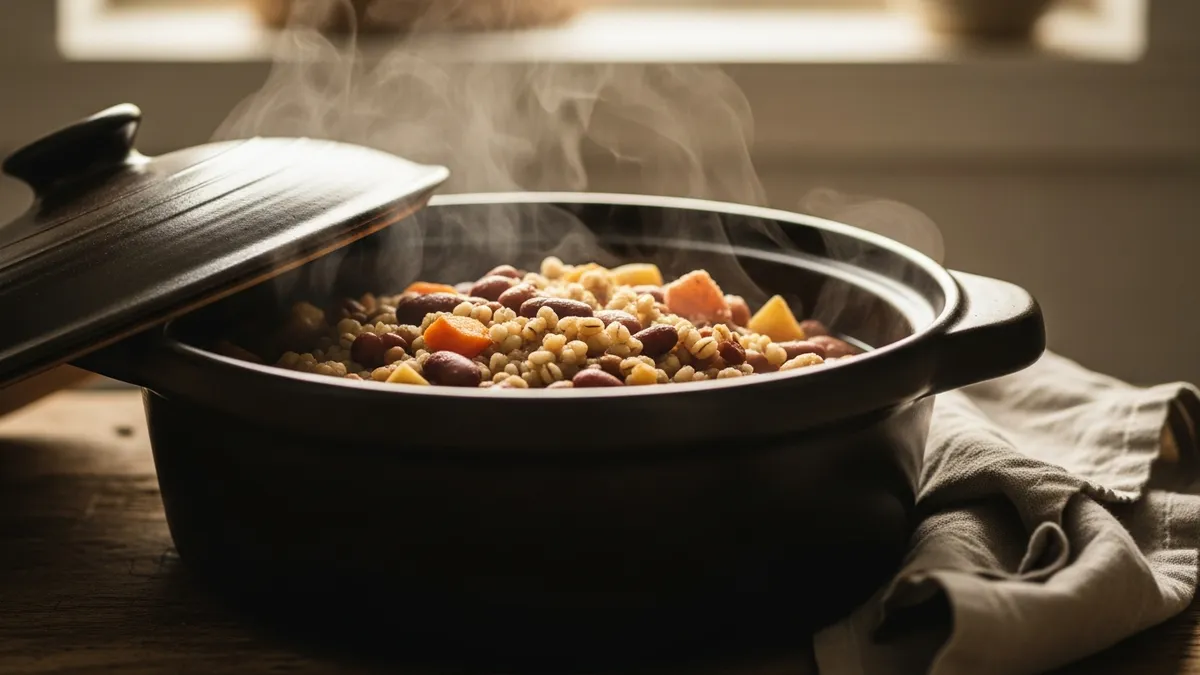
Cholent is the traditional Jewish Shabbat stew that slow-cooks overnight. Its history, ingredients, and why every family's recipe differs.
Quick Answer
Cholent is a hearty stew that slow-cooks overnight from Friday afternoon until Shabbat lunch. Since cooking on Shabbat is prohibited, cholent is prepared before sundown and left on a covered flame or hot plate. Traditional ingredients include meat, potatoes, beans, barley, and onions.
Cholent is a slow-cooked Jewish stew — typically meat, potatoes, beans, barley, and onions — that simmers overnight from Friday afternoon until Shabbat lunch the next day. Because cooking on Shabbat is prohibited, cholent is prepared before sundown and left on a covered flame or hot plate, arriving at the table after eighteen-plus hours of cooking, deeply savory and unmistakably Shabbos.
I'm going to tell you about cholent, but I need you to understand something first: you cannot read about cholent. You have to smell it. You have to walk into your house on a Saturday morning after it's been cooking since four o'clock Friday afternoon — eighteen hours in that pot — and get hit with this wall of warm, meaty, beany, slightly sweet, deeply savory aroma that has soaked into the walls and the curtains and possibly your soul. That's cholent. Everything else is just words on a page.
But I'll try anyway.
The Saturday Morning Smell
Every Shabbat morning in my house starts the same way. I wake up, and before I even open my eyes, I smell it. The cholent has been sitting on the blech — that's the metal sheet we lay over the stove burners so the flame stays covered, since we can't turn a stove on or off on Shabbat — all night long, doing its thing. Low heat. No rush. Just eighteen hours of slow, patient magic.
My kids come stumbling out of their rooms, still in pajamas, and the first thing out of my seven-year-old's mouth every single Shabbat: "Is the cholent ready?" It's been ready for hours, buddy. It was ready at 3 AM. But we're waiting until after shul.
The anticipation is half the experience. You sit through davening knowing that cholent is waiting for you at home. My husband says this is the true test of kavannah — trying to concentrate on your prayers when you can still smell the cholent in your nostrils from the morning.
What Actually Goes in the Pot
My cholent — and I want to be clear, this is MY cholent, not THE cholent, because every family will fight you on this — starts with a fatty cut of meat. Flanken or short ribs. You need the fat. Without it, after eighteen hours you end up with shoe leather. The fat melts into everything and keeps the whole pot moist and rich.
Then potatoes. Big chunks, not small ones, because they need to hold up to the long cook. After eighteen hours, they get this golden, almost caramelized exterior while staying creamy inside. If your potatoes disintegrate, your pieces were too small. I learned this the hard way my first year of marriage when I served what was essentially beef-flavored potato soup.
Kidney beans. Barley — pearl barley that swells up and absorbs every flavor in the pot until each little grain is basically a tiny flavor bomb. Onions, quartered. A lot of garlic. Paprika. Salt. Pepper. And — I'm just going to say it — a squirt of ketchup. Maybe two squirts. For sweetness and color. My mother-in-law uses honey instead, and she gives me a look every time I mention the ketchup, but my cholent is delicious and I refuse to apologize.
I also put a whole kishke on top. That's stuffed derma — a casing filled with flour, oil, onions, and spices. It sits on top of everything and steams for eighteen hours and becomes this crispy-on-top, soft-in-the-middle thing that my children will physically fight over. Last Shabbat my son tried to claim the entire kishke as his own and his sister nearly flipped the table. We're a civilized family, I promise. Except when kishke is involved.
The Eternal Debate: My Cholent vs. Hers
When I got married, I made my mother's cholent. Naturally. It's the cholent I grew up with. Thick, hearty, peppery, the kind that sticks to your ribs and puts you into a three-hour Shabbat nap.
My mother-in-law's cholent is completely different. Hers is sweeter — she adds honey and sweet potatoes — and it's soupier, more of a stew with broth you can actually ladle. When my husband tasted my cholent for the first time after we got married, he didn't say anything bad. He just got very quiet. Then he called his mother.
We've reached a compromise over the years. I make my cholent my way, and roughly twice a year we eat at his parents' house and he gets hers. He still claims hers is better. I have learned to live with this. It is not a dealbreaker, but it is noted.
The truth is, there is no single right way to make cholent. Some people make it thick enough to stand a spoon in. Some make it soupy. Some add sweet potatoes. Some people — and I am not naming names because they know who they are — put cola in their cholent. As in Coca-Cola. In the cholent. Apparently the sugar caramelizes and does something magical. I tried it once. I will not be trying it again. But I respect the audacity.
The Kiddush Cholent Wars
You want to see grown men lose their dignity? Go to a shul kiddush where cholent is being served.
After Shabbat morning davening, many synagogues host a kiddush — basically a communal spread of food. When cholent is on that spread, something happens to otherwise refined, well-mannered men. They start migrating toward the cholent pot before kiddush is even finished. They position themselves strategically. When the rabbi finally finishes, there is a swift, purposeful movement toward that pot that can only be described as a controlled stampede.
My husband once came home from shul kiddush with a cholent stain on his white shirt and a look of deep satisfaction on his face. "Got the last kishke," he said, as if he had conquered a small nation. These are people with advanced degrees, I want you to know. Doctors. Lawyers. Accountants. All reduced to competitive eaters by a pot of stew.
Around the Jewish World
Ashkenazi cholent is what I've been describing — the meat, potatoes, beans, barley version. Cholent is just one beloved corner of the broader world of Jewish cuisine, but it may be the most beloved. The concept of overnight Shabbat stew exists across the entire Jewish world, because every Jewish community has the same halachic question: how do we have hot food on Shabbat without cooking?
Sephardic Jews make something called chamin, or in Moroccan communities, dafina. I had Moroccan dafina at my friend Mazal's house and my life was changed. She uses chickpeas instead of kidney beans, adds whole eggs that cook in their shells overnight and turn golden brown (they're called huevos haminados — "browned eggs"), puts in dates for sweetness, and seasons with cumin and turmeric instead of paprika. Completely different flavor profile, same genius concept.
My Iraqi neighbor makes a version with chicken and rice that comes out almost like a savory pudding. Hungarian cholent is famous for being sweet — lots of honey, sometimes even sugar — which sounds wrong to my Eastern European palate but is actually incredible. I had it at a wedding once and went back for thirds.
Every version tells you something about where that family's ancestors lived, what spices were available, what was affordable. Cholent is edible history.
The Shidduch Question
I should mention — and I'm not joking about this — cholent has come up in shidduch conversations. When people are dating in the Orthodox world and trying to figure out compatibility, food culture is a real factor. "What kind of cholent does your family make?" is a legitimate question that has been asked on dates. It tells you about the family's background, their minhagim (customs), their level of... let's say culinary ambition.
When I was dating my husband, his mother asked my mother what kind of cholent I make. This was considered relevant information. I didn't even have a cholent recipe yet — I was twenty years old. But the question was asked and apparently my mother's answer was satisfactory, because here we are.
Why Cholent Matters
Cholent is not just food. It's the rhythm of Shabbat. It's the smell that means "today is different from every other day." It's my kids running to the kitchen after shul. It's my husband and me standing over the pot on Friday afternoon, tasting and adjusting, adding a little more paprika, arguing about whether it needs more water. It's sitting around the table on Shabbat afternoon, everyone full and warm, talking and singing and not in a rush to be anywhere.
It's a solution to a halachic problem that turned into something beautiful. Jews needed hot food on Shabbat. We couldn't cook. So we invented a dish that requires eighteen hours of cooking — which is, if you think about it, the most Jewish possible response. Give us a restriction and we'll turn it into something so good that people elbow each other to get to it.
If you ever get the chance to try cholent, say yes. And if someone offers you the kishke, take it fast. Before my son gets there.
I'm an Orthodox Jewish woman from Brooklyn. I can't speak for every Orthodox Jew — when I write outside my experience, I say so.
Shabbat — The Jewish Day of Rest Explained
The Complete Shabbat Food Guide: Friday Night to Saturday
What is Kosher? The Complete Guide to Jewish Dietary Laws
Kosher Catering: Everything You Need to Know
Want to keep reading about kosher?
The full site covers kosher laws, symbols, and specific foods. Or if you're a professional working with Orthodox Jewish clients on food — there's a specific guide for that.
The Orthodox Insider
A new letter every Thursday, before Shabbos — plus an instant download of “10 Things Everyone Gets Wrong About Orthodox Jews” when you subscribe.
No spam, unsubscribe anytime.