What Is Matzah? History, Meaning, and How It Is Made
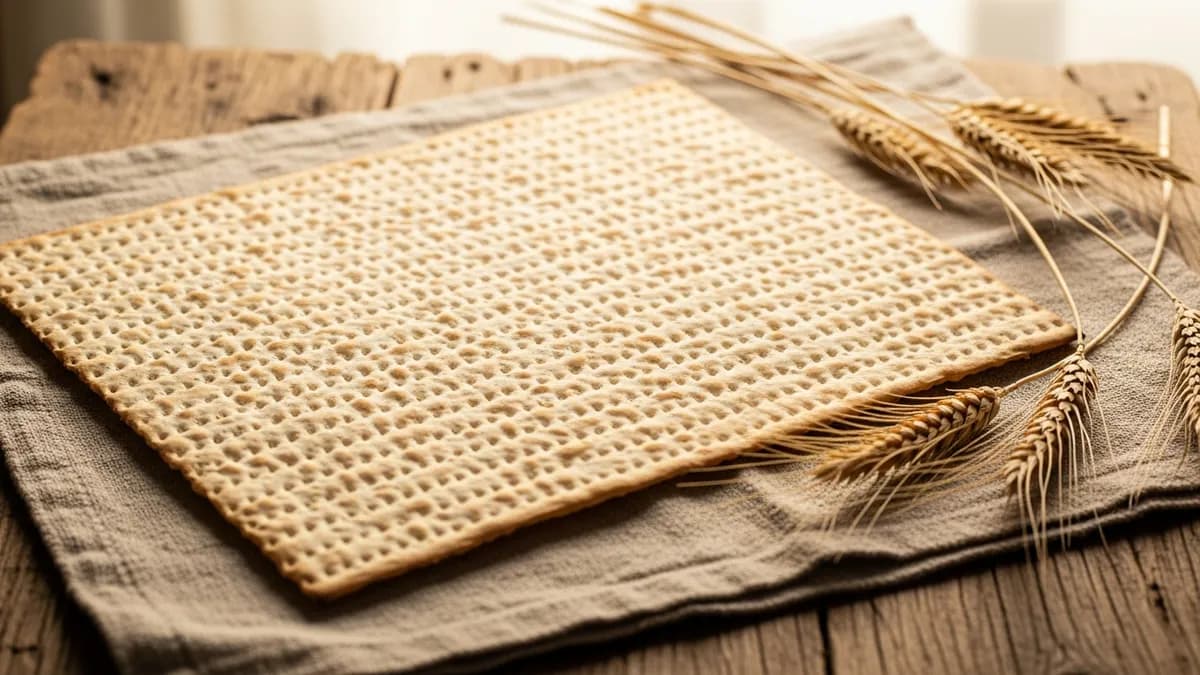
Matzah is the unleavened bread eaten during Passover. Learn how it's made, why Jews eat it, the strict 18-minute rule, and what it symbolizes.
Quick Answer
Matzah is flat, unleavened bread made from flour and water that must be mixed, kneaded, and baked in under 18 minutes to prevent rising. Jews eat matzah during the eight days of Passover to remember the Exodus from Egypt, when the Israelites left in such haste that their bread had no time to rise.
Every year, about a week before Pesach, my kids start complaining preemptively. "Not matzah again." "Matzah makes me thirsty." "Can we have bread just this one year?" And every year, I give them the same answer: no. We eat matzah because our ancestors did not have time for their bread to rise when they left Egypt. If they could walk through a desert on matzah, you can make it through a week in Brooklyn.
Matzah (Hebrew: מצה) is unleavened bread — flat, crispy, and made from just flour and water. It is the food most associated with Passover (Pesach), the holiday commemorating the Jewish people's exodus from slavery in Egypt. For eight days (seven in Israel), matzah replaces all bread and leavened products in a Jewish home.
The 18-Minute Rule
Here is what makes matzah unique: from the moment water touches flour, the entire process — mixing, kneading, rolling, and baking — must be completed in under 18 minutes. After 18 minutes, the dough is considered chametz (leavened) and is unfit for Passover use. This strict time limit ensures that the dough never has a chance to rise.
In matzah bakeries, this is serious business. Workers move with practiced speed. The flour is measured, the water (which has been left to cool overnight, called mayim shelanu) is added, and the clock starts. Teams roll the dough paper-thin, perforate it with lines of tiny holes (to prevent air bubbles from forming), and slide it into extremely hot ovens. The whole operation is timed, supervised, and efficient. There is no room for error.
Types of Matzah
Machine matzah — The majority of matzah sold today is made by machine. It is uniform, square or round, and produces the familiar large thin crackers that most people picture when they think of matzah. It is perfectly kosher for Pesach.
Hand matzah (shmura matzah) — Shmura means "watched" or "guarded." This matzah is made from wheat watched against contact with water — at minimum from the time of milling, and in the most stringent matzah from the moment of harvest — to ensure it never began to leaven. Shmura matzah is typically round, thicker, and more rustic-looking. Many families use shmura matzah specifically for the seder nights.
In Chassidic communities, shmura matzah is standard for the entire holiday. The baking is often done communally, with men participating in the process as a mitzvah. My father-in-law goes to the matzah bakery every year before Pesach and helps bake. He comes home covered in flour and absolutely glowing.
Eating Matzah at the Seder
On the first night of Pesach, eating matzah is a positive Torah commandment (outside of Israel there is a second seder the next night, where eating matzah is a rabbinic obligation). At the seder, matzah plays a central role:
- Three matzos are placed on the seder plate, representing the three groups of Jews — Kohen, Levi, and Yisrael
- The middle matzah is broken in half — the larger piece becomes the afikoman, which is eaten at the end of the meal
- During the seder, specific amounts of matzah must be eaten at designated times
- The matzah is referred to as both "lechem oni" (bread of affliction) and the bread of freedom — because the same humble food represents both slavery and redemption
The Deeper Meaning
Matzah is sometimes called the bread of humility. It is flat, simple, unadorned. No yeast to make it puff up, no rising to make it impressive. Chametz — leavened bread — represents ego, inflation, the parts of ourselves that expand beyond what is real. Matzah is the stripped-down truth. Just flour and water. Just you and Hashem.
There is a teaching that the difference between matzah (מצה) and chametz (חמץ) is a tiny gap in one Hebrew letter — the difference between a Hey (ה) and a Ches (ח). The lesson: the distance between spiritual freedom and spiritual slavery is very small. It does not take much for humility to become arrogance, or for truth to become pretense.
Living With Matzah
By day five of Pesach, honestly, everyone is a little tired of matzah. The crumbs get everywhere. Your stomach stages a quiet protest. You dream about bread. But that mild discomfort is part of the experience. For one week a year, we eat the way our ancestors ate when they left Egypt. We feel, in our bodies, the reality of what it means to leave in a hurry, to trust in Hashem so completely that you do not even wait for your bread to rise. That is not just a story. With matzah on the table, it is dinner.
I'm an Orthodox Jewish woman from Brooklyn. I can't speak for every Orthodox Jew — when I write outside my experience, I say so.
Passover (Pesach): The Complete Guide
What is Kosher? The Complete Guide to Jewish Dietary Laws
Kosher Laws — A Complete Guide to the Rules of Kashrut
Kosher Catering: Everything You Need to Know
Want to keep reading about kosher?
The full site covers kosher laws, symbols, and specific foods. Or if you're a professional working with Orthodox Jewish clients on food — there's a specific guide for that.
The Orthodox Insider
A new letter every Thursday, before Shabbos — plus an instant download of “10 Things Everyone Gets Wrong About Orthodox Jews” when you subscribe.
No spam, unsubscribe anytime.