What Is That Box on Their Forehead? (Tefillin Explained)
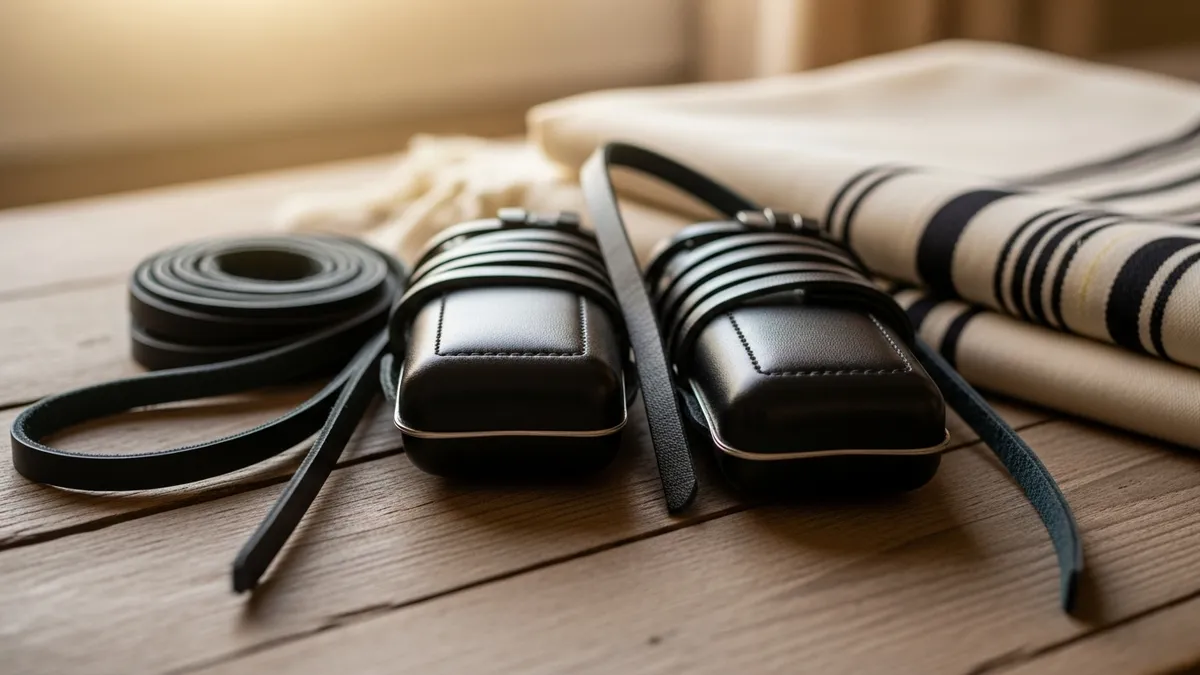
Seen an Orthodox Jewish man with black boxes strapped to his head and arm? Here's what tefillin are, what's inside, and why he wears them.
Quick Answer
The black boxes are called tefillin (also known as phylacteries). They contain tiny handwritten Torah scrolls with four passages about loving G-d and remembering the Exodus. One box is strapped to the head, one to the upper arm facing the heart. They are worn during weekday morning prayers by Jewish men aged 13 and older.
You are on a morning flight. The man in 14C stands up, opens a small velvet bag, and begins strapping black leather boxes to his arm and head. He wraps a thin leather strap around his arm seven times, settles a box on the crown of his head above his hairline, and starts quietly reading from a small book while swaying gently.
You have just seen someone put on tefillin.
What They Are
Tefillin (teh-FILL-in) are two small black leather boxes, each attached to long leather straps:
- Shel rosh — worn on top of the head, above the hairline, centered over the point between the eyes (not down on the forehead). The Torah says "between your eyes," and tradition understands this as the spot above the hairline, not literally on the brow.
- Shel yad — worn on the upper left arm (right arm for lefties), with the strap wound seven times down the forearm and then wrapped around the hand and fingers
Each box contains four passages from the Torah, handwritten on parchment by a sofer (scribe) using a quill and special ink.
What Is Inside
The four passages are:
- Exodus 13:1-10 — Remember the Exodus from Egypt
- Exodus 13:11-16 — Consecrate every firstborn to G-d
- Deuteronomy 6:4-9 — "Hear, O Israel, the Lord is our G-d, the Lord is One" (the Shema)
- Deuteronomy 11:13-21 — Love G-d with all your heart, teach these words to your children
In the arm box, all four passages are written on a single parchment. In the head box, each passage is on a separate parchment in its own compartment. The scrolls are tiny — the boxes are only about 1.5 inches square.
Why They Wear Them
The Torah commands it directly: "You shall bind them as a sign on your hand, and they shall be as frontlets between your eyes" (Deuteronomy 6:8). The placement is specific, though "between your eyes" is understood through tradition rather than read literally:
- On the arm, facing the heart — to direct emotions and actions toward G-d
- On the head, above the hairline (centered over the point between the eyes) — to direct thoughts and intellect toward G-d
The straps are wound around the hand and fingers in a pattern that traditionally spells out a Name of G-d (Sha-dai), though the exact winding varies by custom. The head box itself is embossed with the Hebrew letter shin (ש) on both sides — the iconic letter most people notice. The entire apparatus turns the body into a living expression of devotion.
When They Are Worn
- Weekday mornings only — Sunday through Friday during the morning prayer service (Shacharit)
- Not on Shabbat or holidays — tefillin are called an "ot" (sign) of the covenant, and Shabbat is already an ot. Wearing a sign on top of a sign is unnecessary.
- Duration: 20-45 minutes (the length of morning prayers)
Who Wears Them
- Jewish men from age 13 (after bar mitzvah)
- A small number of women in certain liberal Modern Orthodox circles have taken it on, though this remains a minority and contested practice — many Modern Orthodox authorities discourage it, and it is not done in Hasidic or Yeshivish communities
- Boys often begin practicing a few weeks before their bar mitzvah
What You Need to Know
If you see someone putting on tefillin on a plane, train, or in a park:
- They are praying. This takes about 20-30 minutes.
- Do not interrupt them.
- Do not stare, photograph, or ask questions while they are in the middle of it.
- After they are done, they are usually happy to explain if you ask politely.
If you are a security officer or flight attendant: Tefillin are religious articles, not security threats. They have been mistaken for explosive devices on planes (this has actually happened, resulting in emergency landings). They are leather boxes containing parchment. They are harmless.
The Cost
A set of tefillin costs $400-$2,000+ depending on quality:
- Basic kosher set: $400-$600
- Mehudar (enhanced quality): $800-$1,500
- Top tier (highest hiddur — finest parchment, single-piece batim, perfectly square): $1,500-$3,000+
Price tracks quality, not the arrangement of the passages inside. Which order the four passages are placed in — Rashi, Rabbeinu Tam, or the Arizal sequence — is a matter of custom (and communities differ), not a measure of quality. Some men, often Chassidim, also wear a second pair in the Rabbeinu Tam order, which adds to the cost.
The price reflects the handwork: each set takes a sofer days to write, the leather must be from a kosher animal and hand-shaped, and the boxes must be perfectly square. Like a Torah scroll, tefillin are handmade religious artifacts — not manufactured products.
A boy typically receives his first pair at his bar mitzvah and may use the same set for decades. They are among the most treasured personal possessions in Orthodox life.
I'm an Orthodox Jewish woman from Brooklyn. I can't speak for every Orthodox Jew — when I write outside my experience, I say so.
Jewish Prayer: How Jews Pray, Three Times Every Day
What Is a Tallit? The Jewish Prayer Shawl Explained
Bar & Bat Mitzvah: Meaning, Customs & What to Expect
Why Do Orthodox Jews Sway Back and Forth When They Pray?
Want to understand the whole picture?
The guided tour walks you through 8 topics — prayer fits into a larger rhythm of Orthodox life.
The Orthodox Insider
A new letter every Thursday, before Shabbos — plus an instant download of “10 Things Everyone Gets Wrong About Orthodox Jews” when you subscribe.
No spam, unsubscribe anytime.