What Is a Tallit? The Jewish Prayer Shawl Explained
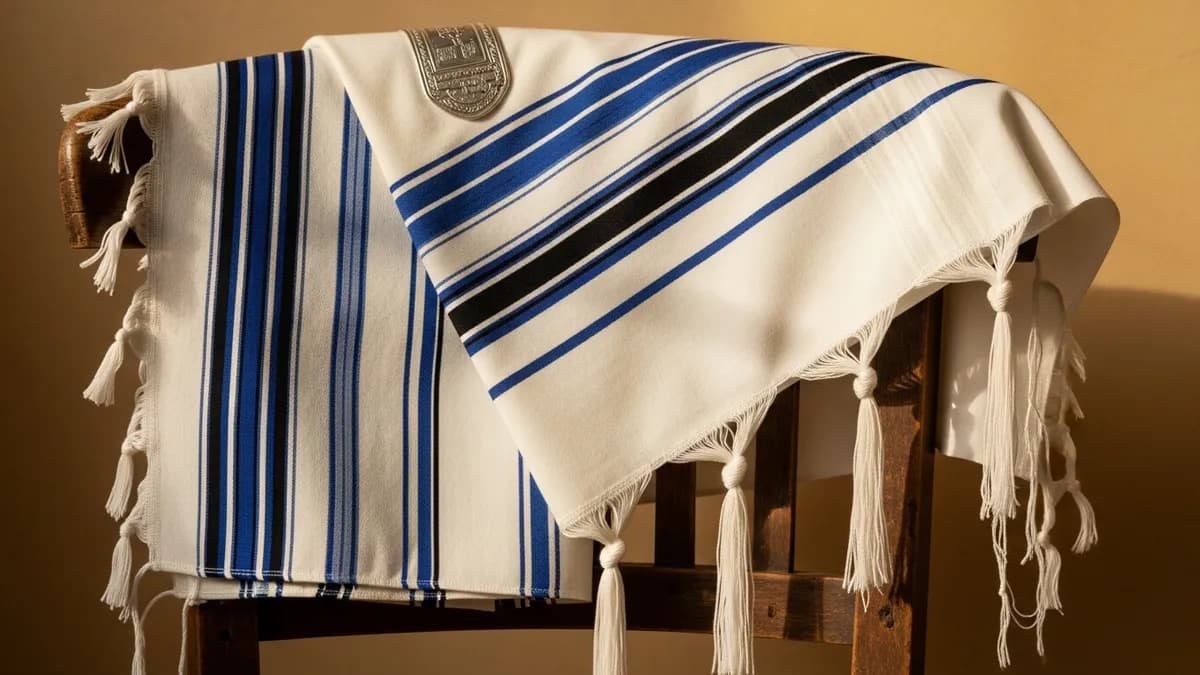
Learn what a tallit is — the Jewish prayer shawl with fringes (tzitzit). Discover who wears it, when, its spiritual meaning, and the two main types.
Quick Answer
A tallit is a Jewish prayer shawl with fringes (tzitzit) tied on each of its four corners, as commanded in the Torah. Worn during morning prayers, it serves as a reminder of all G-d's commandments. There are two types: the tallit gadol (large shawl) and tallit katan (small garment worn all day).
When my husband wraps himself in his tallit every morning before davening, there is a moment — just a brief one — where the fabric goes over his head and he stands completely enveloped, whispering a prayer. He is not visible to anyone. It is just him and Hashem, wrapped in a commandment. It is one of the most private, intimate moments in Jewish prayer, and it happens every single day.
A tallit (Hebrew: טלית, also pronounced "tallis" in Ashkenazi tradition) is a rectangular garment with special fringes called tzitzit (ציצית) attached to each of its four corners. The Torah commands: "Speak to the children of Israel and tell them to make fringes on the corners of their garments... and you shall see them and remember all the commandments of Hashem."
Two Types of Tallit
Tallit Gadol (Large Tallit) — This is the large prayer shawl worn during morning services (Shacharis). It is typically white with black or blue stripes, though styles vary by community. In many Ashkenazi communities, especially those of Eastern European descent, men begin wearing a tallit gadol after marriage. German (Yekkish) and some other Ashkenazi communities, like Sephardim, have men wear one from bar mitzvah age or even younger.
The tallit gadol is draped over the shoulders and often pulled over the head during certain prayers, creating a private space for concentration. It can be made of wool, cotton, or silk. Many men receive their tallit as a wedding gift — often from the bride's family. My husband's tallit was a gift from my parents. It is wool, cream-colored with thin black stripes, and it is one of his most treasured possessions.
Tallit Katan (Small Tallit) — Also called "tzitzit" or an "arba kanfos" (four corners), this is a smaller garment worn under the shirt throughout the day. It looks like a poncho with a hole for the head and tzitzit on each corner. Orthodox Jewish men and boys wear this from a young age — my sons started wearing them around age three, at their upsherin.
The tallit katan ensures that the mitzvah of tzitzit is fulfilled all day long, not just during prayer. The fringes usually hang out over the pants or are tucked in, depending on the custom. When my boys get dressed in the morning, putting on their tzitzit is as automatic as putting on socks.
The Tzitzit Themselves
The real mitzvah is not the garment but the fringes. Each corner has a set of strings — four strings doubled over, making eight — tied in a specific pattern of knots and windings. The exact tying pattern varies between Ashkenazi, Sephardic, and other traditions, but the basic structure is universal.
The numerical value of the word tzitzit (600), plus the 8 strings and 5 knots on each corner, equals 613 — the total number of commandments in the Torah. The tzitzit are a wearable reminder of all the mitzvos. You look at them, and you remember who you are and what you are supposed to be doing. That is the whole point.
Traditionally, tzitzit strings are made of white wool. There is also a tradition of including a string of techeiles — a blue dye derived from a specific sea creature (chilazon). The identity of this creature was lost for centuries, but some communities have revived the practice using dye from the murex trunculus snail. You will see some men with one blue string among the white on their tzitzit.
When Is the Tallit Worn?
The tallit gadol is worn during Shacharis (morning prayers) every day. It is also worn on Yom Kippur for all the prayers throughout the day — including Kol Nidrei on the eve of Yom Kippur, which is the one time the tallit is worn at night. The chazzan (prayer leader) wears a tallit for Mincha (afternoon prayers) as well.
The tallit is not worn at night because the Torah says "you shall see them" — referring to the tzitzit — and at night you cannot see them. Yom Kippur evening is the exception because of the unique holiness of the day.
Wrapping in a Tallit
There is a specific way to put on a tallit. You hold it open, recite the bracha, and then wrap it around your head and shoulders, standing for a moment in complete enclosure. Some have the custom of covering their face with the tallit during this moment. Then you adjust it to rest on your shoulders for the duration of prayers.
Watching a room full of men wrapped in their tallitot, swaying in prayer, is one of the most powerful sights in a synagogue. Each man is in his own world, wrapped in his own private space, connected to the same G-d through the same ancient commandment. It is communal and deeply individual at the same time.
Common Questions
What is the Jewish prayer shawl called? Tallit (Ashkenazi pronunciation: tallis; plural tallitot or talleisim) — that's the Jewish prayer shawl you see draped over shoulders at morning services. The shawl itself is just fabric; the commandment lives in the knotted fringes at its corners, the tzitzit, which is why a tallit without fringes is a scarf and a tallit with them is a mitzvah.
I'm an Orthodox Jewish woman from Brooklyn. I can't speak for every Orthodox Jew — when I write outside my experience, I say so.
Want to understand the whole picture?
The guided tour walks you through 8 topics — prayer fits into a larger rhythm of Orthodox life.
The Orthodox Insider
A new letter every Thursday, before Shabbos — plus an instant download of “10 Things Everyone Gets Wrong About Orthodox Jews” when you subscribe.
No spam, unsubscribe anytime.