Why Do Orthodox Jews Wear Wigs — and What Is a Sheitel?
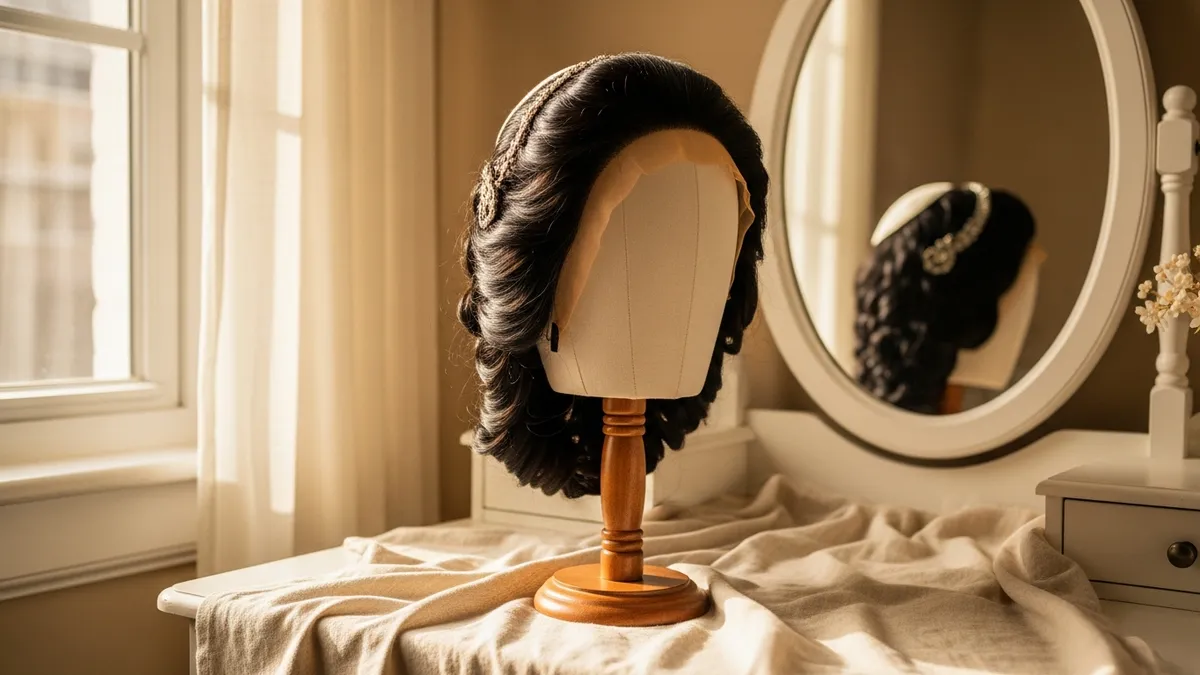
Orthodox Jewish married women wear wigs — sheitels — to cover their hair. Why a wig rather than a scarf, what human hair sheitels cost, and how they're worn.
Quick Answer
Married Orthodox Jewish women wear wigs — called sheitels — because Jewish law obligates a married woman to cover her hair, and in many communities the wig is the covering of choice. A fitted wig covers the entire scalp without shifting or slipping, it stays put through a full day, and it lets a woman meet the obligation without being conspicuous at work or on the street. Most sheitels are human hair; a custom piece typically runs $1,000 to $5,000 and is maintained by a specialist called a sheitel macher. Men don't wear them, and neither do unmarried women.
Why Do Orthodox Jews Wear Wigs?
You might be surprised to learn that the stylish woman next to you on the subway could be wearing a wig for religious reasons. In many Orthodox Jewish communities, married women wear wigs — called sheitels in Yiddish — as their primary form of hair covering.
The short answer has two halves, and most explanations only give you the first one.
Half one: Jewish law obligates a married woman to cover her hair. That obligation predates the use of a wig as a covering by well over a thousand years, it applies to married women only, and it has nothing to do with wigs specifically. If you want that part — the source, when it starts, what counts as covered, and how much the standard varies between communities — that is a whole subject of its own, and I've written it out in full: why Orthodox Jewish women cover their hair.
Half two — which is what this page is about: given that she has to cover her hair, why does she cover it with a wig, of all things? A scarf is cheaper. A hat is easier. A snood takes four seconds. Yet in Chabad, in Litvish neighborhoods like Lakewood and Flatbush, and among a large share of working Orthodox women everywhere, the answer is a sheitel — a piece of real human hair that costs as much as a used car and looks, deliberately, like hair.
That is the actual puzzle, and it deserves a real answer rather than one sentence. Everything below is that answer: why a wig beats the alternatives on the terms that matter halachically, what a sheitel physically is, what it costs and why, how it's worn from morning to night, and the serious objection that a large part of the Orthodox world raises against the whole practice.
Also, since the search phrase says "Orthodox Jews" and not "Orthodox women" — no, men don't wear wigs. Not in any Orthodox community, not for any reason. Orthodox men grow beards and cover their heads with a yarmulke or a hat — practices that aren't tied to marriage at all, and that have their own separate logic. Wigs are entirely a women's practice, and entirely a married women's practice.
Why a Wig Rather Than a Scarf, a Hat, or a Snood?
All four are legitimate coverings. Nothing in Jewish law names the wig as the required one — a woman who wears a tichel every day of her life is fulfilling the obligation exactly as completely as I am. So the question isn't "is a wig allowed," it's "why would you choose the most expensive, most complicated option on the list." Here is the honest answer, in the order the reasons actually weigh.
1. It covers, and then it keeps covering. This is the real one, and it's a halachic argument, not a vanity argument. The obligation is that the hair not be seen. A scarf tied at eight in the morning is not in the same place at three in the afternoon — it creeps back off the hairline, it works loose at the nape, a gust of wind on a subway platform lifts it. A hat leaves the back of the head to whatever is underneath it. A snood slides. A wig, fitted to your head, does none of that. It covers the entire scalp from hairline to nape, it holds that position for fourteen hours, and it does not need you to think about it. Women who switch to sheitels almost always cite this first: the wig is the covering you can stop policing.
2. It survives a normal life. Bending over a stroller, lifting a toddler onto your shoulders, running for a bus, standing over a hot oven on a Friday afternoon. Every one of those is a moment when a wrapped covering shifts and a wig doesn't. For a woman with small children, that difference is not cosmetic — it's the difference between being covered and repeatedly discovering you weren't.
3. It lets a woman be covered without being on display. A nurse on a hospital floor, a teacher in a public school, an accountant in a client meeting — for these women a tichel makes their religion the first fact in every interaction of the day, before they've said a word. A sheitel makes the covering invisible. She's observing the obligation; nobody has to discuss it with her. I want to be straight with you, though: this is exactly the reason that critics of sheitels find most damning, and I'll get to their argument below. It is a real advantage and a real vulnerability at the same time.
4. In some communities, a rabbinic authority settled the question. Chabad is the clearest case. The Lubavitcher Rebbe campaigned for wigs specifically and at length, and his argument was reason one: a kerchief can slip, and a woman who is uncomfortable can push it back, whereas a wig simply stays on. Where a community's leadership pushed that hard, the sheitel became the norm and stayed the norm.
Which Communities Actually Wear Them
The map is uneven, and anyone who tells you Orthodox women wear wigs is flattening a lot of real variation:
- Chabad is the strongest case for the sheitel. The Lubavitcher Rebbe strongly encouraged wigs, arguing they ensure complete coverage consistently, so sheitels are very much the Chabad norm.
- Litvish (Yeshivish) communities use sheitels widely and accept them fully, though hats, snoods, and tichels are all normative coverings too — there's no single mandated option.
- Sephardic communities have historically preferred scarves and other non-wig coverings, with some Sephardic authorities ruling against wigs entirely.
- Chassidish groups vary — many Satmar women don't wear a sheitel at all, covering with a tichel; those who do typically wear it with a hat or partial covering on top rather than a sheitel alone. Other Chassidic groups permit sheitels more freely.
- Modern Orthodox practice is the widest range of all: some women wear a full sheitel, some wear a fall or a hat, some cover only partially, and some don't cover at all.
What a Sheitel Actually Is
People picture a Halloween wig. A sheitel is closer to a piece of custom tailoring, and the vocabulary is worth knowing if you want to understand why one wig is $300 and the one next to it is $4,000.
The cap is the foundation — the mesh or fabric base the hair is attached to. Everything about how a wig sits, breathes, and moves comes down to the cap.
Wefted (machine-made) caps have the hair sewn onto strips in rows, then the strips sewn onto the base. It's fast, it's sturdy, it gives good volume, and it's why machine-made wigs are affordable. The trade-off is that the hair direction is fixed — you can't part it wherever you like, and up close the rows can read as rows.
Hand-tied caps have each strand, or each tiny group of strands, individually knotted into a fine net. It takes a person days. The hair moves in every direction, the wig is lighter and cooler, and it behaves like hair growing out of a head rather than like hair attached to a hat. This is most of what you're paying for in a $3,000 sheitel.
The top is the tell. A cheap wig looks fake at the part, because there's no visible "scalp." Better sheitels solve this with a lace top (fine, near-invisible mesh at the crown, with hairs knotted in individually so light passes through and you appear to see skin), a silk top (a layer that hides the knots so the part looks like a real scalp), or a multidirectional top (hair knotted in varied directions so it can be parted anywhere and restyled).
Length and density drive price steeply. Long, unprocessed hair of consistent quality from a single source is genuinely scarce, and density — how much hair is on the cap — is priced by weight of raw material.
Fit. Sheitels come in petite, average, and large sizes, and a good sheitel macher will adjust the cap to your actual head with elastic, clips, and sometimes a resized nape. A wig that doesn't fit slides, and a wig that slides defeats the entire purpose.
Human Hair vs. Synthetic: What Sheitels Are Made Of
Orthodox Jewish human hair wigs are the default for a primary piece, and the reasons are practical rather than religious: human hair can be washed, heat-styled, cut, and color-matched to the wearer, it moves the way hair moves, and a well-kept piece lasts years. European hair commands the highest prices because it's fine-textured and closely matches many Ashkenazi women's own hair, and hair with the cuticle intact and aligned (remy hair) tangles far less over time.
Not all sheitels are human hair, though. Synthetic wigs are more affordable (typically $100-$400) and are popular for everyday use. They don't look quite as natural, but they're easier to maintain — you can't really restyle them, but they hold their shape well.
Some women use synthetic wigs for daily wear and save their human-hair sheitel for Shabbat and special occasions. It's a practical compromise that makes the whole system more financially manageable.
The Human Hair Controversy
In 2004, a major controversy erupted when it was discovered that some human-hair sheitels were made from hair donated at Hindu temples in India, where the hair donation is part of a religious ritual. This raised serious halachic concerns about benefiting from idolatrous practices. Many women burned their wigs, and the sheitel industry was temporarily thrown into chaos.
Today, reputable sheitel companies carefully source their hair and provide documentation of its origins. The controversy led to much greater transparency in the industry.
The Sheitel Industry
Let me tell you — this is not your grandmother's wig. The modern sheitel industry is serious business. High-quality human hair sheitels can cost anywhere from $1,000 to $5,000 or more. They're custom-fitted, professionally styled, and often indistinguishable from natural hair.
In communities like Crown Heights, Flatbush, and Lakewood, sheitel machers (wig stylists) are in high demand. These women (it's almost always women) wash, set, style, and maintain wigs the way a regular hair salon handles natural hair. Many women own two or three sheitels — an everyday one, a Shabbos sheitel, and maybe a simcha (event) sheitel.
How a Sheitel Is Worn, Day to Day
This is the part nobody writes about, and it's the part people are actually curious about.
Underneath. Your own hair goes flat first. Long hair gets braided or twisted and pinned close to the scalp; most women I know keep their hair a manageable length precisely because of this. Many then add a thin spandex wig cap, which does two jobs: it holds stray hair down and it keeps scalp oils off the wig, which extends the time between washes.
Holding it on. A well-fitted wig mostly stays on by itself, but almost nobody relies on that alone. The common tools are small combs or clips sewn into the cap that grip your own hair, adjustable elastic straps at the nape, and a velvet or silicone headband worn under the wig that stops it from sliding on smooth hair. Nothing is glued. It comes off as easily as it goes on.
How long it takes. Thirty seconds to a minute once it's styled. That's the whole appeal.
Washing and setting. A human hair sheitel gets washed every four to eight weeks depending on wear and season, and it usually goes to a sheitel macher rather than into your bathroom sink — she washes it, sets it on a block, and returns it styled. Between visits it lives on a wig stand or a foam head, not in a drawer. Heat styling is possible on human hair and not on most synthetics, which is a large part of why the human-hair piece is the one worth maintaining.
A fall is not a full wig. You'll hear the word. A fall is a partial piece that covers the back and sides and is worn with a headband or hat, with the wearer's own front hairline showing. It's lighter and cooler than a full sheitel, and it's popular in some Modern Orthodox circles — but understand what it is: it leaves some of the woman's own hair visible on purpose, which puts it in a different halachic category than a full covering. Women who wear falls are generally relying on the more lenient opinions about partial covering, and communities that require full coverage don't accept them.
Overnight and swimming. No. A sheitel isn't slept in — it would wreck the style and the cap. At night and in the water women use something else, or nothing, depending on their practice at home.
Why Do Orthodox Jews Wear Wigs and Shave Their Heads?
This search comes up constantly, and it actually mashes together two separate practices from two different corners of the Orthodox world. Let me untangle them.
Most Orthodox women who wear sheitels do not shave their heads. Their natural hair is simply pinned or tucked underneath the wig — that's the whole arrangement. Shaving is a minority custom found in certain Hasidic communities with Hungarian roots — Satmar is the best known, along with groups like Toldos Aharon — where married women cut their hair very short or shave it, beginning after the wedding. The reasons given within those communities: with no hair at all, not a single strand can ever slip out of the covering, and immersion in the mikvah is simpler, since every part of the body — including every hair — must be under the water at once.
Here's the irony: the women who shave are generally not the ones in wigs. Satmar women typically cover with a tichel or a hat, and those who do wear a sheitel wear something over it. So the woman in the beautiful human-hair wig almost certainly has a full head of hair underneath, and the woman who shaves is probably wearing a scarf. I wrote more about why some Jewish women shave their heads if you want the full picture.
But a Wig Looks Like Real Hair — Doesn't That Defeat the Point?
This is the single most common objection, I hear it from Jews and non-Jews alike, and it deserves better than a brush-off. It is also the reason a substantial part of the Orthodox world does not accept sheitels at all.
The objection. If the whole point of covering your hair is that a married woman's hair isn't for public view, then replacing it with hair — hair that is often longer, glossier, and more expensive-looking than what's underneath — is a joke at the mitzvah's expense. A stranger passing you on the street learns nothing. You have satisfied the letter and gutted the spirit. Rabbi Ovadia Yosef, the preeminent Sephardic authority of the last century, ruled strongly against sheitels on essentially these grounds, and Sephardic practice in many places still follows him. The Satmar Rebbe was firmly opposed for the same reason, which is why Satmar women overwhelmingly cover with a tichel or wear something over a wig rather than a sheitel alone.
The answer. The mitzvah, as the permitting authorities read it, is to cover the hair — not to be visibly, identifiably covered. The obligation attaches to your own hair being unseen, and under a sheitel it is unseen. Making "does she look covered to a stranger" the test would be a different obligation than the one the sources describe. This isn't a modern loophole either: Rabbi Yehoshua Boaz, the sixteenth-century author of the Shiltei Giborim, was the first major authority to permit a wig as a covering, and later authorities built on him. Rabbi Moshe Feinstein, the leading American posek of the twentieth century, permitted sheitels as well.
The middle ground, which is where most of the Orthodox world actually lives. Very few communities land on a pure yes or a pure no. Chassidish practice frequently requires something on top of the sheitel — a hat, a headband, a partial covering — so that the covering is visible as a covering. Some communities set expectations about length and style so that a sheitel doesn't become a showpiece. And plenty of individual women make the same calculation privately, choosing a shorter or plainer sheitel than they could afford because the objection above nags at them too.
This debate has been running for four centuries and both sides have serious halachic support. It is not a case of one camp being observant and the other cutting corners. In practice, women follow their community's custom and their own rabbi's guidance — and the honest thing to say is that a woman in a scarf and a woman in a sheitel have each been told by a legitimate authority that theirs is the right answer.
Do Orthodox Jewish Women Wear Wigs at Home?
Mostly, no — and this surprises people. The hair-covering obligation is about being seen by others: in public, and in front of men who aren't a woman's husband or immediate family. Inside her own home, with just her husband and children, many halachic authorities permit a woman to uncover her hair entirely, and even the stricter opinions agree the standard relaxes in private.
In practice, the sheitel usually comes off the minute a woman walks in the door. Wigs are outside-wear — at home, most of us switch to something soft and comfortable like a snood, a tichel, or a pre-tied scarf, or leave hair uncovered around immediate family, depending on custom. Some women do keep their hair covered at home as well; Chabad in particular encourages it, drawing on the Talmud's story of Kimchit, who said the beams of her house never saw her hair, and on the Zohar's teaching that covering carries blessing even in private. As with everything in this topic, the range of practice is wide, and each woman follows her community's standard and her own rabbi's guidance.
Living With It
Here's the thing about sheitels — once you're used to them, they're just part of getting dressed. I put on my sheitel the way someone else puts on earrings. It takes about thirty seconds.
Do I love it every single day? No. Summer heat makes any head covering less than thrilling. But it's meaningful to me. Every morning when I put on my sheitel, I'm making a conscious choice about how I present myself to the world. That daily intentionality has real spiritual value.
And let's be honest — on days when my real hair would be a disaster, the sheitel saves me. Every woman who's worn one knows the secret relief of a guaranteed good hair day.
One more time, because it's the thing people get backwards: the wig is a method, not the mitzvah. The obligation is to cover the hair, and the sheitel is one of several honest ways to do that. If what you actually came to understand is the obligation itself — where it comes from in the Torah and Talmud, when in a woman's life it begins, how much hair counts as "covered," and why the standard is stricter in Boro Park than in Teaneck — that's the companion piece: why Orthodox Jewish women cover their hair. You can also explore Orthodox Jewish clothing more broadly, or the full range of Orthodox Jewish hair practices for both men and women.
Common Questions
Do Orthodox Jewish men wear wigs? No. Not in any Orthodox community, and not for any reason. The search phrase "why do Orthodox Jews wear wigs" is a little misleading — it's married women, only married women, and only in communities where the sheitel is the accepted covering. Orthodox men cover their heads with a yarmulke and often a hat, grow beards, and in many communities wear peyot — but never a wig.
Is a woman required to wear a wig, or is it her choice? The requirement is to cover the hair; the wig is one way of doing it, and it is not mandated anywhere in Jewish law. A tichel, a hat, or a snood fulfills the same obligation. What decides it in practice is community custom, a woman's own rabbi, and her preference — and in some Sephardic and Chassidish communities the accepted answer is specifically not a wig. The obligation behind all of it is laid out in why Orthodox Jewish women cover their hair.
How does a sheitel stay on? Nothing is glued. A sheitel is fitted to the head, and most have small combs or clips sewn into the cap that grip the wearer's own hair, plus an adjustable elastic at the nape. Many women also wear a velvet or silicone headband underneath so the wig can't slide on smooth hair, and a thin spandex cap to keep their own hair flat and scalp oils off the piece. Putting it on takes under a minute, and it comes off just as easily.
What's the difference between a sheitel and a fall? A sheitel is a full wig covering the whole scalp. A fall is a partial hairpiece that covers the back and sides and is worn with a headband or hat, leaving the wearer's own front hairline visible. Falls are lighter and cooler, and they're common in some Modern Orthodox circles — but because they deliberately leave some natural hair showing, they rely on the more lenient opinions about partial covering, and communities that require full coverage don't accept them.
Why do Jews curl the sides of their hair? That's a different practice — those are peyot, the sidecurls worn by men, from a Torah command not to shave the hair at the temples. The full story of jew curls (peyot) is here. Wigs are the women's practice; peyot are the men's; the only thing they share is that strangers ask me about both.
Do all Orthodox women wear wigs? No — the obligation for married women is to cover the hair, not to wear a sheitel specifically. Scarves (tichels), hats, and snoods are everywhere, and some communities actually prefer them to wigs. Why women cover their hair at all is the better question, and it has a better answer.
How much does a sheitel cost? Human hair sheitels range from $1,000 to $5,000 or more for custom pieces. Synthetic wigs are $100–$400. Most women own 2–3 for different occasions — an everyday sheitel, a nicer one for Shabbat, and sometimes a special-event piece.
Can you tell if someone is wearing a sheitel? High-quality human hair sheitels are often indistinguishable from natural hair. Many non-Jewish colleagues and acquaintances have no idea their Orthodox friend or coworker is wearing a wig.
Do single Orthodox women wear wigs? No. Hair covering is only for married women. Single women do not cover their hair.
Why not just wear a hat or scarf? Many women do — it depends on the community and custom. Sheitels are popular in Litvish and Chabad communities because they provide full coverage while allowing women to look professional and put-together in any setting.
When did Jewish women start wearing wigs? Hair covering itself is ancient — the Torah (Numbers 5:18) already treats a married woman's uncovered hair as significant, and the Mishnah lists going out bareheaded as a serious breach of Jewish practice. Wigs as the method of covering are much newer: they entered Jewish life in sixteenth-century Europe, when wigs were high fashion generally, and Rabbi Yehoshua Boaz (the Shiltei Giborim) became the first major halachic authority to permit them. Rabbis have been debating that ruling ever since — which is why the sheitel question is still live today.
What percentage of Jewish women wear wigs? Nobody has a real count — there's no census of sheitels — but it's a small minority of Jewish women overall. Hair covering applies only to married women, and only Orthodox communities treat it as binding; roughly one in ten American Jews identifies as Orthodox. Within Orthodoxy, wig-wearing varies enormously by group — near-universal among married Chabad women, common in Litvish neighborhoods, and rare in communities that prefer scarves. For the numbers behind that, see how many Orthodox Jews there are.
Why do Jewish women wear long skirts? That's tzniut — Jewish modesty standards. In most Orthodox communities, women's clothing covers the knees, and skirts or dresses are worn rather than pants, based on the principle of avoiding garments considered men's clothing plus community standards of modest dress. The details vary widely by community; I break down the specifics in the modest clothing guide.
Why do Jewish women wear black? They don't have to — that one's mostly about the men. The black-suit-and-hat uniform belongs to Hasidic and yeshivish men; women's modesty rules say nothing about color. In some Hasidic neighborhoods dark, understated colors are the local fashion, but walk through any Orthodox community and you'll see women in every color. The men's story is covered in why Orthodox Jews wear black.
Can Orthodox Jews wear tampons? Yes. Nothing in Jewish law forbids tampons, and married Orthodox women use them like anyone else. The one wrinkle: some traditional families prefer that unmarried girls use pads instead — a custom rooted in old sensitivities, not a legal prohibition. Questions that touch on family-purity timing are brought to a rabbi discreetly, like everything in that private area of Jewish law.
Can Orthodox Jews use toilet paper on Shabbat? Yes — but not torn from the roll. Tearing paper along a perforation falls under the Shabbat prohibition on tearing, one of the 39 categories of forbidden Shabbat work. So observant homes stock pre-cut squares or a box of tissues in the bathroom before Shabbat begins. Practical, slightly funny, and completely standard.
Are Hasidic Jews allowed to use condoms? Generally no. Most halachic authorities prohibit condoms because Jewish law forbids "wasting seed," and a condom prevents the marital act from being complete. When a couple has a genuine reason to prevent pregnancy — health, for example — a rabbi is consulted privately, and permitted methods (usually hormonal ones, used by the wife) are preferred. The fuller picture is in do Orthodox Jews use birth control.
Are orthodox jewish human hair wigs kosher? A human hair sheitel itself is permitted; the concern is the source of the hair. After the 2004 discovery that some hair came from Hindu temple offerings in India, reputable companies began documenting their sourcing so the hair raises no concern about idolatrous practice. Many women ask for that documentation or choose European-sourced hair, and follow their rabbi's guidance on what their community accepts.
Why do Orthodox women choose human hair wigs over synthetic ones? Human hair looks the most natural, can be washed, restyled, and color-matched, and lasts for years, which is why it is the choice for a primary or Shabbos sheitel. Synthetic wigs are cheaper ($100-$400) and hold their shape well, so many women keep one for everyday wear and save the human hair piece for special occasions.
What kind of human hair is used in Orthodox sheitels? European hair is the most prized and most expensive because it is fine and closely matches the texture of many Ashkenazi women's hair. Hair with the cuticle kept intact and aligned (remy hair) is preferred because it tangles less and stays looking natural longer.
How much do human hair sheitels cost and how long do they last? Quality custom human hair sheitels typically run from $1,000 to $5,000 or more, driven by the hair source, length, density, and cap construction. With regular care from a sheitel macher, a good piece can last many years, which is part of why it is treated as a long-term investment rather than a disposable wig.
I'm an Orthodox Jewish woman from Brooklyn. I can't speak for every Orthodox Jew — when I write outside my experience, I say so.
Why Do Orthodox Jewish Women Cover Their Hair?
Orthodox Jewish Clothing — Why They Dress That Way
Modest Fashion: A Complete Guide to Tznius Style
Why Do Orthodox Jewish Men Have Strings Hanging Out?
There's more where this came from.
Orthodox Jewish dress touches on modesty, community identity, and religious law. The full tour covers it all.
The Orthodox Insider
A new letter every Thursday, before Shabbos — plus an instant download of “10 Things Everyone Gets Wrong About Orthodox Jews” when you subscribe.
No spam, unsubscribe anytime.