The Jewish Wedding Ceremony, Step by Step
A guest's complete walkthrough of an Orthodox Jewish wedding — from kabbalas panim through yichud — in exact order, with timing tips and etiquette.
Quick Answer
An Orthodox Jewish wedding begins with separate pre-ceremony receptions, then the badeken (veiling), the chuppah ceremony — which includes the ring, ketubah reading, and sheva brachos — the breaking of the glass, and the yichud room. The reception follows with separate dancing. The full sequence typically takes four to five hours.
A Jewish wedding, in order, from beginning to end: that is what this page is. Not the history, not the deeper meaning — you can find all of that in Jewish wedding traditions — but the actual sequence, so that when you walk in the door you know exactly what you are watching and why everyone around you keeps moving to a different room.
I have been to more Orthodox Jewish weddings than I can count. As a mother of a large family with connections in both Hasidic and Litvish communities — my husband is from Lakewood, I grew up Hasidic in Brooklyn — I have stood at badekens where I was weeping before anyone said a word, danced in circles until my shoes gave out, and eaten wedding chicken at approximately every life stage. Let me walk you through it.
Before any of this: if you're not sure what to wear, read what to wear to an Orthodox Jewish event. The short answer is modest and dressy. And you should also know that among orthodox Jews, men and women are separated for most of the ceremony and reception — this is not a slight, it is just how the event is structured, and it means the two sides are having completely different and equally wonderful experiences.
Before You Even Arrive: The Time Problem
Orthodox Jewish weddings start late. I say this not to be unkind but because someone needs to tell you. The invitation might say 6:00 pm. Arrive at 6:30 or 7:00 and you will not have missed anything substantive. The chuppah — the ceremony itself — is usually an hour or two after the door-open time listed on the invitation. Ask someone in the know what time the chuppah is actually scheduled for. That is your anchor.
The meal rarely starts before 9:00 or 10:00 pm. Plan accordingly — eat something before you come.
Part One: Kabbalas Panim (Separate Receptions)
The evening begins before the chuppah with what are called "kabbalas panim" — literally, receiving faces. There are two of them happening simultaneously in different rooms: one for the chosson (groom) and one for the kallah (bride).
The chosson's tish (the groom's table) is where the men gather around the groom. "Tish" means table in Yiddish, and that is exactly what it is — the groom seated at a table, surrounded by his father, father-in-law, rav, close friends and family. There is singing, there is Torah, and there is a moment where the men try to prevent the chosson from saying a dvar Torah by interrupting him loudly (this is a custom, not an attack — the reasoning connects to a teaching about a groom being like a king, and kings need no speech). Guests bring alcohol, there is lechaim-ing, it is warm and chaotic in the best possible way.
The kallah's reception is where the women receive the bride. The kallah sits on a throne-like chair — I am not exaggerating, it is often genuinely ornate — and guests come to greet her, give brachos (blessings), and wish her well. The mothers of the bride and groom stand nearby. It is beautiful. The kallah is often moved to tears multiple times before the ceremony even begins.
At the chosson's tish, the ketubah — the marriage contract — is signed by two qualified witnesses. This is a serious halachic moment. You can read more about what the ketubah actually says and why it matters on its own page.
Part Two: The Badeken (Veiling)
At some point, a signal is given and the chosson's tish bursts into motion. The groom, accompanied by his father and father-in-law and a crowd of singing men, walks to the kallah's room.
He lowers the veil over her face.
That is the badeken. It takes about thirty seconds. It produces more tears than almost any other moment in the evening.
The echo behind this custom is the story of Yaakov, Rachel, and Leah. Yaakov worked seven years to marry Rachel and was given Leah on his wedding night — because Leah's veil had stayed closed. The chosson looks at his kallah's face and lowers the veil himself, affirming: I know exactly who I am marrying. It is a small gesture with enormous weight.
After the badeken, everyone moves toward the chuppah.
Part Three: The Chuppah — In Order
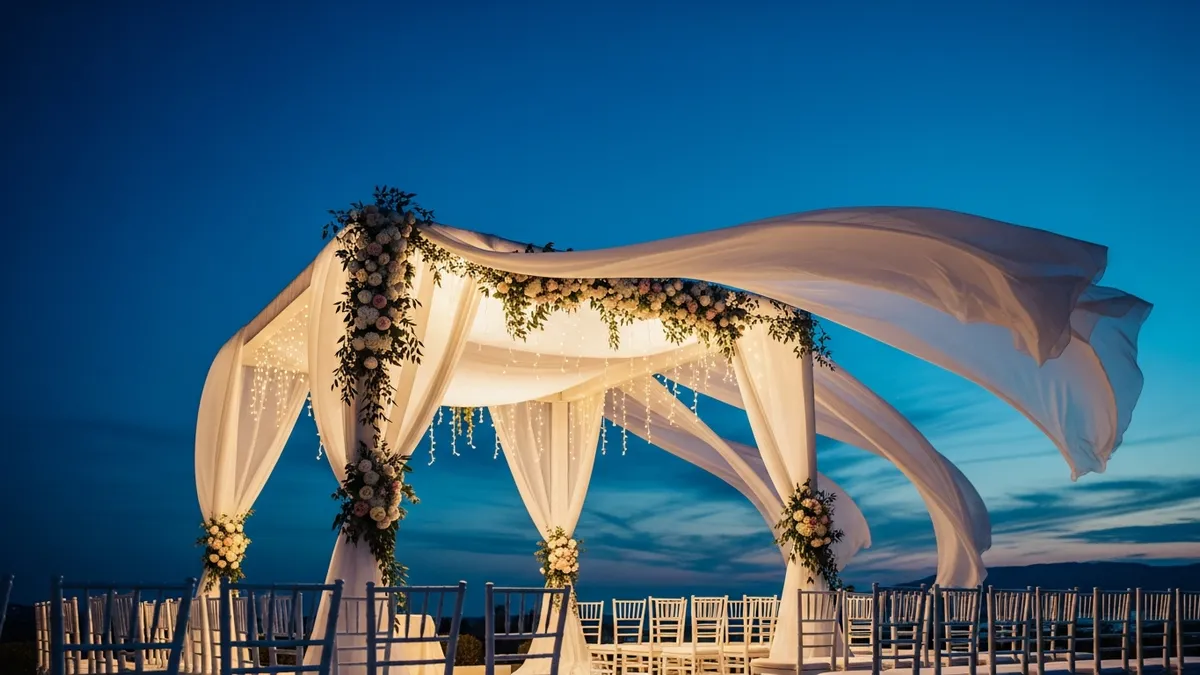
The chuppah is the marriage canopy under which the wedding takes place. It is also the word for the ceremony itself. Here is the sequence, in the order it actually happens:
The Processional
Guests take their seats (usually separated — men on one side, women on the other, or in some venues the mechitza divides the room lengthwise). Then the processional begins.
Typically, the officiant or rabbi walks in first. Then the chosson, escorted by his father and his future father-in-law, walks down the aisle to take his place under the chuppah. Each escort holds a candle — in most Ashkenazic weddings, the processional is done by candlelight, adding a warmth that no electric lighting can match.
Then the kallah, escorted by her mother and her future mother-in-law, walks down. She is veiled. The room stands. People are already crying, including me, every single time.
The Circling — Hakafos
Once the kallah reaches the chuppah, she circles the chosson seven times. This is the Ashkenazic custom. (Sephardic communities vary — some do fewer circles, some do not circle at all, so customs genuinely differ here.)
The seven circles echo many things — the seven days of creation, the seven times in parshas Vayeitzei that Yaakov's name appears in connection with Rachel. The kallah walks her circles slowly, often accompanied by her mother and mother-in-law. Then she takes her place beside the chosson.
Kiddushin — The Ring and the Witnesses
This is the legal heart of the marriage.
The rabbi recites a blessing over a cup of wine. The chosson and kallah each drink from it. Then the chosson places a plain gold ring — or in many Ashkenazic communities, plain gold with no stones — on the kallah's right index finger and recites, in Hebrew: Harei at mekudeshet li b'taba'at zu k'das Moshe v'Yisrael — "Behold, you are consecrated to me with this ring according to the law of Moses and Israel."
The ring must be given in front of two kosher witnesses who are not related to the chosson or kallah. The witnesses are watching intently. Their observation is what makes this legally binding under halacha. This is not ceremonial — they are the legal mechanism.
At this moment the kiddushin is complete — she is mekudeshet, consecrated to him alone. (Technically the marriage has two halachic stages: this betrothal, and the nisuin that completes it under the same chuppah minutes later, sealed by the sheva brachos and yichud. Centuries ago these happened up to a year apart; today they happen in one evening.)
The ring goes on the right index finger during the ceremony — not the left ring finger. This is traditional in Ashkenazic practice because the index finger is considered the most prominent digit, and the witnesses need to see the transaction clearly. After the ceremony, the kallah typically moves it to whatever finger she prefers.
Ketubah Reading
Between the two parts of the ceremony — kiddushin and nisuin — the ketubah is read aloud. Usually a reader or the rabbi chants it in Aramaic. This serves as a halachic separation between the two stages. The ketubah is then given to the kallah and she (or someone on her behalf) holds it for the remainder of the ceremony.
Sheva Brachos — The Seven Blessings
Now comes nisuin. Seven blessings — the sheva brachos — are recited over a second cup of wine, often by different honored guests or rabbis. These blessings are ancient, poetic, and extraordinary:
They bless G-d who created joy and gladness, bridegroom and bride, mirth and song, pleasure and delight, love and brotherhood, peace and fellowship. They invoke the sound of joy in the cities of Judah and in the streets of Jerusalem. They bless the chosson and kallah together.
Both the chosson and kallah drink from the wine cup after the seven blessings are complete.
Breaking the Glass
The most famous moment of the ceremony — and also the most misunderstood.
The chosson places a glass wrapped in cloth on the ground and stamps on it. It shatters. The room erupts with "Mazel tov!" People laugh, cheer, embrace.
The glass is broken to celebrate — a joyful exclamation mark on the ceremony.
The glass is broken in mourning for the destruction of the Beis HaMikdash — the Holy Temple in Jerusalem. Even at the peak of personal joy, we remember. Even at your own wedding, Jerusalem comes first. The Talmud records that Rav Ashi broke a glass at his son's wedding for exactly this reason. The shouts of "Mazel tov!" that follow are genuine — but they come after the pause of grief, not instead of it.
The breaking of the glass is also considered the completion of the ceremony.
Part Four: Yichud — The Private Room
Immediately after the chuppah, the chosson and kallah are escorted to a private room — the yichud room — where they spend approximately fifteen to twenty minutes alone together for the first time as a married couple.
This is not just symbolic. Yichud — seclusion — is a halachic component of the marriage completion. For much of Jewish history (and in many communities today), the couple had not spent time completely alone before the wedding. The yichud room is the first private moment. Two witnesses stand outside the door to attest that the couple entered and remained alone.
In most families, food is brought for the couple — they have been fasting since the morning (it is customary for the chosson and kallah to fast on their wedding day, as it is considered a personal Yom Kippur for them) and they are exhausted and starving by this point. Let them eat in peace. The dancing will wait.
Part Five: The Reception
Once the couple emerges from the yichud room, the wedding meal and dancing begin. Here is what to expect:
Separate dancing. In Orthodox weddings, men and women dance separately, with a mechitza (divider) between the two sides. If you have never experienced an Orthodox wedding dance floor, nothing quite prepares you for it: the energy is extraordinary. The circle dances (horas) can go on for hours, the singing is loud and joyful, and it is genuinely one of the most wonderful things to be part of.
Shtick. On the men's side — and increasingly visible across the mechitza — there is a tradition of entertaining the groom through shtick: juggling, acrobatics, silly costumes, magic tricks, elaborate props. The goal is to bring joy to the chosson. I have seen fire torches, trained doves, and one memorable wedding where someone brought a live chicken. Do not ask.
Mitzvah tantz. At Hasidic weddings — particularly from certain communities — there is a ritual dance called the mitzvah tantz. The kallah holds one end of a long gartel (sash) and men — her father, her new father-in-law, the rebbe, other honored guests — each in turn hold the other end and dance briefly with her without touching. The final mitzvah tantz is with the chosson himself. It is deeply moving. This custom varies significantly by community; it is not universal across all Orthodox weddings.
The meal. Dinner is served in courses after the dancing has been going for a while — appetizers, soup, main course, dessert. The entire evening is punctuated by more sheva brachos blessings recited over wine or grape juice after bentching (grace after meals). These are said again throughout the seven days of celebration after the wedding (also called "sheva brachos" — the whole week is named for the blessings).
Bentching and sheva brachos. At the end of the meal, grace after meals is recited communally. The sheva brachos are then repeated again over two cups of wine. This is the formal close of the wedding meal. It requires a minyan and the presence of someone who has not been at the wedding before — a "new face" — to recite the blessings.
The Do-Not-Do List for Guests
A few things guests sometimes attempt that do not land well at Orthodox weddings:
Do not clink your glass and expect the couple to kiss. This is not done at Orthodox weddings. The couple will not kiss in public. If you clink, you will be met with puzzled silence. It is not an insult — you just did not know.
Do not expect to dance with people of the opposite sex. There is no mixed dancing at an Orthodox wedding. Not at a Litvish wedding, not at a Hasidic wedding. Do not ask a woman to dance if you are a man, or vice versa. The separate sides each have their own dancing and their own joy.
Do not wander into the wrong side. The mechitza and gender separation at the reception are not casual suggestions.
Do not bring a non-kosher gift — a bottle of wine that is not kosher, a box of chocolates without a hechsher. When in doubt, give a check.
I have been to every kind of Orthodox wedding — long, short, lavish, simple, outdoor chuppahs in the snow, yichud rooms in a coat closet, dancing circles that lasted four hours and dancing circles that lasted until the caterer turned the lights on. Every single one of them, when the chosson stamps on that glass and the room erupts, has the same feeling. A mix of grief and joy so close together that for a moment you cannot tell them apart. That is a Jewish wedding. That is what you are walking into. Go and enjoy every minute.
Looking for the path that leads to the chuppah? See how Orthodox Jews get married — dating, the shadchan, and the engagement — or what a shadchan actually does. For the customs and deeper meanings behind what you just read, Jewish wedding traditions goes deeper.
I'm an Orthodox Jewish woman from Brooklyn. I can't speak for every Orthodox Jew — when I write outside my experience, I say so.
Jewish Wedding Traditions: A Guide to the Orthodox Ceremony
How Do Orthodox Jews Get Married?
What Is a Chuppah? The Jewish Wedding Canopy Explained
What Is a Ketubah? The Jewish Marriage Contract Explained
Attending one of these in real life?
Weddings, bar mitzvahs, and other Jewish life events often include non-Jewish guests. If you want practical guest etiquette, ask.
The Orthodox Insider
A new letter every Thursday, before Shabbos — plus an instant download of “10 Things Everyone Gets Wrong About Orthodox Jews” when you subscribe.
No spam, unsubscribe anytime.