Purim & the Story of Esther
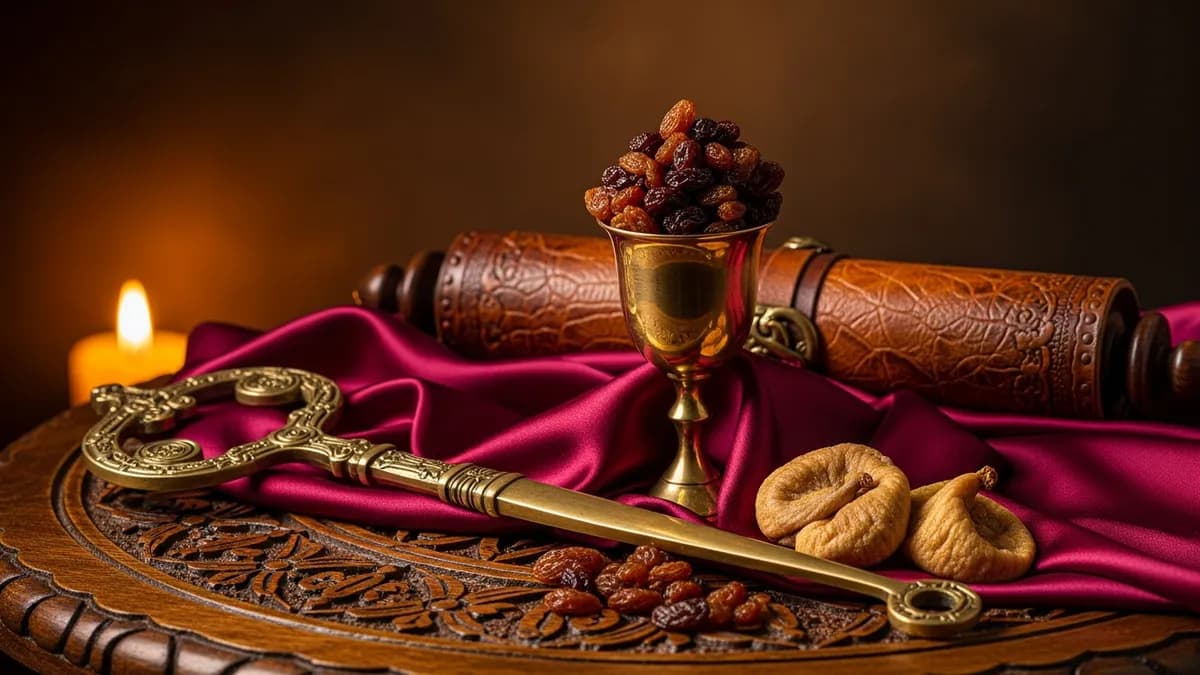
The full story of Megillat Esther: Queen Esther, Mordechai, Haman's plot, and how one woman's courage saved the Jewish people.
Quick Answer
Purim celebrates the salvation of the Jewish people in ancient Persia. Haman plotted to annihilate all Jews. Queen Esther risked her life to reveal the plot. Haman was hanged, the Jews defended themselves, and we celebrate with megillah reading, gifts of food, charity, and a festive meal.
Purim is the wildest day on our calendar. By the time it rolls around, my kitchen table has disappeared under a mountain of cellophane, ribbon, and little bags of hamantaschen, and at least one of my kids is insisting — again — on being Queen Esther, which means I'm hot-gluing sequins onto a cardboard crown at eleven at night. In shul the next morning, the floor is sticky, half the room is in costume, and every time the villain's name is read aloud, two hundred people stamp, boo, and spin their graggers until the rafters shake. It looks like a carnival. It feels like one too.
But here's the thing I always tell my kids when they finally settle down: the story underneath all that noise is deadly serious. It's a story about a decree to murder every Jewish man, woman, and child in 127 provinces — and how it was undone, just barely, at the very last moment. We dress it in costumes and candy precisely because the alternative is too heavy to hold. So let me actually tell you the story, the way I love telling it, before we get to how we celebrate.
How the Purim story begins
It all takes place in Shushan, the capital of the vast Persian Empire, sometime after the destruction of the First Temple, when much of our people lived in exile. King Achashverosh throws a months-long feast to show off his wealth, and at the climax he summons his queen, Vashti, to parade before his drunken guests. She refuses. In a fit of royal ego he has her removed, and suddenly the most powerful empire on earth needs a new queen.
So they hold what amounts to a kingdom-wide search, gathering young women from every province to the palace. Among them is a Jewish orphan named Esther, raised by her older cousin Mordechai, a leader of the Jewish community. Mordechai tells her to keep her Jewish identity hidden, and she does. And of all the women brought before the king, it is Esther whom Achashverosh chooses. She becomes queen of Persia — a Jewish girl on the throne, and almost no one knows it.
Around the same time, Mordechai overhears two of the king's courtiers, Bigthan and Teresh, plotting to assassinate Achashverosh. He passes the warning to Esther, the plot is foiled, and the whole affair is written down in the royal chronicles. It seems like a small detail. Hold onto it — it matters enormously later.
Haman's plot
Then comes Haman, whom the king promotes to chief minister, the second most powerful man in the empire. Haman demands that everyone bow down to him as he passes. Everyone does — except Mordechai, who as a Jew will not bow to a man who sets himself up as something to be worshipped. Day after day Mordechai refuses, and day after day Haman's fury grows.
When Haman learns that Mordechai is a Jew, ordinary revenge isn't enough for him. He decides to destroy not just Mordechai but Mordechai's entire people. He casts lots — purim, which is where the holiday gets its name — to choose the date, and the lot falls on the thirteenth of Adar. Then he goes to the king with a slander as old as exile itself: there is a certain people scattered throughout your kingdom, he says, whose laws are different, who do not obey you. Let them be destroyed. He offers a fortune to the royal treasury, and the king, barely looking up, hands Haman his signet ring and tells him to do as he sees fit.
Letters go out to all 127 provinces, sealed with the king's own seal: on a single day, every Jew — young and old, women and children — is to be killed, and their property plundered. When the decree reaches the Jews of Shushan, the city is thrown into mourning. They fast, they weep, they put on sackcloth.
Mordechai sends word to Esther inside the palace: she must go to the king and plead for her people. Esther sends back the obvious, terrible problem — anyone who approaches the king's inner court uninvited is put to death, unless he extends his golden scepter to spare them, and she has not been called for thirty days. To go is to risk her life. And Mordechai answers her with the line that gives me chills every single year: "Do not imagine that you, of all the Jews, will escape because you are in the king's palace. If you stay silent now, relief will come to the Jews from somewhere else — but you and your family will be lost. And who knows — perhaps it was for just such a moment as this that you reached the throne."
Esther's gamble
Esther decides to go. But first she asks Mordechai to gather all the Jews of Shushan to fast with her for three days and three nights — no eating, no drinking — and she and her maids will do the same. Then, she says, "I will go to the king, though it is against the law; and if I perish, I perish."
After three days she puts on her royal robes and walks, uninvited, into the king's court. This is the hinge of the whole story — a moment where everything could end in her execution. The king sees her standing there, and instead of anger he extends the golden scepter. She has survived the first step.
But notice what she doesn't do: she doesn't blurt out the accusation. Instead she invites the king and Haman to a private wine banquet. At the banquet the king, pleased, asks what she wants — anything, up to half the kingdom. And she answers only: come again tomorrow, to a second banquet, and then I will tell you. Even she may not have known why she was stalling. The delay is the trap, though no one can see it yet.
Haman leaves that first banquet floating on his own importance — only to pass Mordechai at the gate, still refusing to bow. He goes home seething, and on his wife's advice builds a fifty-cubit gallows, planning to ask the king first thing in the morning for permission to hang Mordechai on it.
The reversal
Here is the most cinematic night in the whole Megillah, and it turns on something as ordinary as insomnia.
That very night, the king cannot sleep. So he calls for the royal chronicles to be read aloud to him — and the passage that's read is the record of how Mordechai once exposed the assassination plot and saved the king's life. The king asks: what honor was ever given to this man? Nothing, his servants tell him. Nothing at all.
At that exact moment Haman arrives in the courtyard — early, eager to ask permission to hang Mordechai. Before he can open his mouth, the king asks him: "What should be done for the man the king wishes to honor?" Haman, certain the king means him, describes the most extravagant honor he can dream up — royal robes the king has worn, a horse the king has ridden, a crown, and a nobleman to lead the man through the city square proclaiming his glory. Wonderful, says the king. Now go do all of that — for Mordechai the Jew.
And so Haman spends that morning leading his enemy through the streets of Shushan on the king's horse, calling out his honor, before slinking home humiliated. He barely has time to tell his family the disaster before the king's officers arrive to rush him to Esther's second banquet.
There, at last, Esther springs the trap. When the king again asks what she desires, she says: my life, and the lives of my people — for we have been sold to be destroyed and killed. The king, stunned, demands: who would dare do this? And Esther points across the table: "An adversary and an enemy — this wicked Haman!" Haman, who an hour ago thought he ruled the empire, is hanged on the very gallows he built for Mordechai.
The decree itself can't simply be erased — a law sealed with the king's ring can't be revoked. So the king empowers Mordechai to write a counter-decree: on that same thirteenth of Adar, the Jews are granted the right to gather and defend themselves. When the day comes, the Jews prevail over those who rose to destroy them. In the walled city of Shushan the fighting stretches a day longer, which is why to this day Jerusalem and other ancient walled cities keep Purim a day later — what we call Shushan Purim. It's what makes spending Purim in Jerusalem an experience of its own: when the rest of the Jewish world has already finished, the Old City is still mid-celebration. And the very next day, the people rest, feast, and rejoice. That day of rest became the festival we keep.
How we celebrate Purim today
We mark all of this with four mitzvot, and on Purim morning my whole family is running between them.
Hearing the Megillah. This is the heart of the day. The mitzvah isn't simply to "read" the Scroll of Esther — it's to hear every single word, both at night and again in the morning. If you miss even a word, you haven't fulfilled it, which is why people freeze mid-gragger waiting for the reader to repeat a line. The booing comes from a beloved custom: whenever Haman's name is read, we stamp and spin noisemakers — graggers — to blot out the name of the man who wanted us gone. (And yes, there's a real tension there: we have to quiet down fast enough to still catch every word, which is its own small comedy in a room full of overexcited kids.)
Mishloach manot — sending gifts of food to friends. At minimum it's two ready-to-eat foods to one person, but in practice the whole neighborhood turns into a delivery network: kids in costume sprinting between houses with baskets of hamantaschen, candy, and a little bottle of grape juice, ringing every doorbell on the block. Those are the baskets that bury my table for a week.
Matanot la'evyonim — gifts to the poor. We're obligated to give charity to at least two people in need on Purim day itself, so that no one is left out of the joy. To me this is the soul of the holiday: the same day we feast, we make sure the people who can't afford a feast are taken care of first.
The Purim seudah — a festive daytime meal, with wine and song and far too much food. There's a custom for adults to drink at the meal, but it's meant to lift the joy and the gratitude, not to lose oneself — and plenty of people fulfill it with just a little wine or a nap. It's a meal of relief: we were marked for death, and instead here we are, together, eating.
Where is G-d in the Megillah?
Here's the detail that I think makes Purim the deepest day disguised as the silliest: G-d's name does not appear anywhere in the entire Scroll of Esther. Not once.
And that's the whole point. There are no open miracles in this story — no sea splitting, no plagues. There's a king who happens to banish a queen, a girl who happens to win a beauty contest, an assassination plot that happens to get recorded, a sleepless night that happens to land on the worst possible morning for Haman. Coincidence stacked on coincidence — until you step back and see that every "coincidence" was a thread, and they were all being woven into one rescue. That's what the hidden Name is teaching: that even when we can't see G-d's hand, when life looks like nothing but politics and luck, He is directing all of it.
That's why we can spend the day in costumes and noise. The carnival isn't a distraction from the serious story — it's our answer to it. We were saved when salvation looked impossible, so once a year we let loose with everything we've got.
If the part that moved you most was matanot la'evyonim — making sure the poor share in the joy — you'll find that same instinct runs through everything we do; you can read more in what tzedakah really means. And if you'd like to see how Purim fits alongside the rest of our year, start with the overview of the Jewish holidays.
I'm an Orthodox Jewish woman from Brooklyn. I can't speak for every Orthodox Jew — when I write outside my experience, I say so.
Jewish Holidays: The Complete Jewish Calendar Guide
Passover (Pesach): The Complete Guide
Chanukah: What It Really Means (Not Jewish Christmas)
What Is Tzedakah? Jewish Charity Is Not Optional
Want to experience a Jewish holiday yourself?
Virtual Seders, Rosh Hashanah dinners, and Chanukah candle-lightings are open to non-Jewish guests.
The Orthodox Insider
A new letter every Thursday, before Shabbos — plus an instant download of “10 Things Everyone Gets Wrong About Orthodox Jews” when you subscribe.
No spam, unsubscribe anytime.