What Is an Eruv? The Invisible Boundary Around Your Town
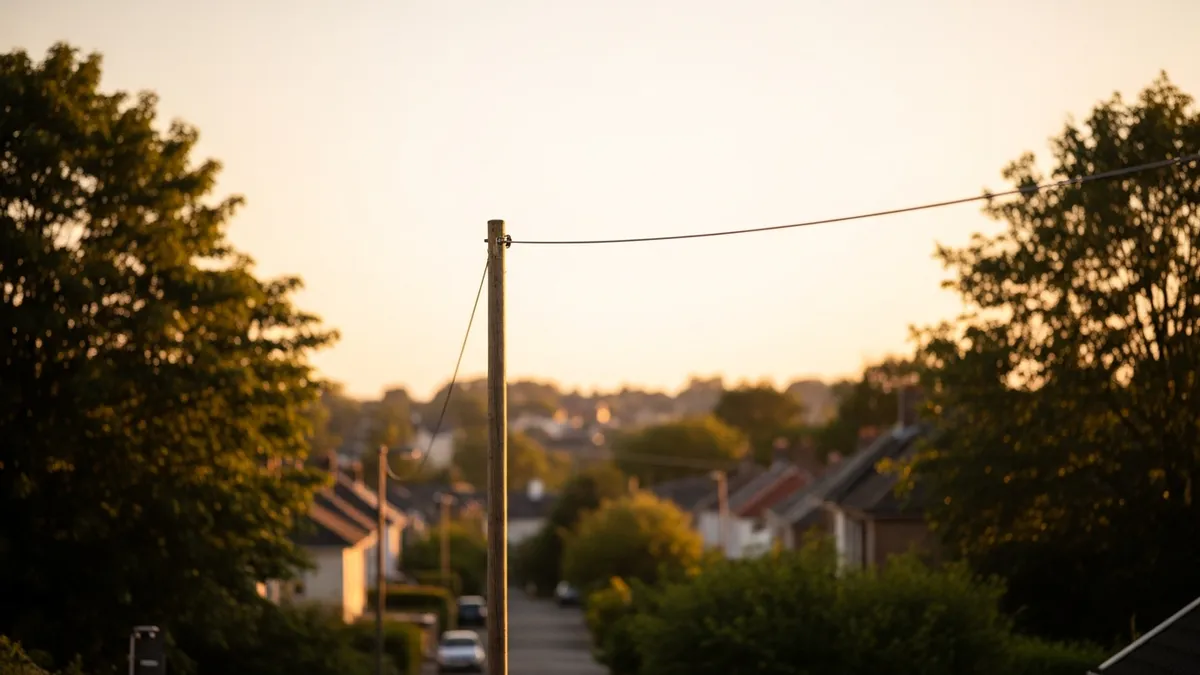
An eruv is a boundary that lets Orthodox Jews carry and push strollers on Shabbat. How it works, why it matters, and why your town may have one.
Quick Answer
An eruv is a symbolic boundary - usually made of poles and wire - enclosing a community area. Within the eruv, Orthodox Jews can carry items and push strollers on Shabbat, which is otherwise forbidden in public spaces.
Every Friday afternoon, a man drives the perimeter of my neighborhood checking a series of poles, wires, and fence lines. If anything is broken, the community is notified before Shabbat begins. This is the eruv check, and it determines whether I can push my stroller to shul the next morning.
I didn't grow up thinking about wires strung between utility poles. Now I check the eruv status the way other people check the weather. It's the difference between a Shabbat where my whole family walks to shul together and a Shabbat where I stay home with the baby while everyone else goes.
What an Eruv Actually Is
An eruv (plural: eruvin) is a halachic boundary that encloses a community area and, for the purposes of Shabbat law, turns a stretch of streets and sidewalks into something treated like one large shared courtyard. It's not a wall and it's not a fence you'd notice unless someone pointed it out. Most of an eruv is invisible to the untrained eye - a thin wire running pole to pole, a fishing line you'd never look at twice, the side of a parkway already there.
The full Hebrew term is eruv chatzeirot, "the merging of courtyards." That name tells you the idea: the eruv legally merges a whole neighborhood's separate spaces into one domain so that moving an object from inside to outside isn't moving it between two different domains anymore. The wire is the visible piece, but a small amount of food (traditionally matzah or another shared item) is also set aside on behalf of all the residents to express that they share the enclosed space. That's the part that gives the eruv its name.
The Rule It Solves
On Shabbat, Jewish law prohibits transferring objects between a private domain and a public one, and carrying an object any meaningful distance through an unenclosed public space. In practice that means a lot of small, ordinary things become impossible the moment you step out your front door: house keys, a tallit bag, a water bottle, reading glasses, a pacifier, a tissue for a runny nose. It also means you can't push a stroller or a wheelchair, and you can't carry a child who's too young to walk.
Here's a piece most beginners miss, because it's the reason an eruv works at all. The strictest, biblical-level form of this prohibition applies to a true public thoroughfare - the kind of wide, heavily trafficked open road the Talmud has in mind. Almost no modern residential neighborhood actually qualifies as that. Most of our streets are what halacha calls a karmelis, an open area that the rabbis restricted by their own enactment rather than something forbidden outright by the Torah. Because the restriction in those areas is rabbinic, the rabbis also gave us the tool to lift it: enclose the area, merge it into one shared domain, and carrying inside it is permitted. That's the whole logic of the eruv. (Where an area genuinely is a biblical-level thoroughfare, a simple wire eruv doesn't help - which is one reason eruv questions can get technical, and why communities lean on a posek to rule on theirs.)
How It's Built: Tzuras Hapesach
The mechanism that does the heavy lifting is called a tzuras hapesach - literally a "doorway form." A vertical pole on each side and a wire or string running across the top create the legal outline of a doorway, and a series of those doorways strung together makes a continuous "wall" in the eyes of Jewish law, even though you can walk right through it.
A community eruv stitches these doorways together with whatever already exists: real walls and fences, the embankment of a highway, sometimes a body of water or a steep slope. The one absolute requirement is that the perimeter be unbroken. A single downed wire, a pole knocked over by a truck, a section taken down for construction - any gap, and the entire eruv is invalid until it's repaired. That's why the Friday-morning inspection isn't a formality. Someone walks or drives the whole boundary, and if a break can't be fixed before candle-lighting, the word goes out: the eruv is down this week.
What It Permits - and What It Doesn't
Inside a valid eruv, the things that were stuck at home become possible again. I can carry my keys and a sefer to shul. I can push the stroller and the wheelchair. I can carry my toddler when his legs give out halfway there. And I can finally bring the cholent next door for a Shabbos meal instead of leaving it on the neighbor's porch before sundown and hoping it's still warm.
What an eruv does not do is change any other rule of Shabbat. This is the single biggest misconception I hear. An eruv only addresses carrying. It does nothing about driving, turning on lights, cooking, using a phone, spending money, or any other Shabbat melacha. People sometimes imagine an eruv is a kind of loophole zone where Shabbat relaxes - it isn't. Everything else stays exactly as restricted inside the eruv as outside it. All it changes is whether I can have my house keys in my pocket on the walk to shul.
I should also be honest that not every Orthodox community relies on a city-wide eruv. Many families in the yeshivish and chassidish worlds, and some poskim, hold by a stricter standard - especially for large eruvin that enclose a karmelis - and won't carry even where one is up. In those homes the answer is simply to plan around it: walk the kids who can walk, leave the rest at home, carry nothing. So if you see a neighbor not using the eruv everyone else relies on, that's not an oversight - it's their standard.
Why It Matters
The first winter after my friend Rivky had her second baby, our neighborhood eruv was down for almost a month - a stretch of wire had come down and the repair needed a permit. For most of the block it was an inconvenience. For her it meant she didn't leave the house on Shabbat. You can't push a stroller, you can't carry an infant, and a newborn isn't walking to shul. So she stayed home, week after week, while the rest of us went. By the time the eruv was fixed, she'd missed more of the season than she'd been part of.
That's what an eruv quietly protects: the ability of the people most tied to home - mothers of young children, anyone in a wheelchair, the elderly who lean on a cane - to actually be part of the community on its central day. When the eruv is up, Shabbat is something we do together. When it's down, our group chat fills up Friday morning with the same two words ("eruv's down"), and you can feel the whole rhythm of the day rearrange around it.
How to Check If Your Eruv Is Up This Week
Because an eruv can fail in any given week, every community has a way to confirm its status before Shabbat. Most have a dedicated eruv hotline - a phone number with a recorded message updated Friday afternoon - and increasingly a website, email list, or text/WhatsApp group that pushes out a yes-or-no the moment the inspection is done. In my neighborhood it's a group text; in others it's a sign posted at the shul. If you've just moved somewhere, the fastest way to find yours is to ask the local Orthodox shul or search your city's name plus "eruv" - the maps and status lines are almost always published online. The cardinal rule: never assume. An eruv that was up last Shabbat can be down this one, and the only way to know is to check.
Your Town Probably Has One
If you live near an Orthodox population in the US, there's a good chance an eruv runs right past you without your ever noticing. New York, Los Angeles, Chicago, Miami, Houston, Dallas, Philadelphia, Boston, Baltimore, Washington DC, Denver, and dozens of smaller communities maintain them, many with published maps you can pull up online. The wire over your street might be part of one. Once someone shows you what to look for, you start seeing them everywhere.
The same question follows you when you travel. Jerusalem has a large central eruv, but it doesn't cover every neighborhood — so observant visitors planning a Yom Tov trip often check whether their hotel actually sits inside it before they book. It's exactly the kind of detail a kosher hotel concierge in Jerusalem will confirm for you, alongside how far the nearest shul and mikveh are on foot.
The eruv only matters because of what carrying means on Shabbat in the first place. If you want the bigger picture - what we can and can't do on the day, and why - start with how Orthodox Jews observe Shabbat and the fuller breakdown of Orthodox Jewish Sabbath rules.
I'm an Orthodox Jewish woman from Brooklyn. I can't speak for every Orthodox Jew — when I write outside my experience, I say so.
Shabbat — The Jewish Day of Rest Explained
Orthodox Jewish Sabbath Rules: What You Can't Do on Shabbat
Why Don't Orthodox Jews Use Electricity on Shabbat?
Orthodox Jewish Neighborhoods: Brooklyn, Lakewood & Beyond
Want to experience a Jewish holiday yourself?
Virtual Seders, Rosh Hashanah dinners, and Chanukah candle-lightings are open to non-Jewish guests.
The Orthodox Insider
A new letter every Thursday, before Shabbos — plus an instant download of “10 Things Everyone Gets Wrong About Orthodox Jews” when you subscribe.
No spam, unsubscribe anytime.