Why Do Orthodox Jewish Men Have Strings Hanging Out?
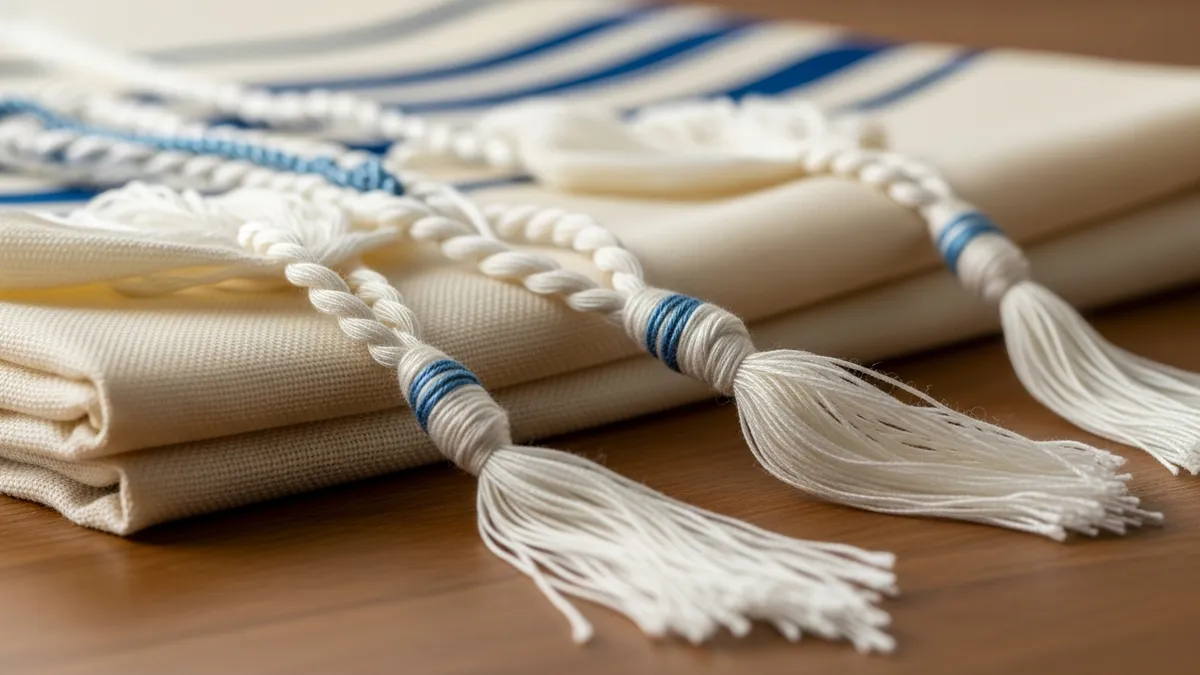
Those white strings hanging from Orthodox Jewish men are tzitzit — ritual fringes commanded in the Torah. What they are, why they're visible, what they mean.
Quick Answer
The strings are called tzitzit (TSEE-tseet) — knotted fringes attached to a four-cornered undergarment called a tallit katan. The Torah commands Jewish men to wear fringes on four-cornered garments as a reminder of G-d's commandments. Most Orthodox men wear them daily, tucked in or hanging out depending on community custom.
You have seen them — white strings hanging out from under the shirt of an Orthodox Jewish man, usually visible at the waistline or below the hem. They are not a wardrobe malfunction. They are tzitzit, and they are there on purpose.
What They Are
Tzitzit (pronounced TSEE-tseet) are knotted fringes made of white thread (sometimes with a blue thread called tekhelet). They are attached to the four corners of a garment called a tallit katan (small tallit) — essentially a rectangular poncho-like undergarment with a hole for the head and tzitzit at each corner.
The garment is worn under the shirt, against the body, all day. The strings hang out — either tucked into the pants or visibly dangling, depending on the community and individual practice.
Why They Exist
The commandment comes directly from the Torah:
"Speak to the children of Israel and tell them to make fringes on the corners of their garments... and you shall see them and remember all the commandments of the Lord and do them." (Numbers 15:38-39)
The tzitzit are a physical reminder. Every time you see them — reaching for something, changing clothes, catching a glimpse during the day — you are reminded that you are a Jew with obligations. It is wearable accountability.
Tucked In vs. Hanging Out
This is a community marker:
- Hanging out visibly — common in Hasidic and Yeshivish communities. The strings are displayed deliberately as an expression of pride and a visible sign of observance.
- Tucked in — common among Modern Orthodox men, especially in professional settings. The garment is worn but the strings are not visible.
- Both approaches are halachically acceptable. Some authorities prefer them visible (to fulfill the "you shall see them" part of the verse). Others consider tucking acceptable.
What They Look Like
Each corner has a cluster of strings — eight threads total (four threads, doubled over and knotted). The knotting pattern is specific: groups of wraps separated by knots, and the number of wraps carries meaning depending on custom. In the common Ashkenazi pattern (7-8-11-13), the counts add up to a numerical value hinting at "Hashem Echad" (Hashem is One); in the Sephardic/Arizal pattern (10-5-6-5), the wraps correspond to the letters of G-d's name.
The strings are usually white wool or cotton. Some men wear techelet — a blue-dyed thread — based on the Torah's mention of a blue thread. The identity of the original blue dye (from a sea creature called the chilazon) was lost for centuries and has been re-identified in modern times, though not all communities accept the identification.
The Bigger Tallit
The tallit katan (with its hanging strings) is the everyday garment. There is also a tallit gadol — the large prayer shawl worn during morning services, draped over the shoulders like a shawl. It has the same tzitzit at its corners but is only worn during prayer.
For Non-Jews
If you see a man with strings hanging from his shirt, you now know what they are. There is nothing you need to do differently — it is not a conversation starter unless you want it to be. If you are genuinely curious and ask respectfully ("I've always wondered what those strings are"), most Orthodox men will be happy to explain.
If you are a manager, coworker, or HR professional: tzitzit are religious attire. Under U.S. employment law (Title VII), employers generally must make a reasonable accommodation for religious dress like this unless it would cause undue hardship. A blanket policy forcing someone to remove them is unlikely to be defensible — though, since tucking the strings in is halachically acceptable, asking that they be tucked rather than visible is often a workable middle ground.
What Are Tzitzit?
Tzitzit (ציצית) are the knotted ritual fringes the Torah commands on any four-cornered garment (Numbers 15:38): "so that you will look at them and remember all of G-d's commandments." Since modern clothing has no corners, observant men wear a small four-cornered undergarment — the tallit katan — precisely so the commandment applies; the strings you see are its fringes. Each corner carries the same knot-and-wind pattern, a wearable string-around-the-finger for 613 commandments. The large prayer shawl worn at morning services is the same idea at ceremonial scale.
I'm an Orthodox Jewish woman from Brooklyn. I can't speak for every Orthodox Jew — when I write outside my experience, I say so.
There's more where this came from.
Orthodox Jewish dress touches on modesty, community identity, and religious law. The full tour covers it all.
The Orthodox Insider
A new letter every Thursday, before Shabbos — plus an instant download of “10 Things Everyone Gets Wrong About Orthodox Jews” when you subscribe.
No spam, unsubscribe anytime.