Chanukah: What It Really Means (Not Jewish Christmas)
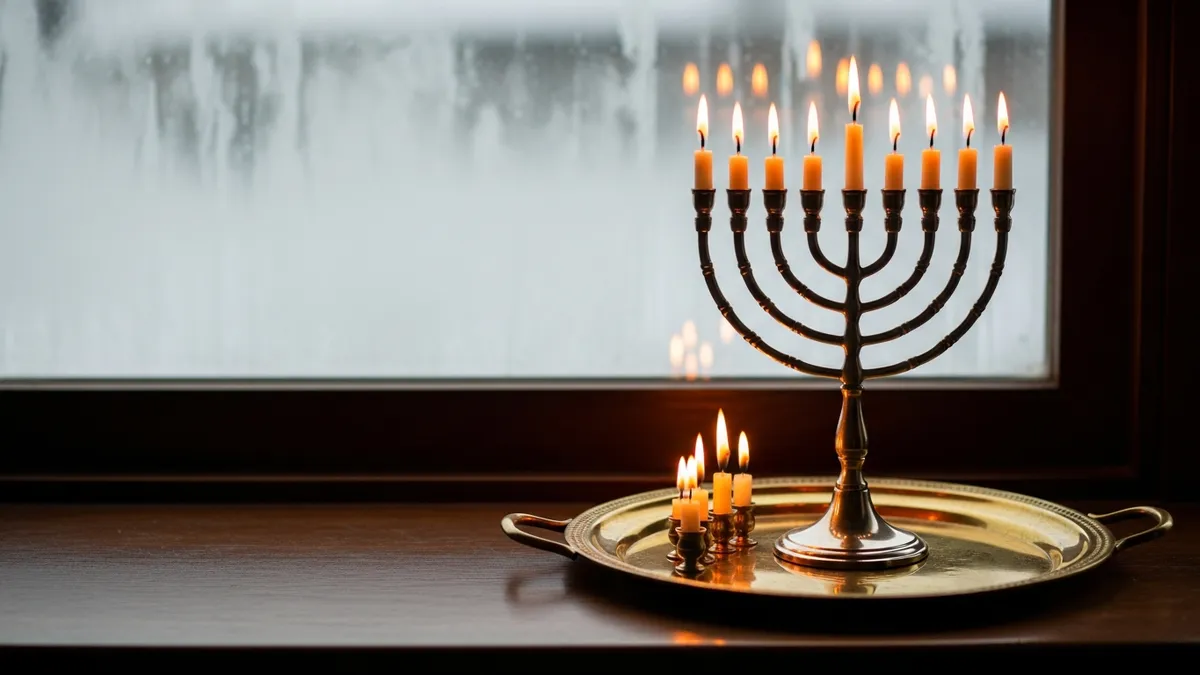
The real story of Chanukah — the Maccabees, the miracle of the oil, how Orthodox Jews celebrate, and why it's not 'Jewish Christmas.'
Quick Answer
Chanukah is an eight-day Jewish festival celebrating the Maccabees' victory over the Greek-Syrian empire and the miracle of one day's worth of oil lasting eight days in the rededicated Holy Temple. Jews light the menorah (chanukiyah) each night, adding one candle per night, and celebrate with fried foods, dreidel, and songs.
If you are completely new to the holiday? start with what Hanukkah is — then come back here for the deeper story. Let me say this right upfront: Chanukah is not Jewish Christmas. I know the timing is close, I know the gift-giving has become a thing, and I know the decorations in stores put them side by side. But they have nothing to do with each other. A woman at the pharmacy once wished my son a "Happy Holidays" and then added, "You must be so excited for Jewish Christmas!" He looked at her, looked at me, and said, "What's Jewish Christmas?" I have never been prouder. Chanukah existed for about 165 years before Christmas was even a concept.
Now let me tell you what it actually is.
The Historical Story
Around 167 BCE, the Greek-Syrian king Antiochus IV outlawed Jewish practice in the Land of Israel. He prohibited Torah study, Shabbat observance, and circumcision — on penalty of death. He desecrated the Holy Temple in Jerusalem by setting up altars to Greek gods and sacrificing pigs on the altar.
A family of Jewish priests — Mattisyahu (Mattathias) and his five sons, known as the Maccabees — launched a revolt. They were outnumbered, outarmed, and fighting the most powerful empire in the region. By any military calculation, they should have lost.
They won. It took three years of guerrilla warfare, but the Maccabees recaptured Jerusalem and rededicated the Temple. The word "Chanukah" means "dedication" — the rededication of the Temple.
The Miracle of the Oil
When the Maccabees entered the Temple to relight the menorah (the seven-branched candelabrum that was kindled in the Temple), they found only one small jug of pure olive oil — enough for one day. It would take eight days to prepare new oil.
They lit it anyway. And the oil lasted for eight days.
That is the miracle we celebrate. Not just the military victory (though that was miraculous too), but the spiritual miracle — the faith to light the menorah even when logic said there was not enough oil, and G-d's response of making it last.
How We Celebrate
Lighting the Menorah
The central observance of Chanukah is lighting the chanukiyah — a nine-branched menorah (eight branches plus the shamash, the "helper" candle used to light the others). We light one candle the first night, two the second, and so on until all eight are burning on the final night. My kids have a clear favorite — night five. That's when the presents peak (yes, we do gifts, and no, I am not going to pretend we don't). By night seven, the gift quality declines and the kids know it. "Another pair of socks?" my son said last year. Gratitude is a work in progress.
The menorah is placed in a window or doorway — specifically so that the miracle is publicized. This is a mitzvah of pirsumei nisa — publicizing the miracle. In Israel, you see menorahs in glass cases outside apartment doors and on windowsills throughout every neighborhood. It's most striking of all in Jerusalem — the stone lanes of the Old City and Nachlaot glow with hundreds of them — which is part of why so many families make a point of spending Chanukah in Jerusalem.
In my family, each person lights their own menorah. On the eighth night, I count them all lined up on the windowsill — five menorahs, each one fully lit, forty flames dancing behind the glass. I turn off the overhead lights and we just sit there for a minute. The whole living room glows orange and gold. You can see it from the street. My neighbor once told me she always looks for our window on Chanukah because it looks like our apartment is on fire. I took it as a compliment.
The candles need enough oil or wax to stay lit for at least about half an hour. During this time, the custom is to sit near the menorah, sing Chanukah songs, and enjoy family time. Women have a tradition of not doing work while the candles burn, in recognition of the role of Jewish women in the Chanukah story.
Fried Foods
Because the miracle involved oil, we eat foods fried in oil. The two stars of Chanukah cuisine are:
Latkes (potato pancakes) — grated potatoes and onions, fried until crispy. The debate over applesauce vs. sour cream as topping is fierce and unending. In my house, it is a full-blown civil war. My husband is a sour cream loyalist. I am applesauce, always have been. The kids switch allegiances yearly to maximize parental approval. Last Chanukah my son declared he was "team both" and put sour cream AND applesauce on the same latke. I am still processing it.
Sufganiyot (jelly doughnuts) — in Israel, these take over every bakery. Filled with jam, custard, chocolate, halva — the creativity is endless. My kids would eat sufganiyot for every meal if I let them. The latkes-vs-sufganiyot question in our house is really a question of who gets to the kitchen first. I ate one every single day of Chanukah last year and I regret nothing.
Dreidel (Sevivon)
The dreidel is a four-sided spinning top with Hebrew letters: Nun, Gimel, Hey, Shin — standing for "Nes Gadol Haya Sham" (A great miracle happened there). In Israel, the Shin is replaced with Pey — "Nes Gadol Haya Po" (A great miracle happened here).
Kids play dreidel for chocolate coins (gelt) or nuts. It is a simple game, but it has a deeper history — tradition says that when the Greeks outlawed Torah study, Jewish children would study in secret and keep dreidels nearby. If soldiers appeared, they would quickly hide their books and pretend to be playing a game.
What Chanukah Is Really About
The deeper message of Chanukah is not just "they tried to kill us, we survived, let's eat." It is about the battle between assimilation and identity.
The Greek-Syrian empire did not want to destroy the Jews physically (at first). They wanted the Jews to become Greek — to adopt Greek culture, Greek philosophy, Greek values. And many Jews did. The Hellenists embraced Greek ways willingly.
The Maccabees fought not just against an external army but against the internal pull of assimilation. They said: our Torah, our traditions, our way of life — these are worth fighting for. Even when the dominant culture tells us they are outdated. Even when it would be easier to just blend in.
That message resonates in every generation. Every time I light the menorah, I am making the same statement the Maccabees made: this identity matters. This light will not go out.
Chanukah vs. Christmas
People are sometimes surprised that Chanukah is actually a relatively minor holiday in Jewish law — it is rabbinic, not biblical. There are no special restrictions on work (unlike Shabbat or the major festivals). The reason it has become so prominent in America is largely because of its proximity to Christmas.
In Orthodox homes, Chanukah is wonderful but it is not the biggest holiday of the year. That title belongs to Shabbat (every single week), and among the annual holidays, the Torah festivals — Pesach, Shavuot, Sukkot — are more significant in Jewish law.
None of that diminishes Chanukah. Those little flames in the window are powerful far beyond their size. That is kind of the whole point.
Common Questions
How long is Chanukah? Eight nights. One additional candle is lit on the menorah each night, starting with one candle on the first night and ending with eight on the last night.
Is Chanukah the Jewish Christmas? No. Chanukah is a relatively minor holiday in the Jewish calendar. It commemorates the rededication of the Temple in Jerusalem after a military victory. It has no theological connection to Christmas.
What foods are traditional for Chanukah? Foods fried in oil — commemorating the miracle of the oil that burned for eight days. Latkes (potato pancakes) and sufganiyot (jelly doughnuts) are the most popular. My kids would eat sufganiyot for breakfast if I let them.
Do Orthodox Jews give gifts on Chanukah? Gift-giving on Chanukah is more of a modern American custom. Traditionally, children receive gelt (money or chocolate coins). Many Orthodox families give modest gifts but do not replicate Christmas-style gift exchanges.
I'm an Orthodox Jewish woman from Brooklyn. I can't speak for every Orthodox Jew — when I write outside my experience, I say so.
Want to experience a Jewish holiday yourself?
Virtual Seders, Rosh Hashanah dinners, and Chanukah candle-lightings are open to non-Jewish guests.
The Orthodox Insider
A new letter every Thursday, before Shabbos — plus an instant download of “10 Things Everyone Gets Wrong About Orthodox Jews” when you subscribe.
No spam, unsubscribe anytime.