The Seder Night: A Step-by-Step Guide to Passover
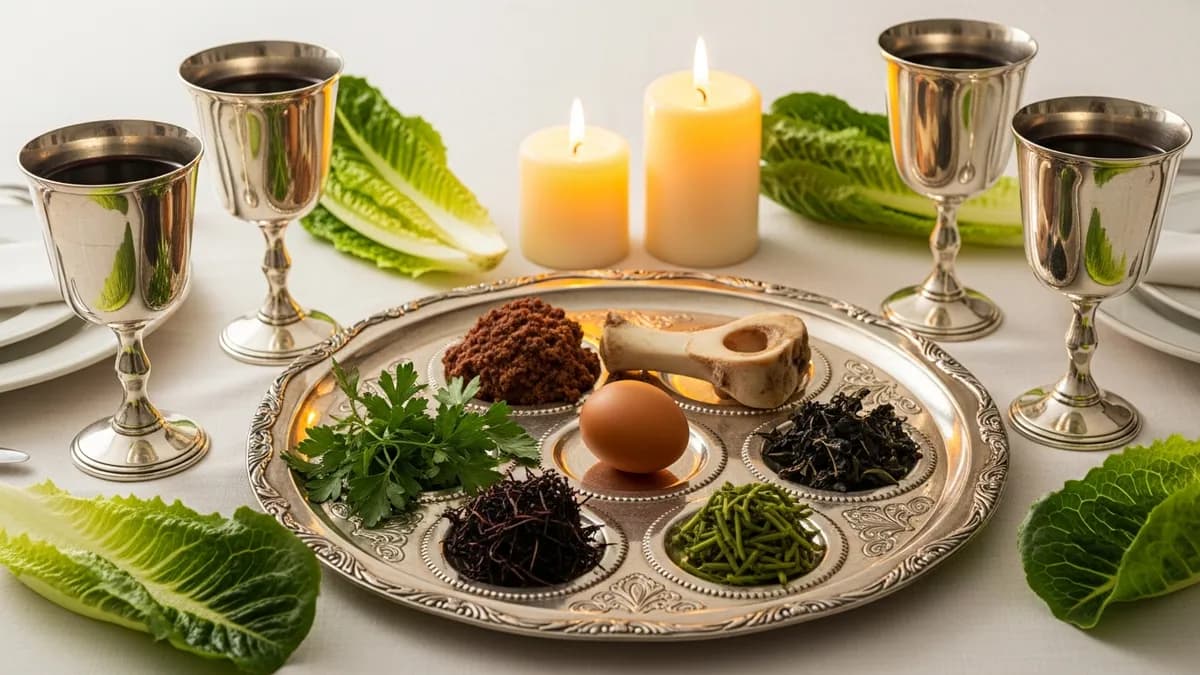
A complete step-by-step guide to the Passover seder — the 15 steps, the seder plate, the four cups, matzah, and how to make it meaningful.
Quick Answer
The Passover seder follows 15 structured steps from the Haggadah, beginning with kiddush and ending with songs of praise. Key elements include four cups of wine, eating matzah and bitter herbs, the retelling of the Exodus story, the Four Questions asked by children, and the search for the afikoman. The seder transforms a meal into an immersive experience of freedom.
The seder is not just a meal — it is the most elaborate, structured, interactive, educational, and food-intensive Jewish experience of the entire year. Every bite, every sip, every word is choreographed. And at the center of it all is a simple command: tell the story. Tell your children how we went from slavery to freedom.
Here are the 15 steps, one by one.
The Seder Plate
Before we start, let me describe what sits at the center of the table. The seder plate (ke'arah) holds six symbolic foods:
- Zeroa — a roasted shank bone, representing the Paschal lamb sacrifice
- Beitzah — a roasted egg, representing the festival offering and the cycle of life
- Maror — bitter herbs (usually freshly grated horseradish), representing the bitterness of slavery
- Charoset — a sweet paste representing the mortar the slaves used to make bricks. My family's recipe is Ashkenazi classic: grated apples, chopped walnuts, sweet red wine, and a heavy hand with the cinnamon. My mother makes it the same way her mother made it. I make it the same way. My daughter stands on a chair and "helps" by eating the apples before they get into the bowl. Sephardic charoset is a whole different thing — dates, figs, sometimes pistachios. Both are delicious, but I am loyal to mine.
- Karpas — a vegetable (parsley, celery, or potato) for dipping in saltwater
- Chazeret — a second bitter herb (usually romaine lettuce)
Three whole matzot are stacked nearby, covered with a cloth. Four cups of wine (or grape juice) will be drunk at specific points during the seder.
The 15 Steps
1. Kadesh — Kiddush
The seder begins with the first cup of wine and the kiddush blessing, sanctifying the holiday. We lean to the left while drinking — leaning like free people, not sitting upright like slaves. (Traditionally the men lean, and in many families the women do too, though the older custom was that they did not.) In my family, we use the same heavy silver kiddush cup my father got for his bar mitzvah. The wine is always Kedem — nothing fancy, but that sweet red grape wine tastes like Pesach to me. My husband pours generously. Four cups is a lot of wine, and by the second one, the conversation gets louder.
2. Urchatz — Washing
We wash our hands without a blessing. This is unusual — normally, we only wash before bread. The change in routine is intentional; it is designed to make children ask, "Why are we doing this?" Questions drive the seder.
3. Karpas — Vegetable Dipped in Saltwater
A small piece of vegetable is dipped in saltwater and eaten. The saltwater represents tears. Again, this unusual action is meant to provoke curiosity.
4. Yachatz — Breaking the Middle Matzah
The middle of the three matzot is broken in half. The larger piece is hidden as the afikoman — and in my house, this is where the real drama begins. My father always hid it. He thought he was clever about it. He was not. My kids figured out his three hiding spots years ago (under the couch cushion, behind the bookshelf, inside the piano bench). The smaller piece is returned to the stack. This broken matzah represents the bread of poverty — slaves do not get whole loaves.
5. Maggid — Telling the Story
This is the heart of the seder — the retelling of the Exodus from Egypt. It begins with the youngest child asking the Mah Nishtanah (Four Questions): Why is this night different from all other nights? The rest of Maggid is the answer.
The Haggadah takes us through the story — from Abraham to Egyptian slavery to the plagues to the miraculous departure. My father has his own way of telling it. He never just reads the text. He stops, looks around the table, and adds his own commentary. "Imagine you are there," he says. "Imagine you are carrying your child and the dough on your back and you don't know where you are going." He does this every year, and every year it lands differently depending on what is happening in the world.
We discuss four sons (the wise, the wicked, the simple, and the one who does not know how to ask). My kids argue about which one they are. We count the ten plagues, spilling a drop of wine for each one (because our joy is diminished when others suffer). The kids love this part — something about dripping wine onto a plate makes them pay attention.
We recite: "In every generation, a person is obligated to see themselves as if they personally left Egypt." This is not ancient history. This is your story.
Maggid ends with the second cup of wine.
6. Rachtzah — Washing Before Matzah
Now we wash our hands with a blessing, preparing to eat matzah.
7. Motzi — Blessing Over Bread
The standard blessing over bread is recited, holding all three matzot.
8. Matzah — Eating Matzah
A special blessing for the commandment of eating matzah is recited, and everyone eats a piece of matzah (at least an olive's worth, ideally from the top and broken middle matzot). We recline while eating it.
Getting through the required amount of matzah in the specified time is a real commitment. Shmurah matzah is thick and dry. Some people pre-break it into pieces. Others power through. The kids make faces. We all manage.
9. Maror — Bitter Herbs
A piece of bitter herb (horseradish or romaine lettuce) is dipped in charoset and eaten. The charoset's sweetness softens the bitterness — a reminder that even in suffering, there was hope. But the bitterness is real. Freshly grated horseradish will make your eyes water and your sinuses burn. That is the point.
10. Korech — The Hillel Sandwich
A sandwich of matzah and maror (and charoset, in some traditions) is eaten. This follows the practice of the great sage Hillel, who would eat the Paschal lamb with matzah and maror together.
11. Shulchan Orech — The Meal
Finally, dinner. The festive meal is served — typically beginning with eggs in saltwater, followed by soup, fish, a main course (chicken or meat), and side dishes. Many Sephardic families have elaborate multi-course meals, and some serve rice — since most Sephardim eat kitniyot (legumes) on Pesach, though a number of communities avoid rice specifically. Ashkenazim do not eat kitniyot at all.
This is when normal dinner conversation happens, kids play, and the table relaxes. But the seder is not over.
12. Tzafun — Finding and Eating the Afikoman
The afikoman — the hidden piece of matzah — is retrieved and eaten. In my family, retrieving it is a full contact sport. The kids scatter the moment Shulchan Orech ends, tearing through the living room, checking every spot they can think of. Last year, my oldest and youngest found it at the same time and both grabbed an edge. The negotiation that followed — who found it first, who gets to hold it, what the ransom should be — lasted longer than some of the actual seder. They settled on a new book each and a trip to the pizza shop after Pesach. My father handed over the prizes with a grin. He lives for this.
The afikoman must be eaten before midnight. It is the last food eaten at the seder — nothing else is consumed afterward (except the remaining cups of wine) so that the taste of matzah lingers.
13. Barech — Grace After Meals
The full birkat hamazon (grace after meals) is recited, followed by the third cup of wine.
At this point, many families open the door for Elijah the Prophet. A special cup of wine (Kos shel Eliyahu) has been sitting on the table all evening. The door is opened, and a passage is recited welcoming Elijah — the harbinger of the Mashiach.
My kids stare at the cup to see if the wine level drops. Every year, someone swears it did.
14. Hallel — Songs of Praise
Psalms of praise (Hallel) are recited, culminating in songs of gratitude to G-d for the redemption. The fourth and final cup of wine is drunk.
15. Nirtzah — Conclusion
The seder concludes with the declaration "L'shanah haba'ah b'Yerushalayim!" — Next year in Jerusalem! This is followed by traditional songs — Chad Gadya, Echad Mi Yodea, and others that have been sung at seder tables for centuries.
By this point, it is 2 AM and the kids are asleep on the couch. My youngest is curled up under the table with a pillow she dragged off the chair. My son is slumped against my husband's shoulder, still holding his Haggadah open to the page with the pictures of the plagues. The table is a disaster — wine stains on the white tablecloth, matzah crumbs everywhere, charoset smeared on the seder plate. My mother is already quietly clearing dishes because she cannot help herself.
I look at the mess, at my sleeping children, at the empty wine cups and the guttering candles, and I feel something I cannot quite name. Gratitude, maybe. Exhaustion, definitely. But also something deeper — the feeling that we just did something ancient and important, and that my children will remember this table for the rest of their lives.
And we do it all again tomorrow night.
Making It Meaningful
The seder is designed to engage everyone — children, adults, scholars, and beginners. The key is participation. Ask questions. Tell stories. Make it interactive. The Haggadah says that even if we were all wise and knowledgeable, we would still be obligated to tell the story. Because the story is not just information. It is identity.
Every year, at the same table, with the same people, telling the same story — and somehow, it is different every time.
I'm an Orthodox Jewish woman from Brooklyn. I can't speak for every Orthodox Jew — when I write outside my experience, I say so.
Passover (Pesach): The Complete Guide
Jewish Holidays: The Complete Jewish Calendar Guide
Shabbat — The Jewish Day of Rest Explained
The Jewish High Holidays: Rosh Hashanah & Yom Kippur
Want to experience a Jewish holiday yourself?
Virtual Seders, Rosh Hashanah dinners, and Chanukah candle-lightings are open to non-Jewish guests.
The Orthodox Insider
A new letter every Thursday, before Shabbos — plus an instant download of “10 Things Everyone Gets Wrong About Orthodox Jews” when you subscribe.
No spam, unsubscribe anytime.