Sukkot: The Festival of Tabernacles
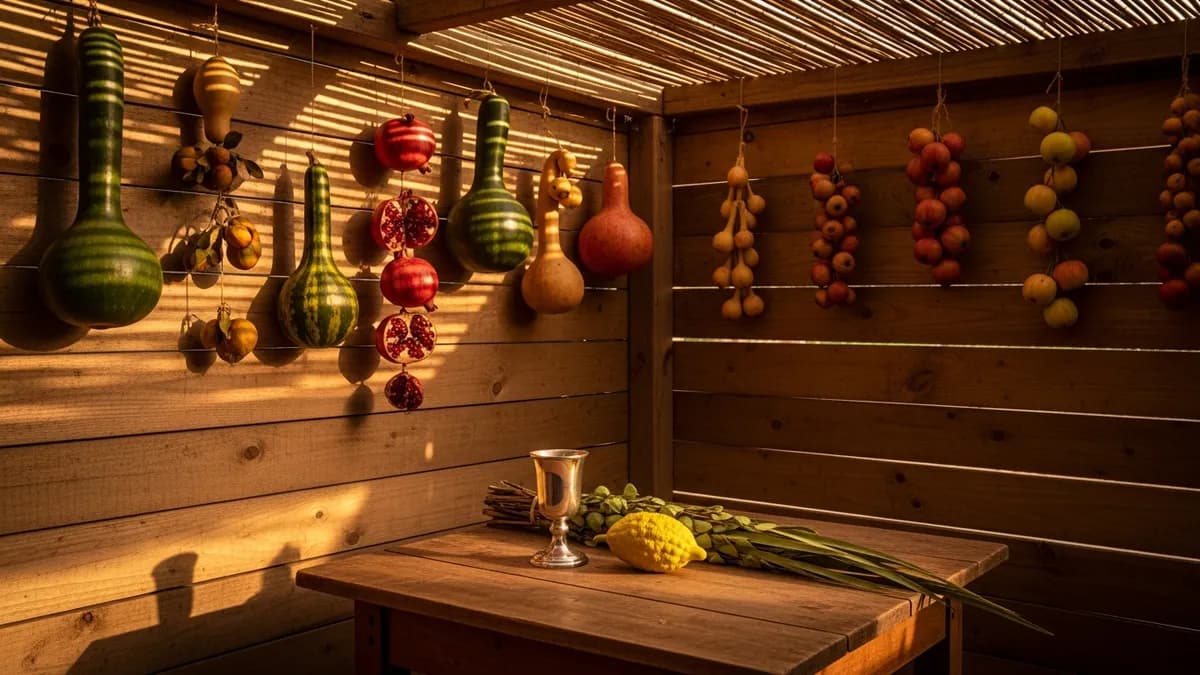
A complete guide to Sukkot — the Festival of Tabernacles. Building the sukkah, the four species, and why this joyful holiday matters.
Quick Answer
Sukkot is a seven-day Jewish holiday celebrating the harvest and commemorating the Israelites' journey through the desert after the Exodus. Orthodox Jews build temporary huts (sukkot), eat and sometimes sleep in them, and wave the four species — lulav (palm), etrog (citron), hadas (myrtle), and aravah (willow) — each day.
Five days after Yom Kippur — five days after the most intense, soul-searching experience of the year — we do something that might seem a little unexpected. We walk outside, build a flimsy hut, hang some decorations, and eat dinner under the stars.
That is Sukkot. And the transition from Yom Kippur's intensity to Sukkot's joy is one of the most beautiful rhythms in Jewish life.
What Is a Sukkah?
A sukkah is a temporary structure with at least three walls and a roof made of organic material — branches, bamboo mats, wooden slats, or corn stalks. The key rule is that the roof (schach) must provide more shade than sun, but you must be able to see the stars through it at night.
That last detail matters. The sukkah is supposed to feel temporary. It is supposed to remind you that your real home, your real security, does not come from brick walls and a solid roof. It comes from G-d.
For seven days, we eat all our meals in the sukkah. Many men sleep in it too, weather permitting. In my family, the kids fight over who gets to sleep in the sukkah — they think it is camping. They are not entirely wrong.
Building the Sukkah
The construction usually starts right after Yom Kippur — sometimes that very night. In Orthodox neighborhoods, the scene is remarkable. Every porch, every backyard, every available space sprouts a sukkah. In apartment buildings in Jerusalem and Brooklyn, sukkot hang off balconies on every floor. For the many families who travel in for the holiday, spending Sukkos in Jerusalem usually means choosing a hotel with its own kosher sukkah, since every meal for seven days has to be eaten in one.
The sukkah must meet specific halachic requirements:
- At least three walls (two full walls and a partial third wall is the minimum)
- The schach must be made from something that grew from the ground and is now detached (no metal roofing, no plastic)
- It must be large enough to fit at least your head, most of your body, and a table
- The schach must provide majority shade
Beyond the minimum requirements, families go all out with decorations. Kids bring home art projects from school. Some people hang fruits, paper chains, and pictures. Others keep it simple. The most elaborate sukkot I have seen have chandeliers, wallpaper, and full dining sets.
The Four Species (Arba Minim)
Each morning of Sukkot (except Shabbat), we perform the mitzvah of waving the four species:
Lulav — a closed palm branch Etrog — a citron fruit (looks like a large, bumpy lemon) Hadas — three myrtle branches Aravah — two willow branches
The lulav, hadas, and aravah are bound together and held in the right hand. The etrog is held in the left. You bring them together and wave them in all six directions — north, south, east, west, up, and down — signifying that G-d is everywhere.
Buying an etrog before Sukkot is an experience unto itself. Men will spend serious time (and sometimes serious money) examining etrogim under magnifying glasses, checking for blemishes, comparing shapes. A beautiful etrog can cost anywhere from $30 to several hundred dollars. The Torah calls for a "fruit of a beautiful tree" (pri etz hadar), which the Sages identify as the etrog — and people take "beautiful" literally.
The Joy of Sukkot
The Torah calls Sukkot "z'man simchateinu" — the time of our joy. And it really is. After the heaviness of Rosh Hashanah and Yom Kippur, Sukkot is a release. You have done the hard spiritual work. You have been forgiven. Now it is time to celebrate.
The meals in the sukkah are festive — good food, good company, singing, and guests. There is a beautiful tradition of Ushpizin — inviting the spiritual "guests" of Abraham, Isaac, Jacob, Moses, Aaron, Joseph, and David to join you in the sukkah each night.
Chol HaMoed: The Intermediate Days
Here in the Diaspora, the first two days of Sukkot are full Yom Tov (holiday), with restrictions close to Shabbat — though not identical, since cooking from an existing flame and carrying are permitted on Yom Tov. The middle days — Chol HaMoed — are semi-festive. Many people take off from work, go on family outings, and visit other people's sukkot. In Israel, Chol HaMoed is the biggest family vacation season of the year.
Sukkot itself runs seven days. Immediately afterward comes a separate festival — Shemini Atzeret and Simchat Torah — which we keep as two days here in the Diaspora and one day in Israel. People often think of it as part of Sukkot, but it stands on its own.
Hoshana Rabbah
The seventh day of Sukkot is called Hoshana Rabbah — the Great Hoshana. It is considered the final sealing of the judgment that began on Rosh Hashanah. During the morning service, we circle the bimah (podium) seven times carrying the four species, and then we take a bundle of five willow branches and beat them on the ground. This is one of those customs that feels ancient in a way that connects you to something very deep.
Why It Matters
Sukkot teaches something that is easy to forget in our comfortable lives: everything we have is temporary. Our homes, our possessions, our health — all of it can change in a moment. The sukkah, with its flimsy walls and leafy roof, is a physical reminder that our true protection comes from Above.
But it is not a depressing message. The opposite, actually. When you let go of the illusion that you are in control, there is a strange freedom in it. You sit in your little hut, rain might drip through the roof, the walls might sway in the wind — and you are happy. Because you know Who is really taking care of you.
Common Questions
When is Sukkot 2026? Sukkot 2026 begins at sundown on Friday, September 25. The first days of Yom Tov are Shabbat, September 26 and Sunday, September 27, the festival runs a week, and it flows directly into Shemini Atzeret (October 3) and Simchat Torah (October 4).
What is a sukkah made of? A sukkah is a temporary structure with at least three walls and a roof made of natural plant material (schach) — usually bamboo mats, palm branches, or wooden slats. The roof must provide more shade than sunlight but allow you to see the stars at night.
Do you really eat in the sukkah? Yes — all meals during the seven-day holiday are eaten in the sukkah. Many families also sleep in the sukkah (weather permitting). It is surprisingly enjoyable, like camping in your backyard.
What are the four species? On Sukkot, Jews hold four plant species together during prayer: an etrog (citron), a lulav (palm branch), hadassim (myrtle branches), and aravot (willow branches). Each symbolizes a different type of Jew.
I'm an Orthodox Jewish woman from Brooklyn. I can't speak for every Orthodox Jew — when I write outside my experience, I say so.
Jewish Holidays: The Complete Jewish Calendar Guide
Rosh Hashanah: The Jewish New Year Explained
Shabbat — The Jewish Day of Rest Explained
The Jewish High Holidays: Rosh Hashanah & Yom Kippur
Want to experience a Jewish holiday yourself?
Virtual Seders, Rosh Hashanah dinners, and Chanukah candle-lightings are open to non-Jewish guests.
The Orthodox Insider
A new letter every Thursday, before Shabbos — plus an instant download of “10 Things Everyone Gets Wrong About Orthodox Jews” when you subscribe.
No spam, unsubscribe anytime.