What Is Hanukkah? The Festival of Lights, Explained
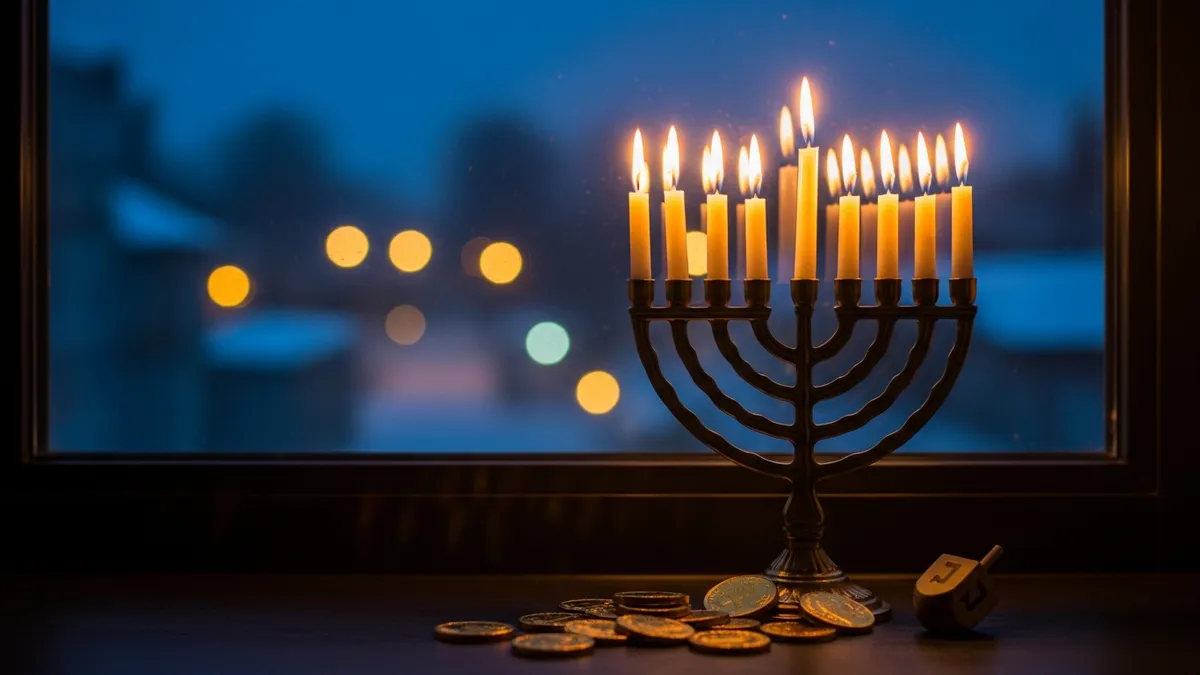
Hanukkah is the eight-day Jewish Festival of Lights celebrating the Maccabees' victory and the Temple's miracle of oil. How it all works.
Quick Answer
Hanukkah is an eight-day Jewish festival, usually falling in December, that commemorates the Maccabees' military victory over the Seleucid-Greek empire and the miracle of a one-day supply of Temple oil that burned for eight days. It is marked by nightly candle-lighting on a special menorah, fried foods, dreidel, and gelt.
Here is the short version, because some of you are going to skip to Google in thirty seconds anyway: Hanukkah is an eight-day Jewish holiday, usually in December, that commemorates the Maccabees' military victory over the Seleucid-Greek empire roughly 2,000 years ago and the miracle of a tiny jug of oil that kept the Temple menorah burning for eight days instead of one. Every night of the holiday, Jews light a special nine-branched menorah called a chanukiyah — one candle the first night, two the second, all the way to eight. We eat foods fried in oil to remember the miracle, spin a top called a dreidel, and give out gelt. That is the core of it.
Now let me actually tell you what this holiday is, where it comes from, and what it looks like from inside the home of someone who has celebrated it her entire life — because the Hallmark version you see at Target every November misses quite a lot.
The Historical Background (Plain English Version)
The story starts around 175 BCE. The Land of Israel was under the control of the Seleucid empire — think Greek culture transplanted onto a Syrian king. Antiochus IV came to power and decided that everyone in his kingdom should adopt Greek culture and religion. For most people in the ancient world, this was not a huge deal. But for Jews, it meant being told to abandon Torah, stop observing Shabbat, stop circumcising their sons, and stop keeping kosher. Under penalty of death.
Antiochus went further. He marched into Jerusalem, desecrated the Beit HaMikdash — the Holy Temple — and converted it into a Greek temple, complete with statues of Greek gods and pig sacrifices on the altar. This was not bureaucratic oppression. This was deliberate humiliation.
A Jewish priestly family in the town of Modi'in — Mattisyahu (Mattathias) and his five sons — refused to comply. When a Seleucid officer arrived to enforce the Greek decree, Mattisyahu killed him and fled with his sons to the hills. Thus began the Maccabean revolt. These were outnumbered, outarmed, undertrained fighters going up against one of the most powerful empires in the region. They fought as guerrillas. They should have lost by any military logic.
They won. After roughly three years of fighting, the Maccabees — led after Mattisyahu's death by his son Judah, called "the Maccabee" (the Hammer) — recaptured Jerusalem.
The Miracle: One Day's Worth of Oil
When the Maccabees entered the Temple to rededicate it and relight the menorah, they found catastrophic damage. But among the chaos, they found one small sealed jug of pure olive oil — enough to keep the menorah burning for exactly one day. Preparing a fresh supply of ritually pure oil would take eight days.
They lit it anyway.
The oil burned for eight days. That is the miracle we are still celebrating more than two thousand years later. Not just the military victory — which was itself remarkable — but this: faith in the face of insufficient resources, and the divine response to that faith.
The word "Chanukah" (which is how it is spelled in the transliteration I grew up using — more on spelling in a moment) means dedication. Specifically, the rededication of the Temple. Every time we light those candles, we are re-enacting that moment.
What Hanukkah Is NOT
Hanukkah is "Jewish Christmas"
Hanukkah is a relatively minor holiday in Jewish law — work is permitted, there are no special prayer restrictions, and it has zero theological connection to Christmas. It became prominent in America largely because of its calendar proximity to Christmas. The gift-giving tradition is mostly an American adaptation, not an ancient practice.
Let me say this clearly: Hanukkah existed for about 165 years before Christmas was a concept. The timing overlap is a coincidence of the calendar. Hanukkah falls on the 25th of Kislev on the Hebrew calendar — a lunar calendar — which means the date migrates around the Gregorian calendar each year. More on that below.
In terms of Jewish law, Hanukkah is a rabbinic holiday, not a biblical one. The major biblical holidays — Passover, Shavuot, Sukkot, Rosh Hashanah, Yom Kippur — carry far greater halachic weight. On those days, work is restricted. On Hanukkah, you can go to work, drive your car, turn on your phone. The holiday's outsized cultural presence in America is almost entirely a product of geography and timing, not religious significance.
What People Actually Do
Lighting the Menorah (Chanukiyah)
The central mitzvah — the religious obligation — of Hanukkah is lighting the chanukiyah: a nine-branched menorah (eight lights plus the shamash, the helper candle used to light the others). You place it in a window or doorway so it is visible from outside, because the mitzvah is pirsumei nisa — publicizing the miracle. You do not hide Hanukkah lights. You put them where people can see them.
The lighting pattern: one candle on night one, two on night two, up to eight on night eight. The candles — or oil — need to burn for at least about half an hour. During that time, the custom is to sit near the menorah, not do regular work, and let the flames do their thing. My husband and I turn off the overhead lights once everything is lit, and there is this moment — just the candles, the dark, the smell of wax or olive oil — that gets me every single time. It is one of those things that words do not quite capture.
For a much deeper look at the how and why of the lighting — wicks vs. candles, who lights, the full blessings, the songs — head over to the Chanukah observance guide.
Latkes and Sufganiyot: Why Everything Is Fried
The food connection to Hanukkah is direct: since the miracle involved oil, we eat foods fried in oil. The two main stars are:
Latkes — potato pancakes, grated and fried until crispy. The debate over sour cream versus applesauce as a topping is alive and well in my house, year after year. My husband is sour cream. I am applesauce. Our children have learned to play both sides strategically.
Sufganiyot — jelly doughnuts, deep-fried and filled with jam or custard or chocolate. In Israel, bakeries start stocking these in early Kislev and the selection gets more elaborate every year. Custard, halva, dulce de leche — they have gotten creative. My kids would eat sufganiyot three meals a day if I did not intervene.
Dreidel
The dreidel is a four-sided spinning top with Hebrew letters: Nun, Gimel, Hey, Shin — standing for Nes Gadol Haya Sham, "A great miracle happened there." In Israel, the last letter is Pey — Nes Gadol Haya Po, "A great miracle happened here." Children play for chocolate gelt (coins) or nuts. There is a tradition that when the Greeks outlawed Torah study, Jewish children studied in secret and kept dreidels nearby to quickly pretend they were just playing a game if soldiers appeared. Whether or not that is the historical origin, the story tells you everything about what kind of people we have always been.
Gelt
Gelt means money. Traditional Hanukkah gelt is coins — real or chocolate. Giving children actual money as part of Hanukkah goes back centuries and has a pedagogical angle: children were encouraged to give some of it to tzedakah (charity). The chocolate coin version is more recent and significantly less useful for tzedakah purposes, but my kids have no complaints.
Gift-Giving: The American Adaptation
I will be straight with you: elaborate Hanukkah gifts are mostly an American Jewish cultural adaptation. Living in a country where Christmas is everywhere in December, Jewish families developed gift-giving traditions to give their children something to look forward to during the same season. There is nothing wrong with this — my kids get presents, I am not going to pretend otherwise — but it is not an ancient or halachically significant practice. In more traditional communities, small gifts or gelt per night is the norm rather than eight nights of major presents.
How Orthodox Families Actually Celebrate
In Orthodox Jewish homes, Hanukkah has a specific texture. Shabbat is the weekly anchor of Jewish life — nothing competes with Shabbat in terms of religious significance — but Hanukkah has its own warmth.
In my house: each person has their own chanukiyah. On the eighth night there is a whole row of menorahs lined up on the windowsill, all eight candles burning on each — dozens of flames. I turn off the overhead lights and we stand there and look at them. The room glows orange and gold, and you can see it from the street. The singing of Maoz Tzur ("Rock of Ages," the traditional Hanukkah song) happens every night. There are latkes at least twice during the holiday. The sufganiyot are non-negotiable.
What you will not find in most Orthodox homes: Hanukkah as a Christmas substitute. No Hanukkah tree. No ornaments. No "holiday party" to replace a religious observance. The holiday is what it is — a beautiful, relatively minor festival about light, perseverance, and the refusal to assimilate — and it does not need to be inflated into something it is not.
The Spelling Chaos
Hanukkah. Chanukah. Hanukah. Chanuka. Hannukah.
They are all trying to spell the same Hebrew word: חֲנֻכָּה. The problem is that Hebrew has sounds that do not exist in English. The first letter is a chet (ח) — a guttural throat sound that English has no letter for. Some transliterations use "Ch" (as in Chanukah), some use "H" (as in Hanukkah), and some give up entirely. The double "k" or double "n" reflect attempts to show where the stress falls.
None of these spellings is wrong. They are all approximations of the same word. The Associated Press style guide uses "Hanukkah." Most American Jewish organizations use "Chanukah." My kids' school uses "Chanuka." I have stopped arguing about it. The candles burn the same either way.
When Does Hanukkah Fall?
Hanukkah begins on the 25th of Kislev — the third month of the Hebrew calendar, which is a lunar calendar. Because the Jewish calendar is lunar-solar (it adds leap months to stay roughly aligned with the solar year), Hanukkah falls somewhere in the November-to-January range on the Gregorian calendar, but the specific date shifts each year.
For a full explanation of how Jewish holidays work on the Hebrew calendar — and why every holiday seems to fall on a different secular date each year — that linked guide will walk you through the mechanics.
Common Questions
Is Hanukkah "the Jewish Christmas"? No — it's not even in Judaism's top tier of holidays. Chanukah is a rabbinic winter festival commemorating the Maccabean rededication of the Temple; Rosh Hashanah, Yom Kippur, and Passover outrank it religiously by miles. Its American prominence is a calendar accident — it lands near Christmas, so it absorbed the season's gift-giving gravity. We enjoy the latkes anyway.
What is the main purpose of Hanukkah? Pirsumei nisa — publicizing the miracle. That's why the menorah goes in the window facing the street rather than on the dinner table: the entire commandment is to make the miracle of the oil, and the victory of Jewish practice over forced assimilation, publicly visible. Eight nights of saying so with candles.
Is Hanukkah in the Torah? No. The events of Hanukkah happened roughly 165 BCE, after the Torah was already complete. The holiday is recorded in the books of Maccabees (which are not part of the Hebrew Bible) and in the Talmud, and was established as a rabbinic holiday by the rabbis of the Second Temple era.
Is Hanukkah the most important Jewish holiday? No — not even close, by Jewish law. Rosh Hashanah, Yom Kippur, Passover, Sukkot, and Shavuot are all higher-ranking on the halachic scale. Hanukkah became the most culturally visible Jewish holiday in America largely because of its December timing, not because of its religious weight.
Can you work during Hanukkah? Yes. Unlike Shabbat or the major biblical holidays, Hanukkah carries no prohibition on labor. You go to work, use your phone, drive — life continues normally. The one restriction some women observe is not doing certain work (traditionally, sewing or spinning) while the Hanukkah candles are burning.
Do all Jews celebrate Hanukkah the same way? The core — lighting the chanukiyah — is universal. The customs around it vary by community. Ashkenazi families in America tend toward latkes; Israeli and Sephardic families lean toward sufganiyot or other fried foods. The amount of gift-giving varies enormously. Hasidic families, very traditional Litvish families, Modern Orthodox families — the vibe is different in each home. The candles are the same.
Why nine branches if it is an eight-day holiday? The ninth branch holds the shamash — the "helper" candle used to light the others. The actual Hanukkah lights are not supposed to be used for illumination or practical purposes; they are holy. So you have a separate candle (the shamash) to light everything and to provide the functional light in the room. It is kept visibly distinct — usually higher or lower than the eight lights.
The philosopher in me loves what Hanukkah is actually about: light in the darkest time of year, a small flame that should not have lasted, a people that should not have survived the assimilation pressure and the military odds — and yet here we are, still lighting those candles, still singing the same songs, still frying the latkes. A small thing, sustained against all logic. That is pretty much the story of the Jewish people in a nutshell.
If you want to go deeper into how Orthodox families actually celebrate — the blessings, the songs, the full customs night by night — the Chanukah guide has all of it.
I'm an Orthodox Jewish woman from Brooklyn. I can't speak for every Orthodox Jew — when I write outside my experience, I say so.
Chanukah: What It Really Means (Not Jewish Christmas)
Jewish Holidays: The Complete Jewish Calendar Guide
What Is a Dreidel? The Chanukah Spinning Top Explained
What is Orthodox Judaism? A Complete Guide
Want to experience a Jewish holiday yourself?
Virtual Seders, Rosh Hashanah dinners, and Chanukah candle-lightings are open to non-Jewish guests.
The Orthodox Insider
A new letter every Thursday, before Shabbos — plus an instant download of “10 Things Everyone Gets Wrong About Orthodox Jews” when you subscribe.
No spam, unsubscribe anytime.