What Is Havdalah? The Beautiful Ceremony That Ends Shabbat
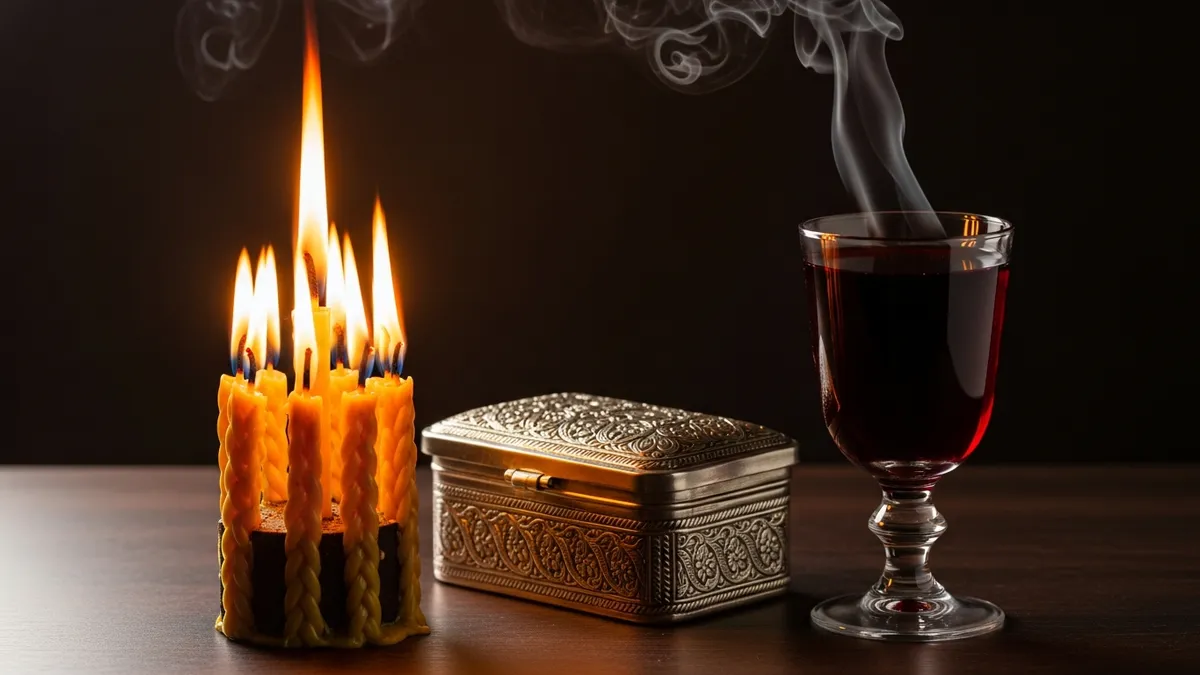
Learn about Havdalah — the beautiful Jewish ceremony that marks the end of Shabbat with wine, spices, and a braided candle. Understand its meaning and customs.
Quick Answer
Havdalah is the ceremony that marks the end of Shabbat on Saturday night. It uses wine, fragrant spices, and a braided multi-wick candle to separate the holy Sabbath from the ordinary week ahead. The word havdalah means 'separation' — we are distinguishing between sacred and everyday time.
If kiddush is how we welcome Shabbat, havdalah is how we say goodbye. And honestly? Havdalah is one of the most beautiful moments of the entire week. The lights are dim, the braided candle is flickering, the smell of spices fills the room, and my children gather close to watch the flame dance. It is magical in the most grounded, real way.
Havdalah (Hebrew: הבדלה, meaning "separation" or "distinction") is the ceremony performed on Saturday night after Shabbat has ended — specifically, after three stars are visible in the sky, which traditionally marks the transition from Shabbat to the new week. It is a short ceremony, maybe five minutes, but it carries enormous weight.
The Four Elements
Havdalah uses four sensory elements, each with its own blessing:
Wine — As with kiddush, we begin with a full cup of wine (or grape juice). The bracha "Borei pri hagafen" is recited. Wine bookends Shabbat — it welcomes Shabbat on Friday night and bids it farewell on Saturday night.
Spices (besamim) — Fragrant spices — often cloves, cinnamon, or a special besamim blend kept in a decorative spice box — are blessed and smelled. The reason is poignant: the rabbis teach that on Shabbat, every Jew receives a neshamah yeseirah, an additional soul. When Shabbat ends and that extra soul departs, the spices revive our spirits and comfort us in the loss. The smell is a consolation. My kids always fight over who gets to smell the besamim first.
Fire — A special braided candle with multiple wicks is lit, and the blessing "Borei me'orei ha'eish" (who creates the lights of fire) is recited. This celebrates the fact that we can now use fire again — something prohibited on Shabbat. The candle must have at least two wicks so that the flames merge into a torch-like light. People hold their hands up to the flame and look at the reflection of light on their fingernails, seeing the distinction between light and shadow — between the holy and the ordinary.
The havdalah blessing itself — The final bracha thanks Hashem for distinguishing between holy and ordinary, between light and darkness, between Israel and the nations, between Shabbat and the six working days.
The Ceremony
The person leading havdalah holds the cup of wine in their right hand while the blessings are recited. Someone else — often a child — holds the candle. Another person holds the spice box. After all the brachot, the leader drinks the wine, and then the candle is extinguished by dipping it into the leftover wine. The sizzle of the flame going out is the sound of Shabbat ending. My youngest always gasps when it happens, even though she has seen it every week of her life.
Some have the custom of dipping a finger into the spilled wine and touching it to their eyes or pockets — a segulah (spiritual custom) for blessing. My kids put wine behind their ears. I have no idea where they picked that up, but they insist on it.
After Havdalah
Once havdalah is made, the new week officially begins. Lights can be turned on, phones can be checked (though many people wait a bit before diving back into the world), and regular weekday activities resume.
Many families sing "Eliyahu HaNavi" (Elijah the Prophet) after havdalah, expressing hope that the prophet Elijah will come and bring the Mashiach (Messiah) — perhaps this very week. Other songs follow depending on family custom, and some people wish each other "shavua tov" (a good week).
There is a tradition that Motzei Shabbat (Saturday night) is an auspicious time — a time of favor from Above. Some people use this time to begin new projects or make important decisions.
The Bittersweet Moment
Havdalah is beautiful, but it is also a little sad. Shabbat is leaving, and the regular world is coming back. The phone buzzes. The to-do list returns. The peace of Shabbat gives way to the hustle of Sunday. I always feel a small pang when the candle goes out.
But that is exactly the point of havdalah. We are not pretending that every day is Shabbat. We are acknowledging the difference — the separation — between the holy and the ordinary. And in naming that difference, we give Shabbat its full weight. It was special. It mattered. And now we carry its light into the week ahead.
I'm an Orthodox Jewish woman from Brooklyn. I can't speak for every Orthodox Jew — when I write outside my experience, I say so.
Shabbat — The Jewish Day of Rest Explained
What Is Kiddush? The Shabbat Blessing Over Wine
Jewish Holidays: The Complete Jewish Calendar Guide
The Jewish High Holidays: Rosh Hashanah & Yom Kippur
Want to experience a Jewish holiday yourself?
Virtual Seders, Rosh Hashanah dinners, and Chanukah candle-lightings are open to non-Jewish guests.
The Orthodox Insider
A new letter every Thursday, before Shabbos — plus an instant download of “10 Things Everyone Gets Wrong About Orthodox Jews” when you subscribe.
No spam, unsubscribe anytime.