What Is Kiddush? The Shabbat Blessing Over Wine
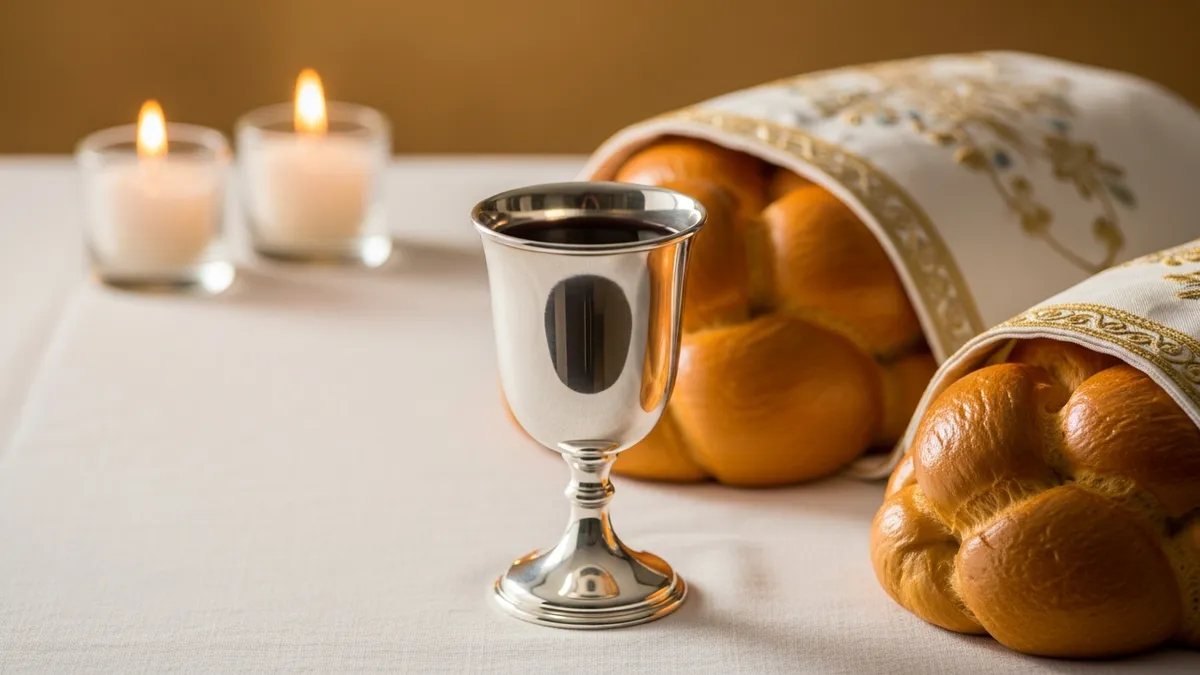
Kiddush is the Jewish blessing over wine that sanctifies Shabbat and holidays. Learn what it means, when it's recited, and the customs behind it.
Quick Answer
Kiddush is the blessing recited over a cup of wine or grape juice to sanctify Shabbat and Jewish holidays. Said on Friday night and Shabbat morning, it formally declares the holiness of the day. The word kiddush comes from 'kadosh' (holy) — we are literally making the day holy through words and wine.
Every Friday night, my family gathers around the table. The candles are lit, we have come home from shul, and before anyone touches the food — before the challah, before the soup, before anything — my husband stands and makes kiddush. He lifts the cup of wine, and everything stops. The kids stand still (mostly). The room is quiet. This is how Shabbat officially begins in our home.
Kiddush (Hebrew: קידוש, from the root kadosh, meaning holy) is the prayer recited over wine to sanctify Shabbat and Jewish holidays. The obligation to mark the holiness of Shabbat in words — "remember the Sabbath day to sanctify it" — is Torah-level. The requirement to make that declaration over a cup of wine is an enactment of the Sages, who gave the mitzvah its familiar form.
Friday Night Kiddush
The Friday night kiddush is the more elaborate version. It includes:
- Vayechulu — the passage from Bereishis (Genesis) describing how Hashem completed creation and rested on the seventh day
- The bracha over wine — "Borei pri hagafen" (who creates the fruit of the vine)
- The sanctification blessing — thanking Hashem for giving us Shabbat as a remembrance of both creation and the Exodus from Egypt
The kiddush is typically recited by the head of the household while standing, holding a full cup of wine (or grape juice). Everyone present listens and answers "Amen," and then everyone drinks from the wine. In my family, my husband pours a little into small cups for each of the kids. They love this part — it is one of the highlights of their Friday night.
After kiddush, everyone washes their hands for bread, and we make the bracha over the challah. The Shabbat meal officially begins.
Shabbat Morning Kiddush
There is also a kiddush on Shabbat morning, sometimes called "kiddush rabbah" (the great kiddush), which is actually shorter than the Friday night version. It includes the bracha over wine and a passage about Shabbat. This is recited before the Shabbat day meal.
In many shuls, a communal kiddush is held after Shabbat morning davening. This is a social gathering with wine, cake, herring, kugel, cholent, and whatever else the sponsors have provided. When someone says "there is a kiddush in shul this week," people get excited. A good shul kiddush is a serious event.
Sponsoring a kiddush in shul is common for celebrations — a new baby, a bar mitzvah, a yahrtzeit, or just because. My husband and I sponsored one when our youngest was born. I made twelve kugels. Twelve. I am still recovering.
Holiday Kiddush
On Jewish holidays (Yom Tov), the kiddush text changes to reflect the specific holiday. Rosh Hashanah, Sukkos, Pesach, Shavuos — each has its own version that mentions the particular holiday and its significance. On Pesach, the kiddush is part of the seder and includes additional elements.
The Kiddush Cup
The cup used for kiddush should hold at least a revi'is — a specific halachic measure of liquid, generally about 3 to 5 ounces depending on the opinion followed. Many families have a special kiddush cup — often silver, sometimes passed down through generations. My husband uses the kiddush cup his grandfather brought from Europe. It is dented and the base is slightly crooked, but he would not trade it for anything.
The cup should be filled to the brim — representing fullness and blessing. Some have the custom of letting it overflow slightly onto a small plate beneath. The wine should be good wine, not something you would be embarrassed to serve to a guest. Grape juice is perfectly acceptable for those who prefer it, and it is what we give the children.
Why Wine?
Wine in Judaism represents joy and significance. The Talmud says: "There is no simcha (joy) without wine." Wine elevates a moment from ordinary to special. By making the blessing over wine and declaring the holiness of Shabbat, we are taking an ordinary Friday evening and transforming it. We are saying: this is not just another night. This night is kadosh. And with that declaration, it becomes so.
That is really what kiddush is about — the power of words to create holiness. Shabbat comes whether we acknowledge it or not. But kiddush is our way of stepping into it deliberately, with intention and with joy.
I'm an Orthodox Jewish woman from Brooklyn. I can't speak for every Orthodox Jew — when I write outside my experience, I say so.
Want to experience a Jewish holiday yourself?
Virtual Seders, Rosh Hashanah dinners, and Chanukah candle-lightings are open to non-Jewish guests.
The Orthodox Insider
A new letter every Thursday, before Shabbos — plus an instant download of “10 Things Everyone Gets Wrong About Orthodox Jews” when you subscribe.
No spam, unsubscribe anytime.