Why Can't You Press the Elevator Button on Saturday?
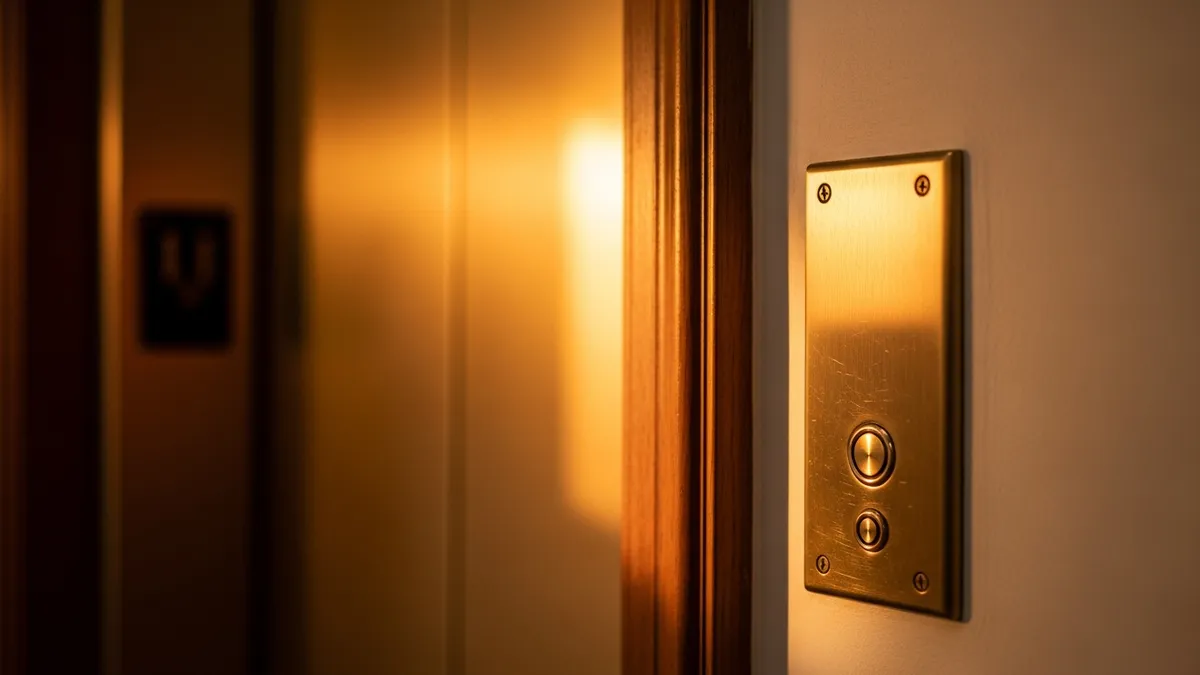
The Shabbat elevator is real — and here's why Orthodox Jews can't press buttons, flip switches, or use electronics from Friday night to Saturday night.
Quick Answer
Pressing an elevator button completes an electrical circuit, which many poskim consider a form of 'building' or 'kindling' under Shabbat law (the exact reason is debated). Orthodox Jews avoid electrical activity on Shabbat. Many buildings in Orthodox neighborhoods have 'Shabbat elevators' that stop on every floor automatically so no one needs to press a button.
You are in a hotel in Jerusalem. It is Saturday. You press the elevator button. A man in a black suit and hat is waiting next to you. The elevator arrives, you get in, press your floor — and he gets in too, but presses nothing. The elevator stops at every single floor on the way up. Welcome to the Shabbat elevator. I have stood in that elevator at the eleventh floor watching it stop at two, three, four, five, and honestly, after a minute you stop counting and just make peace with it.
The Rule
On Shabbat (from Friday sunset to Saturday nightfall), we refrain from 39 categories of creative work, the melachot. Pressing a button or flipping a switch runs into several of them. Here is the part most people do not expect: there is no single agreed-upon reason electricity is forbidden, because electricity simply did not exist when these categories were given. So the poskim — the halachic decisors of the last century — actually debate which melacha is at stake:
- Mav'ir (kindling) — the clearest case is anything with a glowing wire or heating element, like an old incandescent bulb or a toaster coil. A filament that glows is treated as real fire. (For an LED or a quiet motor with no heat, this reason is much weaker.)
- Boneh (building) — the Chazon Ish, one of the most influential poskim on this question, held that closing a circuit "builds" a functioning device that did not exist a moment before.
- Makeh b'patish (the finishing blow that completes a vessel) — a further consideration some raise, though it is the least central of the three.
For many poskim, switching on a modern electronic with no spark or heat is forbidden on a rabbinic level rather than as a clear-cut biblical melacha. The bottom line for daily life is the same either way: no light switches, no elevator buttons, no phones, no computers, no appliances that need to be turned on. (I go deeper into the electricity question here.)
The Shabbat Elevator Solution
In buildings with Orthodox residents — especially apartment towers in Israel, hotels, and hospitals — elevators are set to "Shabbat mode":
- The elevator runs continuously on a timer
- It stops at every floor automatically
- Doors open and close on a schedule
- No one needs to press anything
Yes, it is slow. Yes, you will wait. But it allows Orthodox residents of high-rise buildings to reach their apartments without violating Shabbat.
What You'll Notice in My House on Shabbat
If you came to me for Friday night, none of this would be announced — but a guest who is paying attention starts to see it everywhere.
Lights that turn themselves on and off — The lamps in our living room are on timers set before Shabbat. So if you see a light click on in an empty room at nine o'clock, no one flipped it. We just decided in advance when the house would be lit.
The urn humming on the counter — A big electric urn goes on before Shabbat and keeps water hot until Saturday night. About the tea and coffee, though: this is where it gets genuinely intricate. Because pouring boiling water straight onto loose leaves or fresh grounds raises a real bishul (cooking) concern, most of us do not do that. I make a tea essence on Friday and pour it through a second cup (a kli sheni), or we use instant coffee — pouring through an intermediate vessel so the water has cooled a degree first. That little dance is exactly why people say hot drinks on Shabbat are "complicated."
The crockpot that nobody opens — My cholent — the iconic Shabbat stew — goes into the slow cooker on Friday afternoon, and we do not touch it again until lunch the next day. It just sits there getting better while we sleep.
Pre-torn toilet paper — Tearing paper to a size you want runs into the melacha of tearing (koreya) and shaping-by-cutting (mechatech), so we do not tear on Shabbat. The simple fix in almost every Orthodox home is a box of tissues or paper torn ahead of time.
The blech on the stovetop — This one confuses guests. A blech is a flat metal sheet laid over the burners and the knobs. Its job is not really to "keep food warm" — it is to cover the flame and the controls so no one absent-mindedly turns the fire up or down on Shabbat. (When the food is in the oven instead, we just set it low before Shabbat and leave it; same idea, different appliance.)
Why Not Just Make an Exception?
This is the question every outsider asks. And the answer is the most important thing to understand about Orthodox Jewish observance:
The rules are the point, not the obstacle. Shabbat is designed to be a complete break from human manipulation of the environment. By not pressing buttons, not flipping switches, not creating or destroying — you spend 25 hours as a guest in the world rather than its master. The inconvenience is intentional. The rest it creates is real.
So when I think back to that man in the Jerusalem elevator who pressed nothing, I do not see someone trapped by a rule. I see someone who, for one day, has handed back the controls. And that is what Shabbat actually feels like in my house: the phone is off, the cholent is cooking itself, the lights come and go without me, and for twenty-five hours my family is simply present with each other instead of managing things. The man waiting through every floor is not suffering through a restriction. He is choosing a day where he does not run the world. In a life that demands constant control, constant availability, constant productivity — that choice is more radical than it looks. (If you want the bigger picture of how the whole day fits together, start with Shabbat observance.)
I'm an Orthodox Jewish woman from Brooklyn. I can't speak for every Orthodox Jew — when I write outside my experience, I say so.
Shabbat — The Jewish Day of Rest Explained
Why Don't Orthodox Jews Use Electricity on Shabbat?
What Is a Shabbat Elevator?
Orthodox Jewish Sabbath Rules: What You Can't Do on Shabbat
Want to experience a Jewish holiday yourself?
Virtual Seders, Rosh Hashanah dinners, and Chanukah candle-lightings are open to non-Jewish guests.
The Orthodox Insider
A new letter every Thursday, before Shabbos — plus an instant download of “10 Things Everyone Gets Wrong About Orthodox Jews” when you subscribe.
No spam, unsubscribe anytime.