Why Do Jews Wear Yarmulkes? The Kippah, Explained
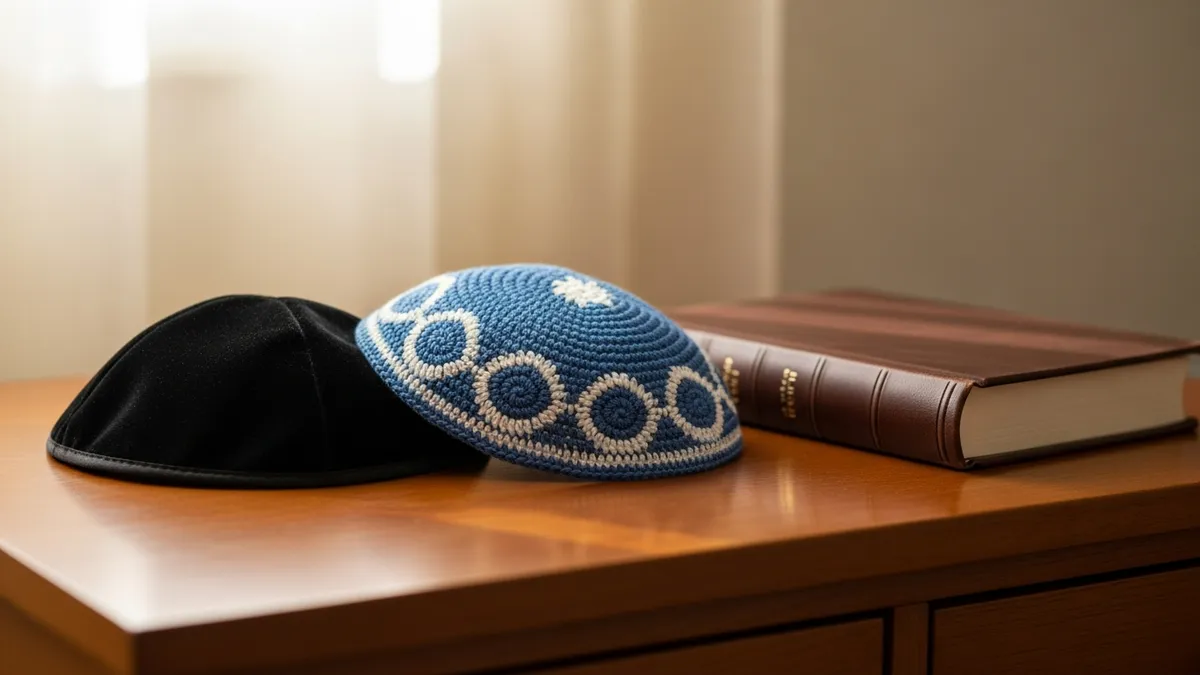
Why do Jews wear yarmulkes? What the kippah means, where the custom comes from, who wears one and when, and what the different styles quietly signal.
Quick Answer
Jews wear yarmulkes (kippahs) as a constant physical reminder that G-d is above them. The practice began as a custom of reverence recorded in the Talmud and became binding practice for Orthodox men, who keep the head covered all day, not just in synagogue. The style — black velvet, knit, suede — often quietly signals which community the wearer belongs to.
The small cap you've seen on Jewish men's heads has two everyday names: yarmulke (the Yiddish word, pronounced YAH-mə-kə) and kippah (the Hebrew word, pronounced kee-PAH; plural kippot). Same object, same purpose — a constant, physical reminder that G-d is above us.
My sons put theirs on before they're fully awake. It goes on with the first stretch, before breakfast, before anything — because in our house, as in every Orthodox home, a bare head feels the way walking outside without shoes would feel to you. Let me explain how a piece of cloth the size of a saucer came to carry that much weight.
Where the Practice Comes From
The Torah itself commands head covering only for the priests serving in the Temple. For everyone else, the yarmulke began as a custom of reverence — and the Talmud gives us its logic in two famous moments. In one, a sage would not walk even a few steps bareheaded, saying the Divine Presence rests above his head. In the other, a mother is told her son is destined to be a thief; she makes him keep his head covered so that "the fear of Heaven will be upon you," and it works — until the day his covering slips.
That's the whole theology in miniature: the covering doesn't protect the head, it positions it. Something is above you. Behave accordingly.
Over the centuries this custom hardened into accepted law for Jewish men, codified in the standard halachic codes. By now, for an Orthodox man, going bareheaded is simply not among the options — it would read, to himself most of all, as declaring that nothing is above him.
What Is a Yarmulke, Practically Speaking?
A round cloth cap, usually 4 to 8 inches across, resting on the crown of the head. It has no strap; it stays on by fit, friction, or — for slippery hair and windy days — a simple clip. There is nothing holy about the object itself: a lost yarmulke is replaced without ceremony, and in a pinch any covering (a baseball cap, a napkin at an outdoor wedding, a hand) does the job. The mitzvah is the covered head, not the cap.
Orthodox men wear one all day — working, eating, driving, watching their kids' baseball games — not just at prayer. Many also add a hat over it for prayer or as community dress; the yarmulke stays on underneath. Boys start as toddlers, usually from age three.
What the Styles Quietly Signal
Here is the part outsiders never suspect: to a Jewish eye, the yarmulke is a business card. The material and size tell you a great deal about the wearer's community before he says a word.
- Black velvet — the standard in Hasidic and Yeshivish (Haredi) communities.
- Knitted / crocheted (kippah serugah) — the signature of Religious Zionist and Modern Orthodox circles; colors and patterns vary freely.
- Suede or leather — common in Modern Orthodox and traditional American communities.
- Large white knitted with a tassel — associated with Breslov Hasidim.
- Satin — the classic "synagogue drawer" kippah handed out at bar mitzvahs and weddings, worn by guests.
None of this is law — a man may wear whatever covers his head — but communities develop uniforms, and the yarmulke is the most legible one. (My husband's is black velvet; I could sort our whole block's affiliations from a second-story window.)
Jewish Head Covering for Women
Women's head covering is a different practice with different rules. Jewish law asks married women to cover their hair — with a wig, scarf, or hat — as a matter of modesty, not to wear a kippah; unmarried girls don't cover at all in Orthodox practice. The full story is in why Orthodox Jewish women cover their hair and the sheitel guide. If you see a woman in a kippah, she is almost certainly from a non-Orthodox community, where some women have adopted it as an egalitarian practice.
Common Questions
Do Jews wear yarmulkes in the shower or while sleeping? No — bathing and swimming are off the hook, and sleep customs vary (many wear a soft one at night, many don't). The obligation is understood as covering the head during waking, upright life.
What happens if a yarmulke falls off? He puts it back on. That's it — no penalty, no ritual. If it blows away entirely, a hand on the head works until a replacement appears.
Can a non-Jew wear a yarmulke? Yes, and at the right moments it's a courtesy: synagogues offer guest kippot at the door for services, weddings, and bar mitzvahs, and putting one on is read as respect, exactly like removing a hat in other settings. Outside those settings there's no reason to wear one — nobody expects it.
Why don't all Jewish men wear one? Because the all-day covered head is Orthodox practice. Many Conservative Jews cover only for prayer and religious study; many Reform and secular Jews only in synagogue, if there. Like most visible Jewish practice, the yarmulke tracks observance level — the denominations differ on this the way they differ on most things.
Is there a required color or size? No. Halacha wants the head covered; everything else — velvet versus knit, saucer versus soup-bowl — is community custom and personal style. The only real rule of thumb: it should actually be visible as a covering, not a token hiding under a comb-over.
The yarmulke is the smallest garment we own and the hardest-working. It converts an ordinary head into a reminded one — and after a lifetime of wearing it, most men will tell you the bare-headed feeling isn't freedom. It's forgetting something.
I'm an Orthodox Jewish woman from Brooklyn. I can't speak for every Orthodox Jew — when I write outside my experience, I say so.
There's more where this came from.
Orthodox Jewish dress touches on modesty, community identity, and religious law. The full tour covers it all.
The Orthodox Insider
A new letter every Thursday, before Shabbos — plus an instant download of “10 Things Everyone Gets Wrong About Orthodox Jews” when you subscribe.
No spam, unsubscribe anytime.