Jewish Cuisine: The Foods, the History, the Taste
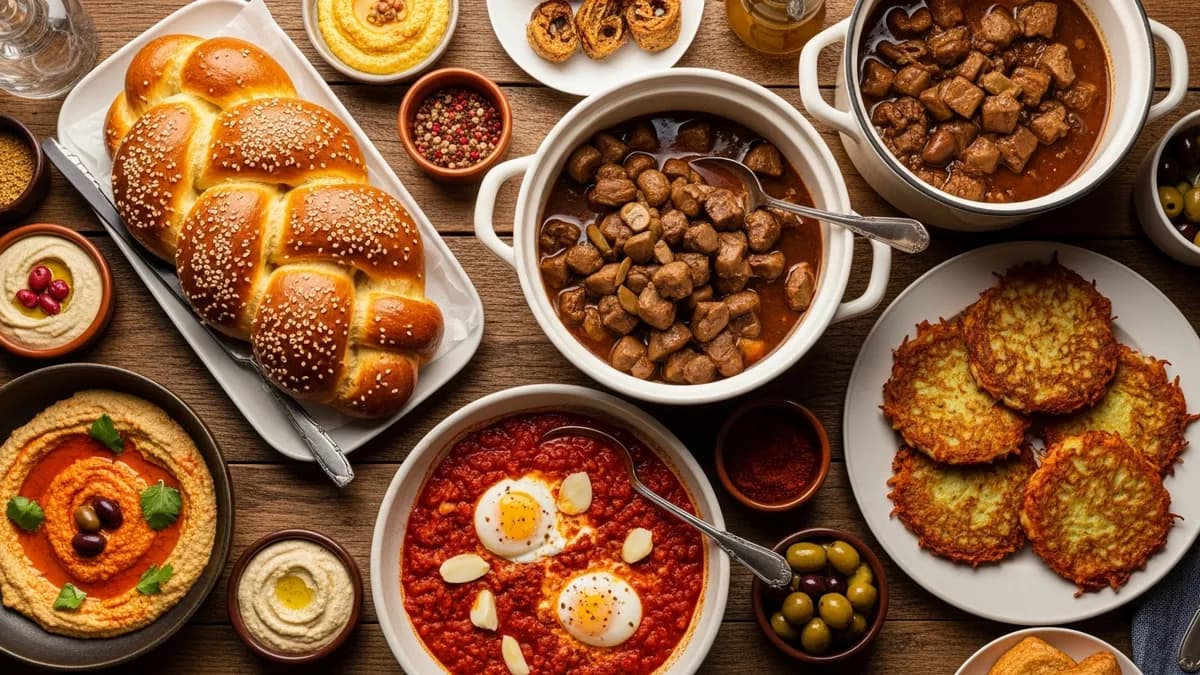
Jewish cuisine spans three great traditions shaped by kosher law, poverty, and exile. Here's the full story — from cholent to shakshuka.
Quick Answer
Jewish cuisine is a family of distinct culinary traditions shaped by kosher dietary law, centuries of migration, and the rhythms of Shabbat and holidays. The three major traditions — Ashkenazi (Eastern Europe), Sephardi (Spain and the Mediterranean), and Mizrahi (Middle East and North Africa) — each developed their own iconic dishes, though all share the same halachic foundation.
Food is the thing that hits first. Before you understand a word of the language, before you've sat through a Shabbat meal, before anyone has explained a single holiday — you smell the food, and you feel something. My grandmother never gave a speech about Jewish identity. She handed you a slice of kugel.
I am an Orthodox Jewish woman who grew up Hasidic in Brooklyn, and I have spent my entire adult life standing over pots. My Shabbat table has fed a lot of people — my own large family, neighbors, guests from every background — and without fail, food is what opens the conversation. So let me tell you about Jewish cuisine: what it is, where it came from, and why it tastes the way it does.
For the record, "Jewish food" and "kosher food" are not the same thing. Not every Jewish dish is automatically kosher-certified, and not every kosher food is traditionally Jewish. For the rules that govern what is and isn't kosher, see what is kosher. This article is about the food itself — the traditions, the history, and the dishes that have been passed down through generations of Orthodox Jews.
How Three Ingredients Shaped Everything
Before you can understand any specific dish, you need to understand the three forces that shaped all of Jewish food.
Kosher law set the parameters. Meat and dairy must never be mixed. Pork and shellfish are out. Animals must be slaughtered according to specific rules. These laws are detailed in what is kosher, but for our purposes, the key point is that they pushed Jewish cooks toward specific combinations — and away from others. You won't find a cheeseburger on any authentic Jewish table. But you will find extraordinary things done with braised brisket, slow-cooked beans, and oil-fried everything.
Poverty and exile shaped what those kosher ingredients actually were. For most of Jewish history, most Jewish communities were poor and politically vulnerable. They made extraordinary food from cheap cuts of meat, dried beans, preserved fish, and whatever produce was available in their region. The fact that Ashkenazi cholent is made from cheap flanken and kidney beans isn't an accident — those were the ingredients a poor family in 19th-century Poland could actually afford. The genius of Jewish cuisine is what it does with limited materials.
Shabbat and the holidays created the entire engine of Jewish cooking. Shabbat observance prohibits cooking from Friday sundown to Saturday night. That single restriction is responsible for an enormous portion of Jewish culinary innovation — including cholent, the most beloved dish in the Ashkenazi world, which exists entirely because Jews needed a way to have hot food on Saturday without cooking. I'll come back to this.
Ashkenazi Cuisine: Eastern Europe and the American Deli
Ashkenazi Jews lived in Eastern Europe — Poland, Russia, Ukraine, Hungary, Romania — for centuries, and the food they developed there reflects the climate, the poverty, and the particular genius of people who knew how to make something from nothing.
The centerpiece of Ashkenazi Shabbat is cholent, the slow-cooked stew that goes on the fire Friday afternoon and comes off Saturday at lunch. Meat, potatoes, beans, barley, onions — it sounds simple, and it is. What eighteen hours of patient heat does to those ingredients is another matter entirely. If you have never walked into a house on a Saturday morning after the cholent has been cooking overnight, you do not know what you are missing. Every family's recipe is different. My husband's family adds sweet potatoes and honey. Mine adds ketchup. There are strong feelings about this.
Then there is kugel — a baked pudding that comes in two completely different worlds. Potato kugel (shredded potato, eggs, oil, onions) is the savory one, crispy on the outside and custardy inside. Lokshen kugel (egg noodle kugel) can go either sweet (with raisins and cinnamon) or peppery and savory, depending entirely on the family's minhag. I grew up with the sweet kind. My husband grew up with the peppery kind. We make both.
Gefilte fish deserves its own moment. I know what people say — I've heard the jokes. But gefilte fish done right, made from scratch with fresh whitefish and pike, lightly sweetened the Hungarian way or peppery the Polish way, served with a sharp horseradish that clears your sinuses from three feet away — it is genuinely delicious. What most people have tried is the jarred kind, which is a different experience. Don't judge the original by the jar.
Challah, the braided egg bread served on Shabbat and holidays, is the most beautiful thing that comes out of an Ashkenazi kitchen. The smell alone is enough. What is challah covers the whole story, but for now just know that challah is not optional — it is the vessel through which Shabbat begins. Brisket (slow-braised beef, usually with tomatoes and onions) is the holiday roast. Matzah balls — fluffy or dense, and again, there are strong feelings — float in golden chicken soup on Yom Tov. And latkes, fried potato pancakes, appear every Chanukah without fail, filling the kitchen with a smell that is either wonderful or alarming depending on your ventilation.
The Ashkenazi deli tradition is a separate story. When Eastern European Jewish immigrants flooded into America — especially New York — in the late 1800s and early 1900s, they brought their food with them, adapted it to what was available, and accidentally invented an American culinary institution. Pastrami (cured and smoked beef) on rye. Corned beef. Lox (salt-cured salmon) on a bagel with cream cheese. Knishes. Kishke. Dr. Brown's cream soda on the side. The Jewish deli conquered New York and, through New York, much of American food culture. Even people who have never set foot in a synagogue know what a pastrami sandwich is.
One important note: the classic deli combination of pastrami with mustard on rye, or lox with cream cheese, works because it keeps meat and dairy completely separate. Pastrami is meat — no cheese. Lox with cream cheese is dairy — no meat. The kosher rules shaped even the deli menu.
Sephardi Cuisine: Spain, the Mediterranean, and Adafina
Sephardi Jews trace their ancestry to the Jews expelled from Spain in 1492, who settled throughout the Mediterranean — Turkey, Greece, the Balkans, North Africa, the Land of Israel. The food is warmer, spicier, and more Mediterranean in character than Ashkenazi cooking.
The Sephardi counterpart to cholent is adafina — arguably cholent's ancestor, since Spanish-Jewish adafina predates the Eastern European version by centuries. It uses chickpeas instead of kidney beans, includes hard-boiled eggs that cook overnight in their shells (huevos haminados, which turn a deep golden-brown and develop a silky, rich flavor), and is seasoned with cumin and coriander rather than paprika. I have a friend from a Moroccan family who makes dafina, the North African variation, and the first time she served it to me I genuinely did not speak for several minutes. That is high praise.
Bourekas — savory pastries filled with cheese, potato, or spinach, with sesame seeds on top — are the great Sephardi snack food. You can find them all over Israel today. Sephardi fish dishes are magnificent: fish cooked in chraime, a fiery tomato-and-pepper sauce, is a Friday night staple in many Moroccan and Libyan Jewish households. Since fish is pareve (neither meat nor dairy), it can appear with both — making it enormously flexible in a kosher kitchen.
Sephardi cuisine is generally fragrant with saffron, cinnamon, cumin, and fresh herbs in ways that Ashkenazi cooking typically isn't. The two worlds sat side by side for centuries without much overlap, which is why your Ashkenazi grandmother's chicken soup tastes nothing like your Sephardi neighbor's.
Mizrahi Cuisine: The Middle East and North Africa
Mizrahi Jews — communities from Iraq, Iran, Yemen, Morocco, Egypt, Syria, and across the Arab world — represent some of the oldest continuous Jewish communities in existence, and their food is extraordinary.
Kubbeh, a dish of stuffed semolina or bulgur dumplings filled with spiced meat, is a Mizrahi masterpiece. Iraqi kubbeh soup, with the dumplings floating in a tart beet or tomato broth, is something you could eat every day and not tire of. Shakshuka — eggs poached in a spiced tomato sauce — has become internationally famous, but it has deep roots in North African Jewish cooking, particularly among Libyan and Tunisian Jews.
Yemenite Jewish food is in a category of its own. Jachnun is a slow-baked rolled pastry that cooks overnight (yes, another Shabbat slow-cook) and is traditionally served on Saturday morning with grated tomato and hard-boiled eggs. Malawach is a flaky, layered fried bread, rich and golden. Both are deeply satisfying in the way that only foods built around patience and fat can be. Yemenite chicken soup, spiced with hilbeh (fenugreek paste) and hawaij (a spice blend of turmeric, cumin, cardamom, and pepper), is one of the great soups in the world.
Moroccan Jewish cuisine is perhaps the most complex in the Mizrahi family — elaborate pastilla (sweet-savory pigeon or chicken pie in phyllo), preserved lemons, chermoula-marinated fish, and the whole spectrum of Moroccan spice traditions adapted through a kosher lens.
Israeli Food: The Beautiful Collision
Israel brought all of these traditions into one place, and what happened is exactly what you'd expect: a collision that produced something entirely new. Israeli food today is a fusion of Ashkenazi, Sephardi, Mizrahi, and Arab culinary traditions, running on fresh local produce from a Mediterranean climate.
Hummus and falafel get claimed by many people, and the conversation about their origins is genuinely complex — they are Arab foods that became central to Israeli food culture, and Israelis have developed their own exceptional versions. Israeli hummus, made fresh and served warm with olive oil and za'atar, is legitimately different from the tub you buy at the grocery store. Falafel in a good laffa with Israeli salad, pickles, and tahini is a perfect food.
Israeli street food, open-air markets (machane yehuda in Jerusalem is the cathedral of this), and the restaurant scene in Tel Aviv reflect what happens when you put every Jewish culinary tradition in one warm country with excellent produce and tell people to cook. The results are remarkable.
The Shabbat and Holiday Engine
I want to come back to something I mentioned earlier, because it explains so much about why Jewish food is the way it is.
Shabbat observance prohibits cooking on Shabbat itself. So does every major Jewish holiday. This means that observant Jews have been planning and preparing food in advance — often cooking things that can be kept warm for 18+ hours — for thousands of years. That pressure produced slow-cooked stews across every tradition: cholent in Ashkenaz, adafina and dafina in the Sephardi world, jachnun in Yemen. All different. All invented for the same reason.
The holidays added their own engine. Matzah on Passover means eight days of cooking without leavened bread, which has produced an entire sub-cuisine of Passover-only dishes. Rosh Hashanah has its symbolic foods — honey cake, apple dipped in honey, pomegranate seeds, fish head. Chanukah means oil-fried foods (latkes, sufganiyot donuts) commemorating the miracle of the oil. Purim means hamantaschen — triangular jam-filled cookies. The Jewish calendar is essentially a food calendar with prayers attached.
In My Kitchen
My own table is a small collision of traditions. I grew up with Hungarian-Hasidic cooking — sweet kugel, sweet cholent, sweet almost everything, which is the Hungarian way. My husband grew up Litvish in Lakewood — his family's cooking is simpler, more restrained, peppery rather than sweet.
So my challah is my grandmother's recipe (richer, slightly sweet). My cholent leans toward my side (peppery, with ketchup — I've written about this before and I stand by it). But his mother's sweet potato tzimmes appears every Rosh Hashanah because my kids have declared it non-negotiable. And somewhere along the way I learned to make shakshuka on Sunday mornings, and now that's also non-negotiable.
That's Jewish cuisine, really. It's the sum of everyone who sat at your table, everyone who taught you something, every community that figured out how to make something beautiful from what they had. It travels with people. It survives. And every dish carries the memory of every time it was made before.
If you want to try making some of these dishes yourself, orthodox-jewish-food-recipes is a good place to start.
Common Questions
Is all Jewish food kosher? No. Jewish cuisine describes cultural and traditional foods — the dish itself. Kosher is a certification about how an ingredient was produced or how a product was processed. A dish can be "traditionally Jewish" and not be prepared according to kosher standards. See what is kosher for the full breakdown.
What is the most famous Jewish food? That depends who you ask, and prepare for an argument. Bagels and lox, matzah ball soup, and hummus all have strong claims in different contexts. Challah might be the most universally loved across communities. Cholent will tell you it's cholent.
Is shakshuka really Jewish? Shakshuka has deep roots in North African Jewish cooking, particularly Libyan and Tunisian Jewish communities, though the underlying technique of poaching eggs in sauce exists across the Arab world. Like most food that crosses cultures, attribution is complicated. What I can tell you is that Israeli Jewish cooks have been making it for generations and it is excellent.
What do Ashkenazi and Sephardi Jews eat differently? Almost everything. Ashkenazi vs Sephardi covers the full picture, but the short version is: Ashkenazi cooking is Eastern European in character (heavy, peppery or sweet, based on potatoes and brisket and dried beans); Sephardi cooking is Mediterranean (olive oil, saffron, chickpeas, warm spices, fresh herbs). Even Passover is different — Sephardim eat rice and legumes during Passover; Ashkenazim traditionally do not.
If you're eating Shabbat lunch at an Ashkenazi family's house for the first time, arrive hungry. There will be cholent, kugel, salads, cholent, fish, cholent, and dessert. I may have mentioned cholent three times. That's accurate.
Jewish food is just deli food
The Jewish deli is one American offshoot of one regional tradition. The full picture includes Yemenite jachnun, Iraqi kubbeh, Moroccan dafina, Israeli street food, and dozens of other culinary worlds that most people have never encountered.
When people ask me what Jewish food is, I think of my grandmother’s kitchen and my own — different cities, different decades, the same smells on a Friday afternoon. The recipes traveled through expulsions and ocean crossings and somehow arrived at my stovetop still warm. That is what Jewish cuisine is: history you can taste, and a seat at the table waiting for you.
I'm an Orthodox Jewish woman from Brooklyn. I can't speak for every Orthodox Jew — when I write outside my experience, I say so.
What is Kosher? The Complete Guide to Jewish Dietary Laws
What Is Cholent? The Legendary Shabbat Stew
What Is Challah? The Braided Bread of Shabbat
What Is Matzah? History, Meaning, and How It Is Made
Want to keep reading about kosher?
The full site covers kosher laws, symbols, and specific foods. Or if you're a professional working with Orthodox Jewish clients on food — there's a specific guide for that.
The Orthodox Insider
A new letter every Thursday, before Shabbos — plus an instant download of “10 Things Everyone Gets Wrong About Orthodox Jews” when you subscribe.
No spam, unsubscribe anytime.