Inside an Orthodox Synagogue: Layout & Services
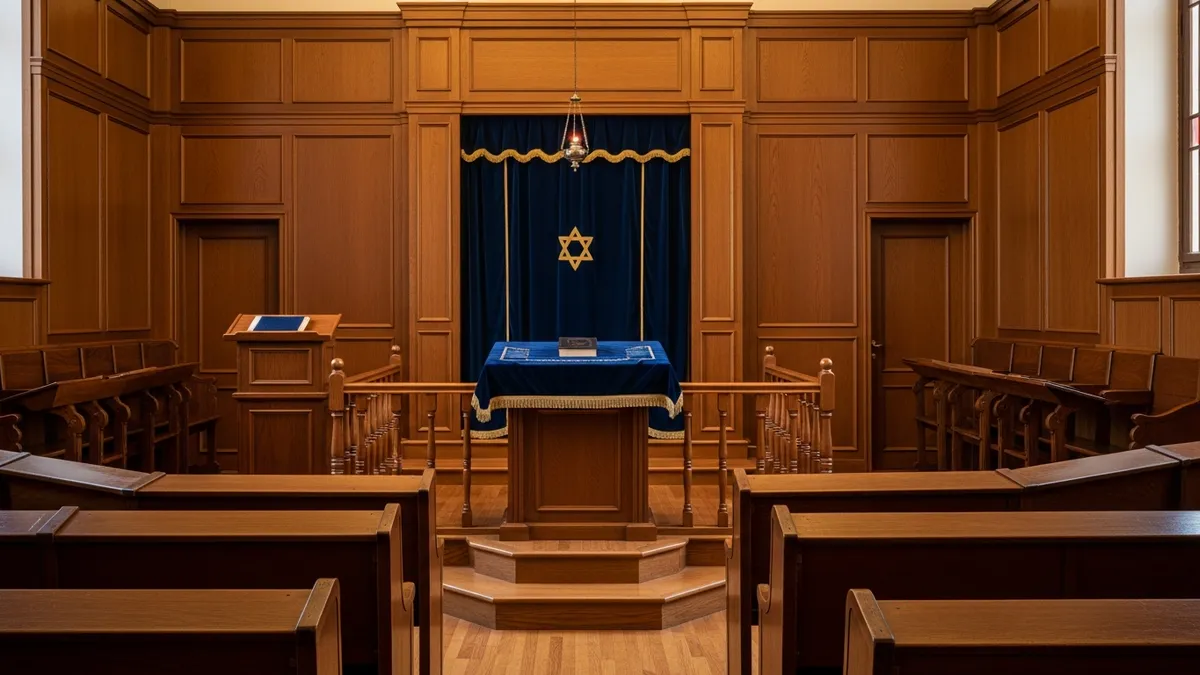
A warm, first-person look at what makes a synagogue Orthodox — the layout, the services, the people, and what to expect as a first-time visitor.
Quick Answer
An Orthodox synagogue (called a shul) is a Jewish house of prayer that holds daily services three times a day and a longer Shabbat morning service. It features a mechitza separating men and women, a central reading platform (bimah), and a Torah ark (aron kodesh) facing Jerusalem. Services follow the full halachic liturgy, conducted in Hebrew, with no musical instruments on Shabbat.
I have been walking into shuls my whole life. As a little girl in Brooklyn, the shul was just another room in my life — as familiar as my classroom, my kitchen, my grandmother's apartment. It was where I sat next to my mother on Shabbat morning trying not to fall asleep during the rabbi's drasha, where I whispered with my friends during Torah reading, where I watched my father get an aliyah and felt an embarrassingly large amount of pride about it.
So when someone tells me they have never been inside an Orthodox synagogue and does not know what to expect — I love that. Let me take you in.
Shul, Synagogue, Temple: What's the Difference?
Before we walk through the doors, let's sort out the terminology, because it actually matters.
A synagogue is the English word for a Jewish house of prayer. Shul is the Yiddish word — it literally means "school," which tells you something about how Jews see the purpose of the place. Beit knesset is the Hebrew term, meaning "house of assembly." All three words refer to the same thing.
Temple, however, is a different story. Reform and some Conservative congregations use "temple" for their prayer spaces. For Orthodox Jews, there is only one Temple — the Beit HaMikdash in Jerusalem, which was destroyed and which we pray will be rebuilt. Calling a shul a "temple" feels off to most Orthodox Jews, like calling a community center "the White House." It is not offensive, just imprecise. When someone says "I go to temple," an Orthodox person will quietly register that they are probably talking about a non-Orthodox congregation.
This distinction connects to a broader point: not all synagogues are alike. An Orthodox synagogue operates very differently from a Conservative or Reform one. If you want to understand the Orthodox version specifically, read on.
What Makes a Synagogue Orthodox?
The short answer: an Orthodox synagogue runs its services according to halacha — Jewish law — without modification or substitution.
That means the full liturgy, in Hebrew, as it has been said for centuries. It means a mechitza. It means no microphone for the rabbi on Shabbat in most congregations (electricity being restricted). It means Torah reading from a handwritten parchment scroll, not a printed book. It means that if you need ten men to form a minyan, you need ten men — not nine and one woman, not eight men and a very sincere wish.
These are not arbitrary customs. They are the parameters that define Orthodox practice. An Orthodox Jew is someone who keeps halacha as authoritative, and that same commitment shapes every synagogue service.
The Physical Layout
Walk into most Orthodox shuls and the first thing you notice is that the room is organized around two focal points: the aron kodesh at the front and the bimah in the center.
The Aron Kodesh
The aron kodesh — literally "holy ark" — is the cabinet on the wall facing Jerusalem that holds the Torah scrolls. Every shul in the world orients toward Jerusalem, which means the aron is on the eastern wall in North America. It is usually the most beautifully crafted element in the entire building: carved wood, silver ornaments, velvet curtains called a parochet, often embroidered with lions or crowns or the Ten Commandments. Above it hangs the ner tamid, a light that burns continuously, representing the menorah in the ancient Temple.
When the aron is opened during services, the entire congregation stands. The Torah scrolls inside are handwritten by a trained scribe on animal parchment — each one takes a year or more to write and costs tens of thousands of dollars. The congregation's Torahs are among its most treasured possessions.
The Bimah
In the center of the room — not at the front — stands the bimah, an elevated platform where the Torah is read and where the service leader often davens. The central placement is traditional in Ashkenazic synagogues (those following Eastern European custom), emphasizing that everyone in the room is equally surrounding the Torah. In Sephardic synagogues (following customs from Spain, North Africa, and the Middle East), you will also typically find a central bimah, often with benches arranged along the walls.
The Mechitza
Orthodox synagogues have a physical separation between the men's and women's sections. This is called the mechitza, and it is one of the most misunderstood aspects of Orthodox practice.
The mechitza can take many forms: a low dividing wall, a chest-high partition with latticework on top, a full wall with windows, or a balcony where women sit above the main floor. The specific style varies enormously by community. A Yeshivish shul in Lakewood might have a solid partition. A more modern Orthodox shul might have a low dividing rail. A Hasidic shteibel might have women tucked behind a curtain in a side room.
What they all share is the basic principle: the prayer space is not mixed. If you want to understand the reasoning and the halachic debate around this, the mechitza article goes much deeper. For now, just know that walking into an Orthodox shul, men go to the right (or left, depending on the building), and women go to the other side.
I will be honest with you: the women's section has its own social life, and it is not always quieter than the men's. In my shul, the women's section on Shabbat morning is a warm, busy, whispered community of its own. Babies are bounced, toddlers are shushed (and un-shushed), and there is a whole network of nonverbal communication happening between women who have been sitting next to each other for twenty years. We know each other's children, each other's kvetchs, each other's beautiful voices when Ashrei starts.
Who's Who at Shul
The Rabbi
The rabbi is the halachic authority and spiritual leader of the congregation. In a large shul, the rabbi gives a sermon (drasha) on Shabbat morning, answers halachic questions, performs life-cycle ceremonies, and is the address for communal decisions. In a small shteibel (informal prayer room), there may not be a formal rabbi at all — just a knowledgeable member who leads.
A common misconception: the rabbi does not lead the prayer service. That is the chazzan's job.
The Chazzan
The chazzan (cantor) is the person who leads the prayer service out loud. In some shuls, the chazzan is a professional with a beautiful trained voice who chants elaborate melodies — a Yom Kippur chazzan in a large shul can be a genuine musical event. In most weekday services, the chazzan is simply the congregant whose turn it is to lead, and the "performance standard" is anywhere from lovely to heroically off-key.
The Gabbai
The gabbai is the lay official who manages the running of the service. He assigns Torah honors (aliyot), calls people up to the Torah, makes announcements, and generally keeps things moving. Being the gabbai requires a strong voice, a good memory for names, and the political instincts of a UN diplomat — because assigning aliyot involves navigating a complex web of who is a yahrzeit (remembering a parent's passing), who is a chatan (groom) this week, who donated money, and who will be quietly insulted if they are not called.
The gabbai is unsung and essential.
The Rhythm of Services
Daily Davening
An Orthodox shul runs three prayer services every day. Jewish prayer is structured around the three daily offerings in the ancient Temple:
- Shacharit (morning): The main morning service, lasting roughly 30–45 minutes on a weekday. On Monday and Thursday mornings, Torah is read publicly, adding 15–20 minutes.
- Mincha (afternoon): A shorter service, often squeezed into a lunch break — 15 to 20 minutes.
- Maariv (evening): The night service, similar in length to Mincha.
For a full minyan (the quorum of ten men required for communal prayer), you need ten men present. Small shuls can sometimes be scrambling to find that tenth man — I have personally heard my husband get emergency phone calls at 7:52 AM asking if he can make it to minyan.
Shabbat Morning — The Full Experience
If you want to see Orthodox synagogue life at its richest, come on Shabbat morning. This is the main event.
The service typically begins around 8:30 or 9:00 in the morning in many American shuls — exact times vary by community and season, and many post multiple minyan times to accommodate different schedules. Shabbat morning in a large shul runs about two and a half to three hours, typically ending around noon, and here is a rough sense of the flow:
Pesukei D'Zimra — a warm-up section of psalms and praises, setting the mood for prayer. The room is gradually filling up; this is not the moment of peak attendance.
Shacharit — the morning service proper. The chazzan leads key sections out loud; the congregation follows along mostly silently in their own siddur. How Orthodox Jews pray is its own topic, but the basic structure alternates between silent personal prayer and communal response. You will also notice many daveners swaying back and forth as they pray — it is called shuckling, and it is completely normal.
Torah Reading — the centerpiece of Shabbat morning. The Torah scroll is taken out of the aron with ceremony, carried through the congregation (everyone reaches out to touch it with their siddur or tallis), and then read on the bimah. The weekly portion (parasha) is divided into seven sections, and seven congregants are called up for an aliyah — the honor of standing beside the Torah while it is read. There is a maftir (final) aliyah and then a reading from the Prophets called the haftarah. The rabbi's drasha (sermon) typically comes after the Torah reading.
Mussaf — an additional service said on Shabbat and holidays, reflecting the additional Temple offerings of those days.
Kiddush — after davening, many shuls hold a kiddush in the social hall or lobby: wine, challah, and food ranging from herring and crackers to an elaborate spread of salads, kugel, cholent, and cake. If you want to understand Orthodox communal life, attend a kiddush. This is where the real community happens — the conversations, the announcements, the catching up, the food-based one-upmanship.
Kiddush is technically a sanctification over wine, but in practice it is also a social institution. A "kiddush club" (the men who slip out during the rabbi's sermon to have a l'chaim) is its own Orthodox cultural phenomenon that I am declining to comment on.
What to Expect as a First-Time Visitor
Dress
Orthodox synagogues have dress standards, and they are not optional. Men should wear dress pants and a button-down shirt at minimum; a jacket is appreciated, and a head covering (kippah, hat) is expected — you can usually borrow a kippah at the door. Women should dress modestly: covered elbows, covered knees, no plunging necklines. Married women in Orthodox communities cover their hair. For a much more detailed guide, read what to wear to an Orthodox Jewish event before you go.
Timing
Arriving at the exact start time is the exception, not the rule. Orthodox Jews arrive at various points during the service, find their place in the siddur, and continue from there. This is not considered rude — it is normal. The service does not wait for you, and you catch up where you can.
Noise Level
I have to be honest: Orthodox shuls are not hushed cathedrals. Children are present, usually running around. Side conversations happen. People walk in and out. There is a background hum of communal life. The prayer itself is sincere — deeply so — but it exists alongside the noise of a real community. Do not be alarmed by it.
Finding Your Place
The prayer book used on weekdays is called a siddur. On Shabbat, the siddur is used for most of the service, with a Chumash (printed Torah) on hand for following the Torah reading. Shuls typically have extra copies at the door or in the pews. Most siddurim used in American Orthodox shuls have English translations alongside the Hebrew.
If you are following along for the first time, focus on finding the page rather than understanding every word. Most shuls have an attendant or friendly neighbor who will happily point you to the right spot.
Orthodox vs. Conservative vs. Reform Synagogues
The differences run deep:
The mechitza is the most visible distinction. Conservative and Reform synagogues have mixed seating — men and women sit together. Orthodox synagogues do not.
The liturgy in Orthodox synagogues is the traditional Hebrew text, unchanged. Conservative synagogues use a modified siddur that omits or alters certain prayers. Reform siddurim are extensively revised, and services often include significant English content.
Musical instruments are prohibited in Orthodox synagogues on Shabbat and holidays. You will hear unaccompanied singing, sometimes extraordinary, but no organ, guitar, or band. Conservative and Reform synagogues often use instruments.
Role of the prayer leader — in Orthodox synagogues, only men lead prayer services. This is a halachic standard, not a policy preference.
Length — Orthodox Shabbat morning services are notably longer than most Conservative and Reform services. This is not padding; it is the full liturgy.
"Orthodox synagogues are cold and unwelcoming to outsiders."
Most Orthodox shuls are genuinely warm, and first-time visitors are typically welcomed, helped to find their place, and invited to kiddush. The community may seem close-knit because it is, but that closeness usually extends outward to guests.
Shul Politics and the Things They Don't Tell You
Every shul has unwritten rules that no one will explain to you directly. Seats are territorial even when not formally assigned. The gabbai's choices about who gets aliyot are scrutinized. Kiddush quality is a matter of communal pride.
There is also an unspoken warmth that runs under all of it. The same man who guards his seat will silently hand you his extra siddur when he sees you are lost. The women's section that looks intimidating from the outside is, in practice, where some of the deepest friendships of a lifetime are formed. These are communities built around daily prayer and weekly Shabbat — people who see each other more than they see most family members.
I have been walking into shuls my whole life, and I still love the moment when the aron opens and everyone stands. Every time. Something about a room full of people rising together for the Torah — it does not get old.
Before You Go
If you are planning your first visit, start with the question people are sometimes embarrassed to ask — can you attend a synagogue service if you are not Jewish? (Yes. Respectful visitors are welcome.) Then read up on what to wear. If you want deeper context on what tefillin are (the black boxes you will see men wearing at weekday morning services) or what Shabbat observance looks like in practice, those articles will help you arrive with more context. And if kiddush involves foods you have never seen before, what is kiddush will prepare you.
The door is open. Come in.
Common Questions
What is a minyan? A quorum of ten Jewish men aged 13 or older — the minimum for full communal prayer, Torah reading, and Kaddish. It is why you'll see a ninth and tenth man greeted like rescuers at a weekday service, and why Orthodox Jews live within walking distance of each other: a synagogue is wherever ten of us can reliably show up.
Can a woman wear pants to an Orthodox synagogue? As a guest, you will not be turned away — come. But if you want to match the room, a knee-length-or-longer skirt or dress is the safer choice, with shoulders covered; married Jewish women also cover their hair there. The full what-to-wear guide takes the guesswork out.
I'm an Orthodox Jewish woman from Brooklyn. I can't speak for every Orthodox Jew — when I write outside my experience, I say so.
What Is a Synagogue? Purpose, Layout & Services
Orthodox Jews: Who They Are and How They Live
Jewish Prayer: How Jews Pray, Three Times Every Day
What Is a Mechitza? Separating Men and Women in Synagogue
Want to understand the whole picture?
The guided tour walks you through 8 topics — prayer fits into a larger rhythm of Orthodox life.
The Orthodox Insider
A new letter every Thursday, before Shabbos — plus an instant download of “10 Things Everyone Gets Wrong About Orthodox Jews” when you subscribe.
No spam, unsubscribe anytime.